Home/Compare/At-home cortisol tests
You can measure cortisol at home with a saliva kit, a finger-prick blood-spot kit, or a continuous wearable. The right choice comes down to one question: do you want a snapshot, or the whole daily pattern? Here's an honest comparison, including ELI Health and DUTCH.
| Auromone Curve | Saliva kit (e.g. ELI Health) | Blood-spot kit | DUTCH (dried urine) | |
|---|---|---|---|---|
| Readings | ~720 / day, continuous | A few, when you sample | 1 per kit | ~4 in a day |
| Sample | None, sweat on the wrist | Saliva, on a timer | Finger-prick blood | Dried urine |
| Results | Live in the app | Instant to days | Days (mail-in) | Days to weeks |
| Shows the daily curve | Yes, the whole day | A few points | No | A partial sketch |
| Overnight pattern | Yes | Hard | No | No |
| Ongoing cost | CA$29 / 4-pack of sensors | Per test | Per kit | Per kit (higher) |
| Best for | Seeing your pattern over time | A quick spot check | A one-time lab value | A broad hormone panel |
Brand names belong to their respective owners and are used for comparison only; details are general and may change. Auromone prices are founder target prices and may differ from the final sale price.
At-home kits are a reasonable way to check cortisol at a moment in time. Saliva kits measure the free, active cortisol and are easy to collect; blood-spot kits give a lab-style value from a finger-prick you mail in. The trade-off is coverage: you only get the moments you sample, and the timing has to be right.
ELI Health's Hormometer reads a saliva sample with your phone, so you can take a reading on demand. That's genuinely useful for spot checks. DUTCH uses dried-urine samples to map several hormones at once, which is thorough but slower and pricier. Both are sampling tools: they tell you about the moments you test, not the shape of your whole day.
Cortisol is a rhythm, not a single number, so the most useful view is the full daily curve. The Auromone Curve reads cortisol from a trace of sweat about 720 times a day, overnight included, with no samples to collect or mail. In bench testing it stayed within about 8% of a lab blood test. If your question is "is my cortisol rising and falling at the right times?", that's what continuous monitoring answers.
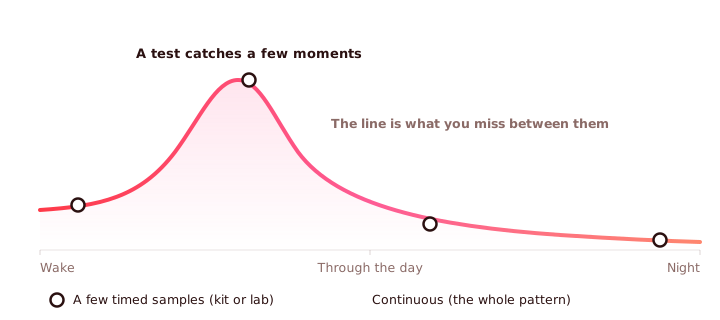
For a one-time check, a saliva or blood-spot kit does the job. To actually understand your rhythm, see whether habits move it, and catch a pattern that single samples miss, a continuous wearable is the better tool. Many people start with a kit and move to continuous once they realize one reading can't answer their question.
See also how cortisol wearables compare and Cortisol 101.
It depends on your goal. For a one-time snapshot, a saliva or blood-spot kit works. To see the whole daily pattern, continuous monitoring like the Auromone Curve is the better fit, since it reads cortisol about 720 times a day instead of once.
Saliva and blood-spot kits measure real cortisol; quality varies by provider and careful, on-time collection. The Auromone Curve tracked a lab blood test within about 8% in bench testing. The bigger difference is coverage: a kit gives a point or two, continuous gives the full curve.
ELI Health is a saliva test you take at chosen moments and read with your phone. The Auromone Curve reads cortisol continuously from a trace of sweat, about 720 times a day. ELI gives discrete readings on demand; Auromone gives the whole daily pattern, overnight included, with no sampling.
Yes. A continuous wearable like the Auromone Curve reads cortisol from sweat on your wrist all day, so there's nothing to collect, time, or mail. It's a general wellness device and does not diagnose.
Both measure real cortisol. Saliva reflects the free, active cortisol and is easy to collect at home; blood is a clinical standard but usually means a draw. Either way you only get the moments you sample, which is what continuous monitoring is designed to fix.
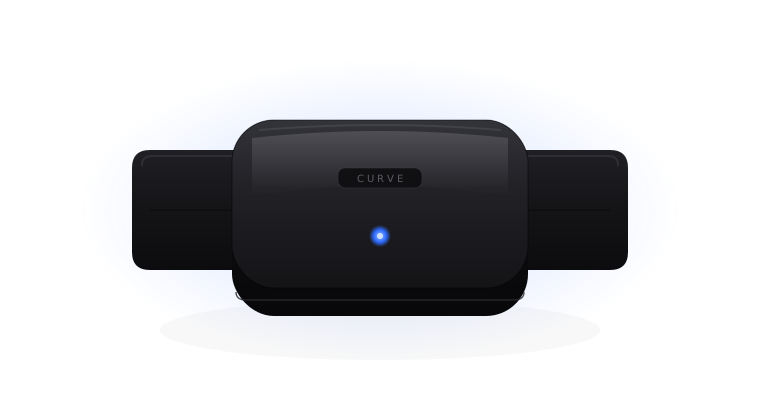
The Auromone Curve reads your cortisol all day from your wrist, no kits to collect or mail. Ships Q4 2026, and reserving is free.