Important: this page is general wellness education. It can't tell you whether your cortisol is high, and the signs below overlap with many ordinary causes. If you have persistent or worrying symptoms, please see a healthcare provider.
What people mean by "high cortisol"
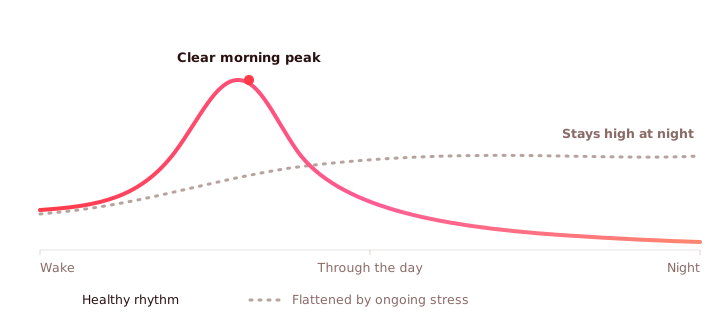
Cortisol is meant to be high in the morning and low at night. When people say their cortisol feels "high," what usually matters isn't one big number, it's cortisol staying up at the wrong time, like the evening, or a daily rhythm that has flattened out. That's why two people with the same morning value can feel completely different: the shape of the day is the part that counts.
Everyday signs people associate with it
These are things people commonly connect with high or mistimed cortisol. They are not proof of anything on their own, and each has many possible causes:
- Trouble falling asleep, or waking in the early hours.
- Feeling "wired but tired," restless but exhausted.
- Afternoon energy crashes.
- Difficulty winding down in the evening.
- A sense that your battery never fully recharges.
Notice these are all about timing and energy, exactly the things a daily cortisol pattern reflects. They're a reason to look closer, not a conclusion.
Why a single test can miss it
A one-off cortisol test captures a single moment. If your issue is cortisol staying high in the evening, an 8 a.m. blood draw can look perfectly normal. Cortisol problems are pattern problems, and a pattern needs more than one data point to see.
Get real data, then talk to a provider
This is where continuous monitoring helps. The Auromone Curve reads cortisol from a trace of sweat on your wrist about 720 times a day, so you can see whether your cortisol drops in the evening the way it should, or stays stubbornly up. That's useful information to bring to a clinician, who can order proper testing if something looks off.
To be clear about what it is: Auromone shows the pattern. It does not diagnose. Used alongside your provider, it turns "I feel like something's wrong" into something you can actually look at together.
Start with Cortisol 101 for the basics, or see habits that support a healthy rhythm.
This guide is for general wellness education only. It is not medical advice, not a diagnosis, and not a substitute for professional testing. The Auromone Curve is a general wellness device and does not diagnose, treat, or cure any condition. If you're worried about your health, talk to a healthcare provider.