The honest short answer
If you are looking for a supplement that reliably lowers cortisol, the honest answer is that the evidence is uneven. It is strongest for ashwagandha, where a handful of randomized trials have reported reduced cortisol or stress. For most other supplements sold for stress — magnesium, L-theanine, omega-3 and the rest — the research is thinner, mixed, or more theoretical than proven.
Two things are worth keeping in mind before you start. First, supplements are not regulated as drugs, so quality, dosing, and even what is actually in the bottle can vary between products. Second, no supplement is a treatment, and the studies below describe group averages, not what will happen to you. If you are concerned about high cortisol, talk to a healthcare provider before starting anything.
It also helps to set expectations. Where an effect on cortisol has been reported at all, it tends to be modest, measured over weeks, and specific to a dose and a population in a study. That is a long way from a bottle that resets your stress response. Reading the sections below as "here is what one or two trials found" — rather than "here is what this will do for me" — is the honest frame, and it is the frame this guide uses throughout.
What the research suggests, supplement by supplement
Here is what the published studies actually found, described as findings rather than advice. Notice how quickly the evidence thins out after the first entry.
Ashwagandha
Ashwagandha is the one with the strongest evidence of the group. In one randomized controlled trial, 600 mg a day of ashwagandha significantly reduced serum cortisol (Salve et al., Cureus, 2019). A separate trial found roughly 23% lower morning cortisol at 240 mg a day (Lopresti et al., 2019). Those are meaningful, repeated findings — but they are still averages from small studies, over a limited time, and ashwagandha remains a supplement, not a treatment for any condition.
Magnesium
Magnesium is commonly discussed for stress and sleep, and correcting a genuine deficiency can matter for how you feel. But the evidence for a direct effect on cortisol is limited and mixed. It is fair to say many people take it for general wellness; it is not fair to say it has been shown to lower cortisol on its own. Part of the appeal is that magnesium plays a role in a lot of the body's processes, so it is easy to assume it must help with stress too — but "plausible mechanism" is not the same as "demonstrated cortisol effect," and this is a case where the two are often conflated. Treat it as a general wellness habit, not a cortisol lever.
L-theanine
L-theanine, an amino acid found in tea, is associated with a sense of calm or relaxation in some studies. The effect tends to be modest and context-dependent — more of a gentle nudge some people notice than a dependable drop in a stress hormone. The research is interesting rather than conclusive.
Omega-3 / fish oil
Some studies suggest omega-3 fatty acids can affect stress reactivity — how the body responds to a stressor — but the evidence is mixed, and results differ across trials and doses. Omega-3 has plenty of general wellness rationale behind it, but its case as a cortisol supplement specifically is unsettled.
Phosphatidylserine
Phosphatidylserine has been studied mainly around exercise stress. In a small study, 800 mg a day blunted the cortisol response to exercise (Monteleone et al., 1992). That is a narrow, specific finding — it is about the cortisol spike from physical exertion, not everyday stress — and the research base is small.
At a glance
A quick, honest summary of the same evidence. The Note column is where the cautions live.
| Supplement | What research suggests | Note |
|---|---|---|
| Ashwagandha | Small RCTs reported reduced cortisol or stress (Salve 2019; Lopresti 2019). | Strongest evidence of the group; still not a treatment. Talk to a provider. |
| Magnesium | Commonly used for stress and sleep; direct cortisol effect not well shown. | Evidence limited and mixed. A general wellness habit, not a cortisol lever. |
| L-theanine | Linked to a sense of calm in some studies. | Effect modest and context-dependent. Evidence inconclusive. |
| Omega-3 / fish oil | Some studies suggest effects on stress reactivity. | Evidence mixed across trials and doses. |
| Phosphatidylserine | 800 mg/day blunted the exercise cortisol response in a small study (Monteleone 1992). | Studied mainly around exercise stress; small evidence base. |
Safety and when to talk to a provider
Because supplements are not regulated as tightly as medications, "natural" does not mean risk-free. They can interact with prescription drugs and with health conditions, and the right dose or product is not the same for everyone. Ashwagandha, for example, is not appropriate for some people, and several of these supplements come with cautions during pregnancy or nursing.
The safe default is simple: before you start anything, talk to a healthcare provider who knows your history — especially if you take medication, are pregnant or nursing, or are managing a condition. This page is general wellness information, not medical advice, and it cannot account for your individual situation.
How to tell if it's actually working
Because these effects are modest and vary from person to person, the only way to know whether a supplement does anything for you is to watch your own pattern. A structured approach beats guessing:
- Baseline your pattern. Get a sense of your normal cortisol trend for a week or two before you change anything.
- Change one thing. Add a single supplement at a time, so you can actually attribute any change to it.
- Watch for about two weeks. Give it enough time to show up in your trend rather than in a single reading.
- Keep what moves it. If your pattern and how you feel both improve, that is worth keeping; if nothing changes, that is useful to know too.
This matters because the effect you are looking for is small enough to hide inside normal day-to-day variation. Cortisol swings with sleep, caffeine, exercise, and stress, so a single reading a few weeks apart can move for reasons that have nothing to do with the supplement. What you actually want to compare is the shape of your pattern over time, not two isolated numbers.
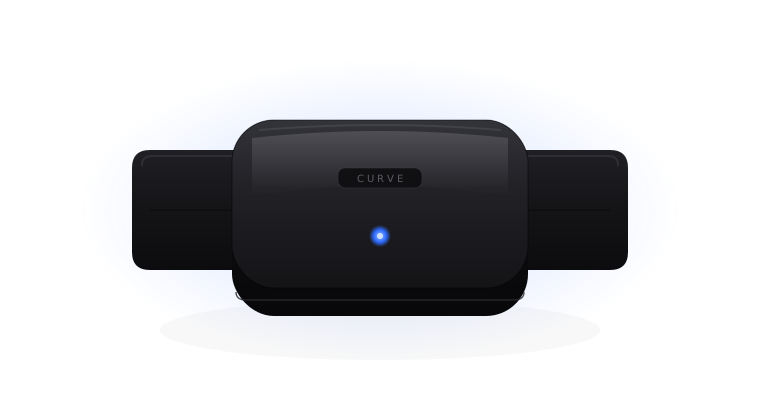
This is where continuous measurement helps. The Auromone Curve reads cortisol from a trace of sweat about 720 times a day, so you can see your own trend before and after a change instead of relying on a single lab value. To be clear about what it is: the Curve does not lower cortisol or treat anything — it is a general wellness device that lets you see your pattern. For habit-based approaches, see how to lower cortisol, and for the basics start with Cortisol 101.
This guide is general wellness information only and is not medical advice. Supplements are not evaluated or approved to treat, cure, or prevent any condition, and results vary from person to person. Consult a healthcare provider before starting any supplement, especially if you take medication or are pregnant, nursing, or managing a health condition. The Auromone Curve is a general wellness device and does not diagnose, treat, or cure anything.