What "normal cortisol" really means
People often ask for the normal cortisol level, as if there were one target to hit. There isn't. Cortisol is your body's main stress hormone, and it moves on a daily rhythm: it climbs sharply to its peak within about an hour of waking, drifts down through the day, and reaches its lowest point late at night. So a value that is perfectly healthy in the morning would be surprisingly high at bedtime.
The numbers a lab prints on your report are reference intervals, not pass-or-fail thresholds. A reference interval is simply the range most healthy people fall inside for that specific test, at that time of day. Sitting slightly outside it is not a diagnosis, and sitting inside it is not a guarantee. That is why a doctor reads a cortisol result in context: the time it was taken, the test used, your symptoms, and often more than one measurement.
It also helps to know why the morning matters so much. Blood is usually drawn between 7 and 9 a.m. precisely because that is when cortisol peaks and the value is most comparable from one person to the next. Draw it at noon or at 8 p.m. and you would expect a much lower number — not because anything is wrong, but because the rhythm has moved on. The clock is part of the result.
A cortisol levels chart
The table below gives illustrative ranges for the three most common ways cortisol is measured. Serum figures are drawn from published reference ranges at the Cleveland Clinic and UCSF; the saliva figures follow the University of Michigan's MLabs; and the 24-hour urinary free cortisol figures follow UCLA Health and the University of Iowa. Notice that the units are completely different from one row to the next.
| Test type | Typical morning | Typical evening / night | Good to know |
|---|---|---|---|
| Serum / blood | 10–20 mcg/dL (some labs 5–25) | 3–10 mcg/dL | Source: Cleveland Clinic; UCSF |
| Saliva | 100–750 ng/dL | under ~100 ng/dL | Source: U. Michigan MLabs |
| 24-hour urine (free cortisol) | — | 10–100 mcg/24h (method-dependent) | Source: UCLA Health; U. Iowa |
These are illustrative, assay- and lab-dependent reference intervals, not diagnostic thresholds. Different labs use different methods and report different ranges, so always use the range printed on your own report. This chart is for general education and is not a substitute for medical advice.
Why the ranges are so wide
The first reason is the test itself. Labs use different assays — different chemistry to detect cortisol — and each assay comes with its own validated reference range. A result from one lab does not map cleanly onto another lab's numbers, which is why comparing your value to a range you found online can be misleading.
The second reason is units. Blood is usually reported in mcg/dL, saliva in ng/dL or nmol/L, and urine as a total amount over 24 hours. As a rough conversion for blood, mcg/dL × 27.6 ≈ nmol/L — that is a unit conversion, not a quoted reference range. Between different tests, different times of day, and different labs, it is easy to see two "normal" cortisol values that look nothing alike.
There is a biological reason the tests don't line up, too. Most cortisol in blood is bound to carrier proteins, while saliva and 24-hour urine reflect the smaller, unbound "free" fraction — the part that is actually active. So they are not measuring quite the same thing, which is another reason a saliva number and a blood number can't be compared side by side. The safest habit is to read each result only against the reference interval printed next to it.
The shape beats the number
Because cortisol is a moving target, a single reading can be reassuring and still miss the point. An 8 a.m. blood draw can land squarely in the normal morning range while your evening level, when cortisol is supposed to be low, stays stubbornly high. One snapshot cannot show you that. Cortisol is a pattern over the day, not a single figure.
If you are new to this, the best starting point is Cortisol 101, which walks through the daily curve and how cortisol is measured. If you are here because something feels off, the common signs of high cortisol put the numbers in context.
What high or low levels can point to
Levels well outside the reference range, or a pattern that never drops in the evening, are worth a conversation with a healthcare provider. Persistently high cortisol and persistently low cortisol are both associated with conditions a doctor diagnoses with proper testing — for example Cushing's syndrome or Addison's disease — but these are clinical diagnoses, never something to read off a single number at home.
It is worth saying plainly what these ranges cannot do. A number outside the reference interval does not name a condition, and a number inside it does not rule one out. Doctors confirm or exclude a diagnosis with dedicated protocols — repeat measurements, timed samples, and stimulation or suppression tests — not with one figure compared to a chart. Nothing on this page is a substitute for that.
The honest takeaway is simple: a chart like the one above helps you understand your report, not replace your doctor. If your results look unusual, or you have symptoms that concern you, see a provider who can order the right tests and interpret them together.
How to see your own daily pattern
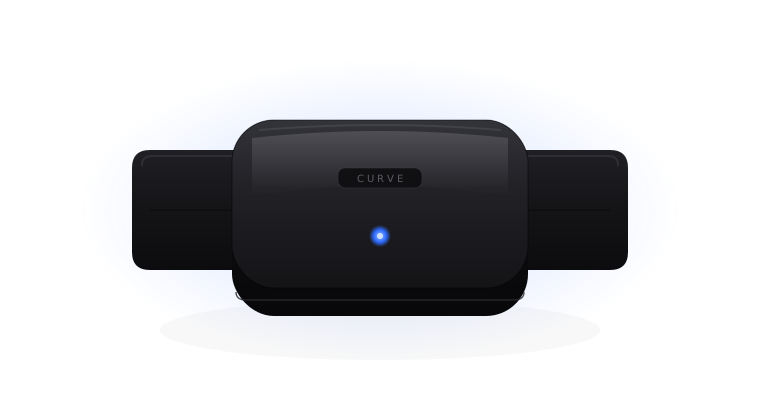
Lab tests are precise, but each one is a single point in time. To see the shape of your day — the morning rise, the afternoon drift, the evening drop — you need many readings, not one. The Auromone Curve reads cortisol from a trace of sweat on your wrist about 720 times a day, so instead of one value on a slip of paper you watch the whole curve unfold. Over a couple of weeks you can see whether your pattern rises and falls the way it should.
The Curve is a general wellness device, not a diagnostic. It won't hand you a clinical verdict, and it isn't meant to. What it gives you is the thing a one-off number can't: the pattern.
This guide is for general wellness education only. The Auromone Curve is a general wellness device, not a diagnostic, and does not replace medical advice. If you are concerned about your cortisol levels, talk to a healthcare provider.