What does "adrenal fatigue" claim to be?
Proponents of the term claim that chronic stress makes your adrenal glands work too hard for too long, until they wear out the way a battery drains. In this telling, cortisol production falls, and that is supposedly why you are tired, foggy, dependent on caffeine, crashing in the afternoon, and wide awake at midnight.
It is a satisfying story. It has a villain, a mechanism, and a cure you can buy. That is most of why it spread.
The people who use the term usually describe some combination of the following:
- Waking up exhausted no matter how long you slept
- Needing caffeine to function, and needing more of it over time
- An energy crash in the mid-afternoon
- A second wind late in the evening, then trouble falling asleep
- Brain fog, low mood, and craving salt or sugar
These experiences are real. What follows is about the explanation attached to them, not about whether you feel this way.
Is adrenal fatigue real? What the evidence found
The evidence says no. A 2016 systematic review in BMC Endocrine Disorders examined 58 studies and concluded that there is no substantiation that adrenal fatigue is an actual medical condition. The authors titled the paper Adrenal fatigue does not exist. The Endocrine Society, the main professional body for hormone specialists, holds the same position.
The authors screened 3,470 studies and included the 58 that met their criteria. They found that those studies used inconsistent methods and reached contradictory results, testing cortisol in ways that were never validated for the purpose.
This is worth being precise about, because the internet is not. Adrenal fatigue is not controversial or emerging or under-researched. It has been looked for, carefully, and it is not there.
Your symptoms are still real
Most articles on this subject stop at the debunk and leave you exactly where you started, except now you also feel foolish.
So, plainly: rejecting the label is not the same as dismissing what you feel. Waking exhausted, running on coffee, crashing at 3 p.m., then finding a second wind at 11 p.m. is a real pattern that a great many people live with. It has causes. They are not the cause you were sold.
The common ones include chronic sleep loss, ongoing psychological stress, thyroid problems, anemia, depression, and, occasionally, adrenal insufficiency, which is a genuine condition and a different thing entirely. Every one of those is worth investigating. None of them is adrenal fatigue.
Is it the same as adrenal insufficiency?
No, and this is the most important thing on this page. Adrenal insufficiency is a real, diagnosable condition in which the body genuinely does not make enough cortisol. It is not the severe end of adrenal fatigue. It is a separate thing with real tests and real treatment.
| "Adrenal fatigue" | Adrenal insufficiency | |
|---|---|---|
| A recognized diagnosis? | No | Yes |
| Is there a valid test? | No | Yes. Morning blood cortisol, then an ACTH stimulation test |
| Risk if ignored | The real cause of your symptoms stays unfound | Can progress to adrenal crisis, which is life-threatening |
The row that matters is the last one. Someone with genuine adrenal insufficiency who has been told they have "stage 2 adrenal fatigue" has an untreated medical condition. That is the real harm in this term. The full side-by-side comparison, and how adrenal insufficiency is actually diagnosed, is here.
The condition that is real, and worth ruling out
Adrenal insufficiency is a diagnosable condition in which the body genuinely does not produce enough cortisol. It is not the severe end of adrenal fatigue. It is a separate thing, with actual diagnostic criteria and actual tests, and it needs a doctor.
If your fatigue is severe, or comes with low blood pressure, unexplained weight loss, nausea, dizziness when you stand, low blood sugar, or persistent low mood, do not self-diagnose from a wearable or a saliva kit. See a healthcare provider. Here is what adrenal insufficiency is, how it differs from adrenal fatigue, and how it is actually diagnosed.
If you take long-term steroid medication such as prednisone, this applies to you doubly. Long-term steroids suppress your own cortisol production, and this is the most common cause of genuine adrenal insufficiency. Never stop or reduce a prescribed steroid on your own. Stopping abruptly can trigger an adrenal crisis, which is life-threatening. Any taper must be supervised by the doctor who prescribed it. Here is what a steroid taper actually does to your cortisol.
Why the saliva panels do not settle it
A whole testing industry grew up around this term. Four-point salivary cortisol panels, sold direct to consumers, promising to reveal which "stage" of adrenal fatigue you are in.
The 2016 review looked at those too. It found the tests used to support the diagnosis were not validated for it and did not produce consistent results. This is not a small technical quibble. A test can only confirm a condition that has diagnostic criteria in the first place, and adrenal fatigue has none. There is no threshold, no reference range, no agreed definition of what a positive result would even look like.
Measuring your cortisol tells you about your cortisol. It cannot confirm a diagnosis that does not exist.
What can actually be measured
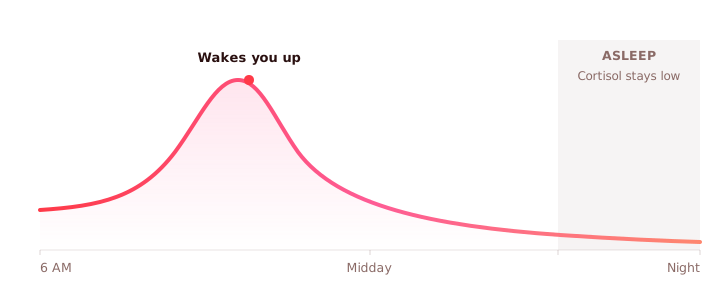
Cortisol is real, and it is measurable. What carries the information is not a single number but the shape of the day.
A healthy cortisol rhythm climbs steeply in the morning, giving you the lift that gets you out of bed, then declines through the afternoon and bottoms out late at night so you can sleep. That curve is the thing worth looking at. A single reading at 8 a.m. tells you almost nothing about what your cortisol did at 4 p.m. or at midnight.
This is the honest reason the "wired but tired" description keeps coming up. It describes a timing problem: energy that arrives at the wrong hour. Timing is precisely what a one-off test cannot see, and it is the whole reason the daily curve is more informative than any single value.
What to do instead
None of this is medical advice, and none of it is a cure for a condition you do not have. These are the things that genuinely support a healthy daily rhythm.
- Get your fatigue properly investigated. This is the first and most important item on this list. Ask a doctor about thyroid function, iron, vitamin D, blood sugar, sleep quality, and mood. These are common, testable, and treatable, and no wearable substitutes for having them checked.
- Protect the morning anchor. Daylight early in the day helps set the rhythm that everything else follows.
- Move your caffeine cut-off earlier. In controlled studies, a caffeine dose equivalent to roughly 2 to 3 cups of coffee raised cortisol by about 30% above baseline. In habitual coffee drinkers the morning response was largely abolished, but the response to later doses persisted, which is a specific argument for moving your last cup earlier rather than cutting coffee altogether (Lovallo and colleagues).
- Keep a steady wake time. A consistent wake time does more for the curve than a perfect bedtime.
- Be skeptical of anything sold to "heal your adrenals." There is nothing to heal, and the supplement is not free.
One warning worth more than the rest of this page
Some products sold for "adrenal fatigue" and "adrenal support" contain actual adrenal hormones or adrenal glandular extract. The Endocrine Society warns that taking adrenal hormone supplements when you do not need them can cause your own adrenal glands to stop working. They can become unable to make the hormones you need under physical stress, and when the supplements are stopped, the glands can remain dormant for months.
Read that again, because it is the cruel part of this. A treatment for a condition you do not have can create a real problem you did not have either. Do not take adrenal hormone or glandular supplements without a doctor. Check the label, and if you are already taking one, do not simply stop. Talk to a healthcare provider first.
How to see your own rhythm
The reason people reach for adrenal fatigue is that they want an explanation they can see. That instinct is right. The label was wrong.
The Auromone Curve is designed to read cortisol from a trace of sweat on your wrist about 720 times a day, day and night. It ships Q4 2026. Instead of one value from one morning, you see the actual shape of your own curve: whether the morning rise is there, whether the evening comes down, and whether the changes you make to your routine move any of it.
It will not diagnose you, and it is not meant to. What it does is replace a story you were sold with data about your own body. If you want the full picture of what cortisol is and how it is measured, start with Cortisol 101, or see how the measurement methods compare.
This guide is for general wellness education only. The Auromone Curve is a general wellness device, not a diagnostic, and does not replace medical advice. Persistent fatigue deserves a proper medical assessment. Please talk to a healthcare provider.
References
- Cadegiani FA, Kater CE. Adrenal fatigue does not exist: a systematic review. BMC Endocrine Disorders. 2016;16:48.
- Endocrine Society. Adrenal Fatigue. Endocrine Library. (States that no scientific proof supports adrenal fatigue as a condition, and that tests sold for it are not based on scientific facts.)
- Bornstein SR, et al. Diagnosis and Treatment of Primary Adrenal Insufficiency: An Endocrine Society Clinical Practice Guideline. 2016. (Cited for adrenal insufficiency, the real condition, not for adrenal fatigue.)
- Lovallo WR, et al. Cortisol responses to mental stress, exercise, and meals following caffeine intake in men and women. Pharmacology, Biochemistry and Behavior. 2006.
- StatPearls (NCBI Bookshelf). Physiology, Cortisol.
- Lovallo WR, et al. Caffeine stimulation of cortisol secretion across the waking hours. Psychosomatic Medicine. 2005.