What can a wearable stress score not rule out?
Most of what would put you in an ambulance. That belongs at the top of this page rather than the bottom, because people arrive here in one of two states: a device told them something alarming, or a device told them nothing and they feel alarming anyway. Both roads end at the same mistake, which is treating a score as a verdict.
A score is not triage. Ours included.
A good HRV, a green recovery score, or a calm stress reading does not rule out a heart attack. No consumer wearable is designed to detect one. Call 9-1-1 immediately if you have any of the signs the Heart and Stroke Foundation of Canada lists:
- Chest discomfort: pressure, squeezing, fullness, pain, burning or heaviness
- Upper body discomfort: neck, jaw, shoulder, arms or back
- Shortness of breath, sweating, nausea, or light-headedness
Then, while you wait for the ambulance, Heart and Stroke's own instructions are: stop all activity and sit or lie down; take nitroglycerin if it has been prescribed to you; and "chew and swallow ASA (Aspirin)", which Heart and Stroke specifies as either one 325 mg tablet or two 81 mg tablets, unless you are allergic to it or a doctor has told you not to. Do not drive yourself. If someone collapses, is unresponsive and is not breathing normally, that is cardiac arrest: call 9-1-1, send for an AED, and start CPR.
Do not wait for the chest pain to arrive first. Heart and Stroke states that although chest pain or discomfort is the most common sign, "women can experience a heart attack without chest pressure." Standard guidance on women's heart-attack symptoms adds that they may instead have shortness of breath, pressure or pain in the lower chest or upper abdomen, dizziness, lightheadedness or fainting, upper back pressure, or extreme fatigue. If you are waiting for the television version of a heart attack before you take yourself seriously, you may be waiting on a sign that is not coming.
After a viral illness, a bad recovery score is not automatically a rest day. This is the most dangerous version of the trap, because the app's advice and the mistake are the same action. Cleveland Clinic lists the symptoms of myocarditis, inflammation of the heart muscle most often caused by a viral infection, as shortness of breath, tiredness, fever, chest pain, heart palpitations, abdominal pain, lightheadedness, abnormal heart rhythm, fainting, loss of appetite, weakness, swollen legs or feet, and being unable to exercise. Fatigue and a red recovery score are exactly what a tracker will show you, and exactly what it will tell you to sleep off. Cleveland Clinic also states that myocarditis is "linked to nearly 20% of sudden deaths in young people."
So: chest pain, trouble breathing, or fainting means call 9-1-1 now. That rule does not get a softer version because you think you know why you feel bad, and "it is probably just the virus" is not a diagnosis you can make from a sofa. The milder symptoms, meaning unusual fatigue, a racing or skipping pulse, swollen legs or feet, or being unable to do exercise you could do a month ago, need a same-day medical assessment, not a nap and a lighter training week.
And do not let "after a viral illness" become the test. That symptom list is a list, not a checklist. The absence of a fever does not rule myocarditis out, and neither does the absence of a virus you remember having. Cleveland Clinic also names bacterial infection, autoimmune disease and medications, including heart drugs, antidepressants, seizure medicines and antibiotics, among the causes, and in a large share of cases no cause is ever found. If you have had vaccine-related myocarditis, Cleveland Clinic says to "check with a cardiologist before starting to exercise again." Its instruction to anyone who has myocarditis is blunt: "Don't exercise until your provider says you can." A readiness score cannot give you that permission, and a green one is not it.
An unusually wild HRV is not automatically good vagal tone. HRV is computed from the gaps between heartbeats, so an irregular rhythm corrupts the input. Shaffer and Ginsberg warn that "when cardiac conduction abnormalities elevate HRV measurements, this is strongly linked to increased risk of mortality," and they recommend examining the ECG itself to identify problems such as atrial fibrillation. The reverse trap is the more common one: a quiet phone is not a normal rhythm. Apple's own guidance for irregular rhythm notifications states that the feature "is not constantly looking for AFib, which means it cannot detect all instances of AFib," that "the absence of a notification is not intended to indicate no disease process is present," and that "if you're not feeling well, you should talk to your doctor even if you don't get a notification." Palpitations, an irregular pulse, breathlessness, chest discomfort or fainting are a clinician's question, whatever your app has or has not sent you.
Never stop, reduce or change a prescribed medication because of a wearable number. Medications move HRV on purpose. A scoping review of 29 trials in 2,230 people found that "beta-blockers and non-dihydropyridine calcium channel blockers consistently enhanced parasympathetic activity and improved HRV." If your HRV climbed after you started a heart or blood-pressure drug, that is the drug working, not a training adaptation, and it is not a reason to touch the dose. Take that to the prescriber.
The manufacturers say a version of this too, quietly. Oura's own documentation notes that "Daytime Stress results may not be valid for users with heart diseases, neurodegenerative diseases, or pacemakers." If you are in one of those groups, the score you are reading may not mean what the app implies it means.
And no score measures whether you are safe. If you are in distress, in crisis, or thinking about harming yourself, the number on your wrist is irrelevant. In Canada, call or text 9-8-8, the Suicide Crisis Helpline, 24 hours a day.
One more thing before the physiology, because framing quietly excludes people. This page is not only for athletes, and not only for ring owners. If your device shows you a stress score, a recovery or readiness score, a body-battery number or a strain number, this page is about you. Note too that HRV falls with age and that the spread between healthy people is enormous: in the short-term norms Shaffer and Ginsberg cite, SDNN is 50 ± 16 ms and RMSSD is 42 ± 15 ms. Comparing your number to a friend's tells you almost nothing, which is exactly why every device shows you a trend against your own baseline instead of a verdict.
What does HRV actually measure?
The nervous system's grip on your heart, second by second. Shaffer and Ginsberg define heart-rate variability as "the fluctuation in the time intervals between adjacent heartbeats." Your heart does not tick like a metronome. The gaps stretch and compress as your brain, your breathing and your blood-pressure reflexes pull on the pacemaker cells, and the size of that wobble is the measurement.
Two metrics are worth naming, because they are what your device is mostly using. RMSSD is, in Shaffer and Ginsberg's words, "the primary time-domain measure used to estimate the vagally mediated changes reflected in HRV." The high-frequency band (0.15 to 0.40 Hz) "reflects parasympathetic activity." In plain terms, both are a read on your vagus nerve: the brake, not the accelerator.
The part the stress-score industry glosses over
The intuitive story is that HRV splits into a sympathetic half and a parasympathetic half, and that the ratio between them is your stress balance. That story is not supported, and has not been for more than a decade. Shaffer and Ginsberg note that in the low-frequency band, "half of the variability in this frequency band is due to the PNS and a smaller proportion is produced by unspecified factors." Billman, writing in Frontiers in Physiology, puts it harder: "the LF/HF sympatho-vagal balance hypothesis has been disproven, the preponderance of evidence confirms that LF/HF data cannot accurately quantify cardiac 'sympatho-vagal balance' either in health or disease."
This is not a reason to put the ring in a drawer. It is a reason to know which part of the score is load-bearing. The vagal metrics are solid. The balance ratio is not.
Be fair: HRV is genuinely well validated
It would be convenient for a cortisol company to tell you HRV is noise. It is not, and its evidence base is better than most consumer metrics can claim.
- It predicts hard outcomes. Shaffer and Ginsberg report the classic finding in patients after a heart attack: those with a 24-hour SDNN over 100 ms had a 5.3 times lower risk of mortality at follow-up than those under 50 ms. Very few numbers on your wrist have that pedigree.
- Consumer hardware reads it well overnight. In a 35-person study comparing the Oura Ring against a reference ECG, nocturnal heart rate tracked at r = 0.99 and RMSSD at r = 0.92. That is strong agreement for a device you sleep in without noticing.
- It is cheap, passive and continuous. No sample, no consumable, no lab. That matters, and it is why HRV became the default stress proxy in the first place.
The same Oura study is the best single illustration of where the caution belongs. Its authors conclude that the ring measured nocturnal heart rate and RMSSD accurately, while "the LF and LF:HF ratio of the ring had high error rates in both tests." The device is accurate on the metric that is scientifically sound, and inaccurate on the metric that was never sound to begin with.
| HRV metric | What it reflects | Oura vs reference ECG (n = 35, 5-minute test) |
|---|---|---|
| Heart rate | Not HRV, but the foundation of it | r = 0.99 |
| RMSSD | Vagally mediated (parasympathetic) change | r = 0.92 |
| HF power | Parasympathetic activity | r = 0.63 |
| LF power | A mixture. Half of it is parasympathetic | r = 0.42, high error |
| LF/HF ratio | Sold as "sympatho-vagal balance." Disproven as such | r = 0.35, high error |
Those numbers belong to one ring, and they do not transfer. Validation is device-specific and sensor-specific, and agreement earned by a ring on a finger overnight says nothing about a wrist band mid-workout. If you wear a WHOOP, an Apple Watch, a Garmin or a Fitbit, look up the validation for your own device rather than borrowing this one. For the device-by-device version, see what the Apple Watch, WHOOP, Oura and Garmin are actually sensing.
So what is inside a "stress score"?
Your heartbeat, mostly, compared against yourself. The two companies that publish their inputs describe them plainly:
- Oura, Daytime Stress. Built from heart rate, heart-rate variability, motion and average body temperature. It updates every 15 minutes while you are awake, wearing the ring and relatively still. Oura states that "your metrics are compared against your personal baseline, which is recalibrated daily based on new data" and that it "does not use fixed thresholds for stress."
- WHOOP, Stress Monitor. Built from heart rate and heart-rate variability in the moment, compared against your personal baseline from the past 14 days, with motion used to separate a known stressor such as exercise from other stressors, and reported on a 0 to 3 scale.
Both are honest engineering, and both do what they say they do. Neither is detecting the cortisol molecule, because no ring or watch on the market does. That is not an insult to the hardware. It is a statement about which quantity the sensor is pointed at.
What does cortisol measure that HRV does not?
A different axis, on a different clock. Cortisol comes from a chain that starts in your brain. Per StatPearls: "Corticotropin-releasing hormone (CRH), synthesized and secreted by the paraventricular nucleus of the hypothalamus, stimulates the anterior pituitary to release ACTH. ACTH then acts on the adrenal cortex to promote cortisol synthesis and secretion." Three organs, two messengers, and a hormone that then travels in your blood to act on nearly every tissue you have.
It also runs on a daily rhythm that has nothing to do with your heartbeat. StatPearls describes secretion "beginning to rise during the final hours of sleep, peaking near the time of awakening, and gradually declining throughout the day to reach the lowest concentration at night." That morning surge has its own name and its own literature, covered in the cortisol awakening response.
The half-hour gap that makes them different instruments
This is the whole argument, and it is a timing argument.
Dickerson and Kemeny's meta-analysis pooled 208 laboratory studies of 6,153 people exposed to acute psychological stressors. Their finding on timing is unambiguous: "the peak cortisol response occurs 21 to 40 min from onset of acute psychological stressors." Their own methods note explains why, in one line: "there is a delay in detecting elevations in cortisol from the onset of stressful experience, as it takes time to activate the HPA axis."
Your HRV, meanwhile, has already moved. It responds on the timescale of a breath. An HRV reading and a cortisol reading taken at the same instant are not two views of one event. They are views of two events, half an hour apart.
Cortisol is fussy about what kind of stress it is
The same meta-analysis found something a heartbeat-derived score cannot represent. Cortisol does not respond to "stress" in general. It responds to a particular kind of it.
Across the 208 studies, controllable tasks produced an average effect size of d = 0.16, while uncontrollable ones were nearly 3 times larger at d = 0.52. Tasks carrying social-evaluative threat, meaning your performance could be judged badly by others, produced d = 0.67, against d = 0.15 without it. Split the tasks into categories and the pattern is stark:
| Type of laboratory stressor | Cortisol effect size (d) |
|---|---|
| Passive task, such as watching a distressing film | −0.07 (not significant) |
| Performance task, controllable, nobody judging | −0.08 (not significant) |
| Performance task, uncontrollable only | 0.32 |
| Performance task, socially evaluated only | 0.35 |
| Performance task, uncontrollable and socially evaluated | 0.92 |
Two consequences follow, and both are inconvenient for a stress score. First, the emotion-induction studies reliably made people feel bad and did not move the hormone: the authors report no relationship between increases in subjective distress and cortisol changes. Second, and more pointedly, Dickerson and Kemeny note that effort and engagement are "associated with activation of the sympathetic nervous system, whereas cortisol is unrelated to this dimension." A hard interval session and a hostile performance review will both dent your HRV. Only one of them is what the cortisol system is built to answer. Which is also why what athletes actually measure when they talk about overtraining is a different question from what a training app is showing them.
| HRV | Cortisol | |
|---|---|---|
| What it is | The variation in time between consecutive heartbeats | A hormone, made in the adrenal cortex |
| Which system | The nervous system, mostly the vagus nerve | The brain-adrenal loop (hypothalamus, pituitary, adrenals) |
| How it is sensed | An optical pulse sensor or an ECG, timing your beats | Chemistry. The molecule has to be detected, in blood, saliva or sweat |
| Speed | Seconds. It moves with your breath | Peaks 21 to 40 minutes after a stressor begins |
| Daily rhythm | Typically higher at night, when the vagus dominates | Peaks near waking, lowest at night |
| Strongest evidence for | Cardiac autonomic function, post-heart-attack risk, training load | The shape of the daily hormone curve, and the physiology of the stress response |
| Known weak spot | The LF/HF "balance" ratio | A single reading with no timestamp. The time of day is most of the information |
| Moved by things that are not stress | Age, breathing rate, posture, alcohol, illness, beta-blockers, arrhythmia | Waking, exercise, food, time of day, steroid medication |
Do HRV and cortisol actually agree?
Less than you would expect, and the researchers hunting for the link say so themselves. This is the finding that decides the question, and it is worth quoting rather than paraphrasing.
Pulopulos and colleagues, in Psychoneuroendocrinology, state that "most of the studies that investigated the association between changes in HRV and cortisol in stressful situations have found non-significant results." In their own study of 171 healthy adults put through a laboratory stress test, HRV change during the stressful task did not predict the cortisol response. What did predict it was HRV during the anticipation phase beforehand: "a larger decrease in HRV during the anticipation of a stress task was related to higher stress task-induced cortisol increase" (β = −0.160, p = 0.024). A real effect, in a window most wearables are not even looking at.
Bennett and colleagues took the same question to 386 mid-life adults from the MIDUS study, using a data-driven method that did not assume everyone reacts the same way. They found three cortisol trajectories rather than one: the prototypical rise-and-fall in 80% of people, a "rise" pattern in 13%, and a "decline" pattern in 7%. Within the prototypical group, greater HRV during stress was associated with the decline in cortisol afterwards, at r = 0.19. In the two atypical groups, the relationship failed to emerge at all.
r = 0.19 is not nothing. It is also nowhere near a substitute. Your HRV tells you something about your cortisol, and not much, and in roughly one person in five it told these researchers nothing. If you want to know what your cortisol did, you have to measure cortisol. That is not a line we invented. It is what the people studying the two systems side by side keep reporting.
Why we are not going to tell you which number to trust
The tidy line for an article like this is that the hormone is the truth and the heartbeat is the guess. We will not write that, because it is not how instruments work.
HRV is a truthful measurement of autonomic activity. Cortisol is a truthful measurement of a hormone. Neither is a measurement of you, and neither one can tell you that you are fine. A low HRV is not a diagnosis, and it is also not something to wave away, because the same measure that tracks your training load is the one that tracked mortality risk after a heart attack in the study cited above. A cortisol curve, for its part, does not tell you whether anything is wrong, cannot be compared to a clinical result, and screens for nothing. The instruments report. The interpretation is yours and, when it matters, your doctor's. If your device and your body disagree, believe your body and book the appointment.
There is a documented failure mode for people who forget this. Baron and colleagues coined the term orthosomnia in the Journal of Clinical Sleep Medicine for a pattern they were seeing in clinic: patients seeking treatment for sleep disturbances they had self-diagnosed from tracker data. The authors' observation is the uncomfortable one: "sleep tracker data often feels more consistent with their experience of sleep than validated techniques, such as polysomnography or actigraphy." The number had started outranking the person. That can happen with a cortisol curve exactly as readily as with a sleep score, and a company that sells one has an obligation to say so out loud.
So which one should you look at?
Both, for different questions. They are not competing products. They are different sensors pointed at different organs.
- Reach for HRV when the question is about your heart and your nervous system: training load, whether to push or back off today, how a late night or a few drinks landed, whether your resting physiology is drifting over months. It is well validated, passive and inexpensive, and rings and bands are good at it.
- Reach for cortisol when the question is about the hormone itself: the shape of your daily curve, how sharply it rises after you wake, where it sits at the hour you are trying to fall asleep, what a hard week does to it. HRV cannot answer any of those, because it was never measuring the hormone. For the mechanism, see what cortisol actually does during stress, how cortisol and sleep run into each other, and what actually moves cortisol day to day.
- Reach for a doctor when the question is whether something is wrong. That question belongs to neither instrument, and the red flags at the top of this page are the short list of when it is urgent.
Reading the hormone instead of inferring it
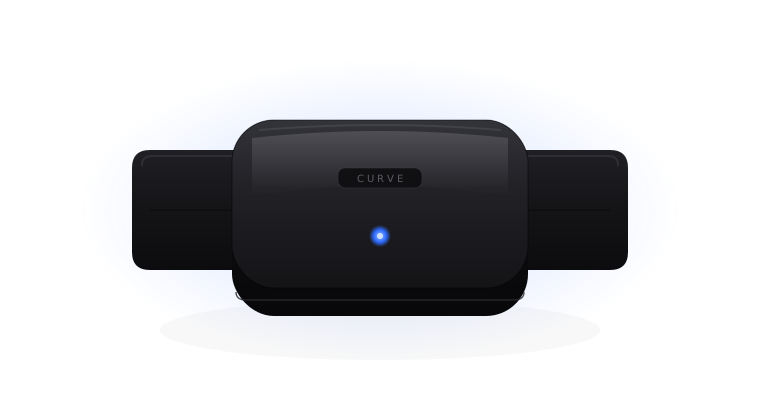
The Auromone Curve is a band designed to read cortisol from a trace of sweat on your wrist, about 720 times a day, roughly every 2 minutes. It does not compute a stress score. It reports the hormone, so you can see the shape of your own day: the rise after you wake, the fall through the afternoon, and where it sits at midnight. In bench testing it tracked a lab blood test to within about 8% over 14 days of continuous wear. It ships Q4 2026.
What that is not, stated plainly. It is a general wellness device, not a diagnostic. It will not tell you that a number is high, low, normal or abnormal, and it does not interpret your curve on your behalf. It cannot detect, rule out or screen for any medical condition, it is not comparable to a clinical test, and it does not replace one. It does not replace your ring either, and it does not replace your doctor. It measures cortisol and shows you the curve. What you make of that is yours. To see how it sits alongside saliva kits, blood draws and HRV wearables, read how the measurement methods compare, or start with Cortisol 101.
This guide is for general wellness education only. The Auromone Curve is a general wellness device, not a diagnostic, and does not replace medical advice or clinical testing. Device names are trademarks of their respective owners, and product descriptions reflect the manufacturers' publicly available documentation as of July 2026. If you have symptoms that concern you, talk to a healthcare provider.
References
- Shaffer F, Ginsberg JP. An Overview of Heart Rate Variability Metrics and Norms. Front Public Health. 2017;5:258. (Definition of HRV; RMSSD and the HF band as vagal measures; half of the LF band is parasympathetic; SDNN over 100 ms vs under 50 ms and the 5.3-times mortality figure; short-term norms SDNN 50 ± 16 ms and RMSSD 42 ± 15 ms; conduction abnormalities such as atrial fibrillation elevating HRV.)
- Billman GE. The LF/HF ratio does not accurately measure cardiac sympatho-vagal balance. Front Physiol. 2013;4:26.
- Dickerson SS, Kemeny ME. Acute stressors and cortisol responses: a theoretical integration and synthesis of laboratory research. Psychol Bull. 2004;130(3):355-391. (208 studies, 6,153 participants; peak cortisol 21 to 40 min from stressor onset; controllable d = 0.16 vs uncontrollable d = 0.52; social-evaluative threat d = 0.67 vs d = 0.15 without; category effect sizes −0.07, −0.08, 0.32, 0.35 and 0.92; effort and engagement activate the sympathetic nervous system while cortisol is unrelated to that dimension.)
- Pulopulos MM, Vanderhasselt MA, De Raedt R. Association between changes in heart rate variability during the anticipation of a stressful situation and the stress-induced cortisol response. Psychoneuroendocrinology. 2018;94:63-71. (n = 171; most prior studies of HRV change and cortisol found non-significant results; β = −0.160, p = 0.024 for the anticipation phase.)
- Bennett MM, Tomas CW, Fitzgerald JM. Relationship between heart rate variability and differential patterns of cortisol response to acute stressors in mid-life adults. Stress Health. 2024;40(3):e3327. (n = 386, MIDUS Refresher; three cortisol trajectories at 80%, 13% and 7%; r(306) = 0.19 in the prototypical group, and no relationship in the other two.)
- Cao R, Azimi I, Sarhaddi F, et al. Accuracy Assessment of Oura Ring Nocturnal Heart Rate and Heart Rate Variability in Comparison With Electrocardiography. JMIR Mhealth Uhealth. 2022;10(1):e27487. (n = 35; heart rate r = 0.99, RMSSD r = 0.92, HF r = 0.63, LF r = 0.42, LF:HF r = 0.35; the LF and LF:HF ratio had high error rates.)
- StatPearls (NCBI Bookshelf). Physiology, Cortisol. (CRH to ACTH to cortisol; the diurnal rhythm.)
- Oura. Daytime Stress. (Heart rate, HRV, motion and average body temperature; 15-minute updates; personal baseline, no fixed thresholds; results may not be valid for users with heart disease, neurodegenerative disease or pacemakers.)
- WHOOP. Introducing Stress Monitor. (Heart rate and HRV against a 14-day personal baseline, with motion to distinguish exercise; reported on a 0 to 3 scale.)
- Heart and Stroke Foundation of Canada. Signs of a heart attack. (The sign list; call 9-1-1 immediately; women can experience a heart attack without chest pressure.)
- Cleveland Clinic. Myocarditis. (Symptom list; most often caused by a viral infection; linked to nearly 20% of sudden deaths in young people; do not exercise until your provider says you can.)
- Apple. Heart health notifications on your Apple Watch. (The irregular rhythm notification is not constantly looking for AFib and cannot detect all instances of it; the absence of a notification is not intended to indicate no disease process is present.)
- The Effects of Hypertension Treatment on Heart Rate Variability: A Scoping Review. (29 trials, 2,230 participants; beta-blockers and non-dihydropyridine calcium channel blockers consistently enhanced parasympathetic activity and improved HRV.)
- Baron KG, Abbott S, Jao N, Manalo N, Mullen R. Orthosomnia: Are Some Patients Taking the Quantified Self Too Far? J Clin Sleep Med. 2017;13(2):351-354.
- 9-8-8 Suicide Crisis Helpline (Canada). Call or text 9-8-8, 24 hours a day.