Read this before you book, buy, or wait
If you are unwell right now, a cortisol test is the wrong next step
Most people reading this page are planning a test calmly. A few are not, and the difference matters more than anything else here.
Go to emergency care now, and say the words "possible adrenal crisis", if you have:
- Severe weakness, collapse or fainting, or feeling faint on standing
- Persistent vomiting or diarrhoea, severe abdominal pain, or a fever alongside profound weakness
- Confusion or drowsiness, or a sudden drop in blood pressure
You do not need a diagnosis for this to be about you. An adrenal crisis is the first presentation in roughly half of the people who turn out to have Addison's disease, and in one national series two thirds were identified only during an emergency admission. If you have never taken a steroid, have never seen an endocrinologist, and are on this page because you feel this ill, this is your paragraph. It applies with extra force if you take, or have recently stopped, steroid medication of any kind (including inhaled, nasal, topical, injected and joint injections), if you take long-term opioids or cancer immunotherapy, or if you have a known adrenal or pituitary condition. Do not wait for a test. The Endocrine Society's primary adrenal insufficiency guideline is explicit: in a suspected crisis, treatment comes first, and "treatment should therefore not be delayed by awaiting the results of cosyntropin testing."
The trap, and the way out of it. An adrenal crisis does not merely look like a bad stomach bug. A stomach bug is the most common thing that triggers one, with gastroenteritis accounting for 35 to 45% of crises, so "but I really do have gastroenteritis" is not the reassuring explanation it feels like. The instinct is to swallow a steroid tablet and lie down. If you are vomiting, you cannot rely on absorbing an oral tablet. The joint European and Endocrine Society guideline on glucocorticoid-induced adrenal insufficiency states that injected glucocorticoids are needed "when there are signs of hemodynamic instability or prolonged vomiting or diarrhea."
If you have an emergency hydrocortisone injection kit: use it, and still call emergency services. The injection is a bridge, not the treatment. The Endocrine Society's guideline treats it as the first step of a package, "an immediate parenteral injection of 100 mg…hydrocortisone, followed by appropriate fluid resuscitation and 200 mg…of hydrocortisone/24 hours", and the fluids, salt, glucose and monitoring only exist in a hospital. Published guidance on adrenal crisis is blunt about it: "this emergency injection does not obviate the necessity to attend for acute medical care." Inject, then call an ambulance. If you do not have a kit, call an ambulance now and say you may have adrenal insufficiency and may need hydrocortisone. This is an ambulance, not a taxi, either way.
And what a missing sign does not buy you. A crisis can arrive without vomiting, without fever, and without any warning that reads as an emergency. The absence of any one of these signs does not rule it out. Neither does a normal cortisol result from an earlier test, for the reasons in the section below. If you are frightened enough to be reading this paragraph twice, go and be seen.
The slow version, which is the one most people have. Adrenal insufficiency usually arrives over months, and it is missed because the early symptoms are ordinary: fatigue, unintended weight loss, nausea, loss of appetite, dizziness on standing, muscle and joint aches. Two signs are worth raising with a doctor by name, because they point at the adrenal glands rather than at your life: craving salt, and skin that looks tanned where it should not be, in scars, palm creases, knuckles, gums or the inside of the cheek. If either is on your list, ask specifically about adrenal insufficiency. Do not wait to be offered the question.
When is the best time to test cortisol?
There is no single best time, and that is not a dodge. Cortisol runs on a daily rhythm: it climbs in the last hours of sleep, peaks around waking, and falls through the day to its lowest point late at night. StatPearls, the NIH-hosted clinical reference, describes secretion as following "a diurnal rhythm, with levels beginning to rise during the final hours of sleep, peaking near the time of awakening, and gradually declining throughout the day to reach the lowest concentration at night."
So the clock is not a nuisance variable. It is an input. A morning sample asks whether the peak is there. A midnight sample asks whether the floor is there. Those are different questions, and the tests are built around them.
| Test | When the sample is taken | What the timing is for |
|---|---|---|
| Blood (serum) cortisol | Morning, near the peak. MedlinePlus notes blood is often drawn twice, once in the morning and again around 4 p.m. | A baseline reading. Two draws sketch the fall across the day rather than one point on it |
| Late-night salivary cortisol | Between 2300 and 2400 h, on two separate evenings | Looks for the loss of the late-night low point. One of the Endocrine Society's four recommended first tests for Cushing's syndrome. A clinician orders it and reads it |
| 24-hour urine free cortisol | Every void across a full 24 hours, at least two collections | Total output over a day. It deliberately gives up timing information in exchange for a whole-day total |
| 1 mg overnight dexamethasone suppression test | Tablet late at night, blood drawn the following morning | Asks whether the system switches itself off when instructed to |
| Corticotropin (ACTH) stimulation test | Baseline, then 30 or 60 minutes after a 250 microgram injection | The Endocrine Society's standard for establishing adrenal insufficiency. A peak below 500 nmol/L (18 mcg/dL) indicates it. The guideline adds "(assay dependent)", so the cutoff belongs to the lab that ran your sample, not to the internet |
| 4-point diurnal saliva panel (sold direct to consumers) | Doctor's Data, one lab that sells the panel, collects it 30 minutes after waking, before lunch, before dinner, and before bed | Sold as a picture of the daily pattern. It is not among the tests the Endocrine Society recommends for diagnosis. See below |
Notice what the list is doing. Five of these six tests are defined by their timing, and the one that is not, the 24-hour urine, throws timing away on purpose and says so. Medicine did not arrive at four different first-line tests for cortisol excess because it could not decide. It arrived there because a single number, taken at a single moment, does not describe a rhythm. For what those numbers mean once you have them, we keep a separate guide to normal cortisol levels and why the ranges disagree.
Does a normal cortisol result rule anything out?
No, and this is the single most important line on the page. A test result is a statement about one sample, taken at one moment, in one assay. It is not a verdict about your adrenal glands.
For adrenal insufficiency, the Endocrine Society's guideline suggests the 250 microgram corticotropin stimulation test "over other existing diagnostics tests to establish the diagnosis." A basal morning cortisol is offered only as a fallback, and the guideline is pointed about its limits: a morning cortisol below 140 nmol/L (5 mcg/dL) alongside ACTH is a "preliminary test suggestive of adrenal insufficiency", an approach it describes as applicable in acute situations and one that should not be used for community-based screening. A reassuring morning number is not an all-clear, and it was never designed to be one.
For cortisol excess, the same problem runs the other way. The Endocrine Society describes patients with "episodic secretion of cortisol excess in a cyclical pattern with peaks occurring at intervals of several days to many months." A scheduled test can land in a trough of that cycle and come back clean. The guideline puts it carefully: with a normal initial result, and no reason to mistrust it, "the patient is very unlikely to have Cushing's syndrome", but where pre-test probability is high it recommends "further evaluation by an endocrinologist" anyway. "Very unlikely" is not "excluded", and which of those two sentences applies to you is a decision for a clinician who knows your history, not for you and a result printout.
Which means one thing in practice
Do not use a cortisol number, yours or anyone's, as permission to stop seeking care. If symptoms that worried you enough to research testing are still there after a normal result, that is a reason to go back to the doctor, not a reason to close the tab. Symptoms outrank a single sample, and the people who write the guidelines say so in writing.
Why does the morning peak matter, and is 8am the right time?
The peak matters because it is the sharpest, most information-dense part of the day. But 8am is the wrong way to find it. Cortisol's morning rise is triggered by waking up, not by the hour. The expert consensus guidelines on the cortisol awakening response, published in Psychoneuroendocrinology by Stalder and colleagues, define it as "a sharp increase in cortisol levels across the first 30–45 min following morning awakening", with a magnitude in healthy adults ranging "between a 50 and 156% increase in salivary cortisol levels."
That is a large, fast movement, and it is measured from your alarm, not from the wall clock. The same consensus paper notes that the discovery of the awakening response explained why clock-time based cortisol assessments in the early morning had poor test-retest reliability, and that aligning sampling to awakening produces the more reliable measure.
The practical consequence is unforgiving. Stalder and colleagues report that delaying the first sample by more than 15 minutes after waking produces a falsely high waking value and a falsely low rise. This is not a rare failure. In one set of studies using objective verification of waking and sampling times, participants delayed that first sample by 3 to 30 minutes on 19.3% of sampling days, and by more than 30 minutes on 14.0% of days. A separate analysis found that the participants who showed no awakening response at all had a mean delay of 42 minutes, with a range up to 135 minutes. They did not lack a cortisol rise. They slept through it and then measured its aftermath.
We wrote a whole guide to that rise, what it is and what it is not: the cortisol awakening response.
If your morning is not in the morning, this page is still about you
Everything above is written around a person who sleeps at night and wakes in the morning, because that is who the reference ranges were built from. If you work nights, rotate shifts, have a newborn, or sleep on a schedule that moves, none of that stops being relevant. It stops being simple.
The Endocrine Society flags this directly for late-night salivary cortisol, warning that the test "may not be appropriate for shift workers or patients with variable sleep patterns", and noting that "the circadian rhythm is blunted in many patients with depressive illness and in shift workers." A midnight sample is only meaningful if midnight is when your body is at its floor. Tell whoever is ordering the test what your actual sleep looks like. It changes which test they choose.
What is late-night salivary cortisol, and should I do one?
It is a screening test for Cushing's syndrome, and no, not on your own initiative. The Endocrine Society's guideline for the diagnosis of Cushing's syndrome lists four first tests, to be chosen "based on its suitability for a given patient": 24-hour urine free cortisol with at least two measurements, late-night salivary cortisol with two measurements, a 1 mg overnight dexamethasone suppression test, or a longer low-dose dexamethasone test over 48 hours. Of the late-night saliva test, the guideline notes that "most clinicians using the late-night salivary cortisol test ask patients to collect a saliva sample on two separate evenings between 2300 and 2400 h."
The logic is elegant. In health, late night is when cortisol should be at its lowest. A late-night sample therefore asks a very specific question: is the floor still there? The test exists because the loss of that nightly low point is one of the earliest measurable features of pathological cortisol excess.
The advice we are not going to give you
You will find wellness content telling you to "watch your evening cortisol come down" and to draw conclusions when it does not. We are not going to tell you that, and we want to be precise about why.
Watching a late-night cortisol value and deciding what it means is the late-night salivary cortisol test. It is a clinical screening test for Cushing's syndrome, it is performed on two separate evenings against an assay-specific threshold, and it is interpreted by a doctor against everything else they know about you. Dressing that up as a self-improvement habit does not make it a different activity. It makes it the same activity, done badly, with nobody accountable for the answer.
The Auromone Curve does not do that test and is not designed to. If you think you might have Cushing's syndrome, that belief deserves a clinician and a proper test, not a wearable and a hunch.
Why do the diurnal panels use four time-points?
Because one point cannot draw a line, and two cannot draw a curve. A diurnal profile tries to describe the shape of the fall from morning peak to nighttime floor, and a shape needs several points. Doctor's Data, one of the labs selling a consumer version, describes its four-sample panel as showing cortisol that "should be at their highest level 30 minutes after waking up in the morning, decreasing gradually over the course of the day, reaching their lowest point at bedtime." Research studies do something similar, though often with three samples: waking, 30 minutes after waking, and bedtime.
Two honest caveats, and they are not small.
- The 4-point saliva panel is not one of the tests the Endocrine Society recommends for diagnosis. It is not on the list of four first-line tests above. Labs sell it as a picture of daily pattern, and a picture of daily pattern is genuinely interesting, but it is not a diagnostic instrument and buying one does not put you in the diagnostic pathway.
- Multi-sample profiles live or die on your compliance with the clock. The pretest for a large population-based study (Add Health, Wave IV) found that, of the respondents whose timing could be checked against an electronic bottle cap, only 46% fully adhered to the collection protocol, and that "diurnal profiles are different for respondents who do and do not adhere to protocol, and the response to awakening appears to be especially sensitive to non-adherence." The researchers abandoned the cortisol measure entirely. Instructed, incentivised, electronically monitored participants could not hit the windows. You are doing it on a Tuesday, half asleep, on your own.
Which is the honest context for our own guide to at-home cortisol test kits, and what they can and cannot tell you.
What can invalidate a cortisol test?
More things than most kit instructions mention. A cortisol result is a product of the sample, the timing, your medication, and the assay. Break any one of them and the number is still printed, in bold, with a reference range beside it. It just does not mean what it appears to mean.
| What breaks the test | Why | What to do about it |
|---|---|---|
| Sampling by the clock instead of from waking | The morning rise is triggered by awakening. A late first sample gives a falsely high waking value and a falsely low rise | Record the actual minute you woke. Take the first sample immediately, not after the kettle |
| Steroid medication, by any route | The joint Endocrine Society and European Society guideline states that "any route of administration has the potential of HPA axis suppression, including oral, topical, inhaled, intra-nasal, intravenous and intra-articular administration" | Tell the doctor who ordered the test. Never stop or reduce a steroid to prepare for a test. Withdrawal is a physician's decision and stopping abruptly can precipitate a crisis |
| Estrogen: the combined pill, HRT, some fertility treatment | Estrogen raises cortisol-binding globulin, which inflates total blood cortisol. The Endocrine Society advises that "estrogen-containing drugs should be withdrawn for 6 wk before testing or retesting" in the dexamethasone test | This is the ordering doctor's call, not yours. Stopping contraception unilaterally has a consequence that has nothing to do with cortisol. Raise it, do not act on it. And it cuts both ways: on estrogen, a reassuring cortisol can also be false, because the inflated binding protein can make a low free cortisol look normal and hide adrenal insufficiency. Disclose it whichever answer the test gives |
| Night shifts, rotating shifts, irregular sleep | The late-night test assumes a late-night low point exists. The guideline warns it "may not be appropriate for shift workers or patients with variable sleep patterns" | Describe your real sleep schedule before the test is chosen, not after the result comes back odd |
| Licorice, chewing tobacco, cigarettes | Licorice and chewing tobacco contain glycyrrhizic acid, and the guideline notes users "may have a falsely elevated late-night salivary cortisol". Smokers show higher late-night salivary values than non-smokers | Disclose them. They are not vices in this context, they are variables |
| The assay itself | The Endocrine Society notes that "results for a single sample measured in various assays may be quite different", and that upper limits of normal are much lower with mass-spectrometry methods than with antibody-based ones | Use the range printed on your own report. Never compare your number to a stranger's, or to a range you found online |
| Stress, exercise, pregnancy, temperature | MedlinePlus lists cortisol as affected by "Stress, Pregnancy, Exercise, Hot and cold temperatures, Certain medicines, such as birth control pills" | Do not train hard, panic, or sprint for the bus before a sample. Tell the lab if you are pregnant |
The one instruction on this page that can hurt you if you follow it literally
Two rows in that table say a medication interferes with the test. It would be an easy, tidy, and dangerous conclusion to stop the medication so the test comes back clean. Do not do that.
Steroids. Stopping or reducing a steroid on your own is how people end up in an adrenal crisis, and recovery of your own cortisol production after long-term steroids is slow: the joint guideline describes adrenal function recovering "in a time frame from a few months to up to 4 years in some cases." If you are on steroids and facing a cortisol test, the person who prescribed them decides what happens next. Our guide to what happens when you come off steroids covers this in full.
Estrogen. The 6-week withdrawal is a real guideline recommendation, and it is written for a clinician making a plan with a patient. Read as a home instruction it becomes "stop your contraception for six weeks," which is a different decision with a different consequence.
MedlinePlus puts it in one line, and we will not improve on it: "don't stop using any medicines without talking with your provider first."
A continuous reading is not a test, and we are not going to blur that
Everything above is clinical testing: ordered for a reason, timed to a question, and read by someone qualified to be wrong in public. What follows is not that, and the boundary is worth stating plainly rather than leaving to inference.
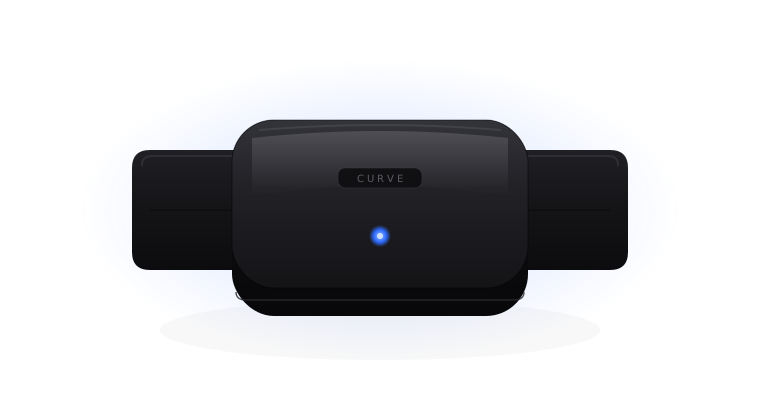
Every test on this page freezes cortisol at a chosen moment, which is exactly why the moment has to be chosen so carefully. That is the right design for a diagnostic question, and nothing below improves on it. The Auromone Curve is designed to read cortisol continuously from a trace of sweat on your wrist, so you can see your own daily pattern move. It ships Q4 2026.
What that is not, in the plainest terms we can manage: it is not any of the tests above, it cannot be compared to them, and it does not detect, screen for, monitor or rule out adrenal insufficiency, Cushing's syndrome, or anything else on this page. It will not tell you whether your late-night value is where it should be, and we are not going to build a feature that pretends otherwise. It is a general wellness device. Its subject is your own rhythm, and the meaning of that rhythm belongs to you and, when it matters, to your doctor. Start with Cortisol 101 if you want the whole picture of what cortisol does before you decide whether any of this is a question for you.
This guide is for general wellness education only. The Auromone Curve is a general wellness device, not a diagnostic, and does not replace clinical testing or medical advice. Decisions about which cortisol test to run, when to run it, and what the result means belong to a qualified healthcare provider. Please talk to one.
References
- Endocrine Society. The Diagnosis of Cushing's Syndrome: An Endocrine Society Clinical Practice Guideline. J Clin Endocrinol Metab, 2008. (Source for the four first-line tests; late-night saliva collected on two separate evenings between 2300 and 2400 h; estrogen withdrawal for 6 wk; blunted rhythm in shift workers and depressive illness; licorice, chewing tobacco and smoking; assay variability; cyclical cortisol excess.)
- Endocrine Society. Diagnosis and Treatment of Primary Adrenal Insufficiency: An Endocrine Society Clinical Practice Guideline. J Clin Endocrinol Metab, 2016. (Source for the 250 microgram corticotropin stimulation test and the 500 nmol/L peak; the 140 nmol/L morning cortisol as a preliminary acute test not for community screening; and that treatment must not be delayed by awaiting test results in a suspected crisis.)
- European Society of Endocrinology and Endocrine Society. European Society of Endocrinology and Endocrine Society Joint Clinical Guideline: Diagnosis and Therapy of Glucocorticoid-induced Adrenal Insufficiency. J Clin Endocrinol Metab, 2024. (Source for suppression by any route of administration; injected glucocorticoids when there is prolonged vomiting or diarrhoea; and recovery times of a few months to 4 years.)
- Stalder T et al. Assessment of the cortisol awakening response: Expert consensus guidelines. Psychoneuroendocrinology, 2016. (Source for the 30 to 45 minute window, the 50 to 156% rise, the failure of clock-time sampling, and the effect of a first sample delayed by more than 15 minutes.)
- MedlinePlus, U.S. National Library of Medicine. Cortisol Test. (Source for the morning and 4 p.m. blood draws; the list of things that affect cortisol; and the instruction not to stop any medicine without talking to your provider.)
- StatPearls (NCBI Bookshelf). Physiology, Cortisol. (Source for the diurnal rhythm: rising in the final hours of sleep, peaking near awakening, lowest at night.)
- National Library of Medicine (PubMed Central). Challenges of Measuring Diurnal Cortisol Concentrations in a Large Population-Based Field Study. Psychoneuroendocrinology. (Source for the 46% adherence figure and the abandonment of the cortisol measure.)
- Doctor's Data. Diurnal Cortisol Profile, saliva. (Source for the four sampling times of a commercially sold diurnal panel. Cited to describe what the panel is, not to endorse it.)
- Rushworth RL, Torpy DJ, Falhammar H. Adrenal crisis: prevention and management in adult patients. Ther Adv Endocrinol Metab, 2019. (Source for gastroenteritis as the leading precipitant of adrenal crisis; for adrenal crisis as a first presentation in undiagnosed adrenal insufficiency; and for the instruction that an emergency injection does not remove the need to attend for acute medical care.)
- Nowotny HF et al. Salivary Cortisol and Cortisone Can Circumvent Confounding Effects of Oral Contraceptives in the Short Synacthen Test. J Clin Endocrinol Metab, 2024. (Source for the risk of an apparently normal plasma cortisol during Synacthen testing in women taking combined oral contraceptives.)
- StatPearls (NCBI Bookshelf). Adrenal Crisis. (Source for hyperpigmentation of skin and buccal mucosa in primary adrenal insufficiency, and for treating on suspicion without waiting for blood work.)