Before you price anything: when buying a test is the wrong move
Every test on this page is a draw-and-wait or a mail-and-wait test. Turnaround runs from 1 to 7 business days, and up to about 10 working days for hair. If you are acutely unwell right now, that turnaround is the whole problem, and the purchase you are about to make is the wrong one.
Call emergency services, do not order a test, if you have:
- Vomiting or diarrhea together with severe weakness, dizziness, or fainting
- Severe abdominal, lower chest or back pain
- Drowsiness, confusion, or collapse
That picture can be adrenal crisis. It can also be a heart attack, sepsis, diabetic ketoacidosis or a surgical emergency, all of which need the same answer, which is emergency care now, and none of which are answered by a test you mail off. StatPearls lists adrenal crisis's early symptoms as weakness, fatigue, nausea, vomiting, fever, lower chest or abdominal pain, loss of appetite, back pain, dizziness, drowsiness and confusion. In other words, it reads exactly like a stomach bug or the flu, which is not a coincidence: gastrointestinal and flu-like illnesses are its most common trigger. It can also present as an acute abdomen severe enough to be mistaken for a surgical emergency.
Do not use fever as your filter for the emergency room. Fever appears on both lists. A stomach bug causes it, and a stomach bug is the commonest thing that tips someone into a crisis, so its presence settles nothing and its absence rules nothing out. What decides the emergency is severity and direction of travel: weakness, dizziness, confusion or collapse layered on top of a GI illness is an emergency, not a data-collection opportunity.
But if you take glucocorticoids, fever is not nothing. It is your cue to act, before any of that happens. This is the step that prevents the crisis described above, and it is the step articles like this one leave out. The Endocrine Society's primary adrenal insufficiency guideline instructs patients on steroid replacement to double the hydrocortisone dose for a fever above 38 °C and triple it above 39 °C, continuing until recovery, usually 2 to 3 days. The NIDDK says it plainly: "You will need to increase your dose if you have a high fever." Do not wait to feel weak. If you are ill, feverish, injured, or facing surgery or a dental procedure, and nobody has ever given you a sick-day rule, that is an urgent call to your prescriber, not a reason to buy a test. And if you are already vomiting, you are past the tablet stage. See the injection paragraph below.
And it is not only a risk for people who already have a diagnosis. StatPearls reports that acute adrenal crisis is the initial presentation in about 50% of patients later diagnosed with Addison's disease. Having never been told you have an adrenal problem is not protective.
If you take a steroid by any route, and that means tablets, an inhaler, a nasal spray, a skin cream, eye drops or a joint injection, and you are vomiting, you cannot absorb an oral steroid tablet. The NIDDK is explicit: you need immediate medical attention if you have a severe infection or diarrhea, or are vomiting and cannot keep your corticosteroid pills down. Swallowing another pill and lying down is the failure mode. The treatment is an injection. If you have an emergency hydrocortisone injection kit, use it and call emergency services. If you do not, call emergency services rather than driving yourself, because StatPearls describes this progressing to circulatory collapse, coma and death. Say the words, to the dispatcher and again at triage: "I may be having an adrenal crisis. I may need intravenous hydrocortisone and saline." Say them twice, because adrenal crisis is routinely mistaken for gastroenteritis in a waiting room, and it is treated in minutes, not hours.
The Endocrine Society's guideline on primary adrenal insufficiency treats an adrenal crisis with 100 mg of hydrocortisone given by injection, intravenously or intramuscularly, never swallowed, followed by 200 mg over the next 24 hours, and recommends that people at risk carry a glucocorticoid injection kit, a steroid emergency card and medical alert identification. If you take steroids long-term and you have never been given those, that is a conversation to have with your prescriber this week. More on that in our guide to coming off steroids.
What does each cortisol test cost?
Here is the comparison, with what each sample type actually measures alongside the price, because the two are related and the price alone will mislead you.
One number sets up the whole table. About 90% of the cortisol in your blood is bound to cortisol-binding globulin, about 5% to albumin and similar proteins, and only about 5% is unbound, or "free." The free fraction is the part your tissues respond to. A blood test measures total cortisol, bound and free together. Saliva, urine and hair all measure the free fraction. That distinction is the reason the same person can produce a high blood number and a normal saliva number on the same morning, and it is not a lab error.
| Test | What it measures | What clinicians use it for | Typical US self-pay price | Turnaround |
|---|---|---|---|---|
| Serum (blood) cortisol, single draw | Total cortisol, bound plus free | A morning value is used in the adrenal insufficiency workup. The Endocrine Society recommends against random serum cortisol to screen for Cushing's syndrome | US$49 (Walk-In Lab, random serum) to US$89 (Labcorp OnDemand), plus a US$4 to US$6 order fee | 1 to 5 business days |
| Late-night salivary cortisol, 2 samples | Free cortisol at the hour it should be at its daily low | One of the four Endocrine Society first-line tests for Cushing's syndrome. Two measurements are stipulated | Normally ordered through a clinician. We could not verify a reliable standalone direct-to-consumer price, so we are not printing one | Days |
| 4-point salivary "diurnal" panel | Free cortisol at 4 clock times across one day | A consumer product, not a guideline test. The guideline test is the two late-night samples above | US$125 (ZRT 4-point via Walk-In Lab, US$119 + US$6) to US$245 (Genova Adrenocortex Stress Profile, US$239 + US$6) | 5 to 7 business days |
| 24-hour urinary free cortisol (UFC) | Free cortisol excreted across a whole day. The lab checks creatinine to confirm you collected all of it | One of the four Endocrine Society first-line tests for Cushing's syndrome. At least two collections are stipulated | US$85 (Walk-In Lab, US$79 + US$6). Remember the guideline asks for two | 4 to 6 business days |
| Hair cortisol | Cumulative free cortisol over up to 6 months. Scalp hair grows about 1 cm per month, so each centimetre is roughly one month | A research tool. Reference values for typical groups have not been established. One Canadian lab sells it "for educational and research purposes only" | £126.75 at one UK consumer lab (list £169) | About 10 working days |
Prices are the sellers' own list prices, read on 13 July 2026. Treat every figure as an estimate. They vary by country, by lab, by state, by promotion, and by whether insurance is involved. In publicly funded systems, a cortisol test ordered by a physician is normally billed to the public plan rather than to you, which means the price many readers are shopping for is a price they may not have to pay at all.
Two tests are missing from that table on purpose. The 1 mg overnight dexamethasone suppression test and the 2 mg 48-hour version are both Endocrine Society first-line tests for Cushing's, and neither is really a thing you can buy: they cost about the price of one serum cortisol draw plus a prescription tablet, and the tablet is the point. You need a prescriber. Similarly, the 250 microgram corticotropin stimulation test, which the Endocrine Society calls the gold standard for diagnosing primary adrenal insufficiency, is a procedure performed in a clinic, not a kit.
Which cortisol test do I actually need?
The clinical question chooses the test, and the cheapest test answers almost none of them. This is the single most useful thing on this page, so it is worth being blunt about.
When Cushing's syndrome (sustained cortisol excess) is suspected, the Endocrine Society's clinical practice guideline offers a choice of four first-line tests: 24-hour urinary free cortisol, late-night salivary cortisol, the 1 mg overnight dexamethasone suppression test, or the longer 2 mg 48-hour version. Because of the variability in cortisol secretion, the guideline stipulates at least two measurements of urinary free cortisol and two of late-night salivary cortisol. One sample is not the protocol. And the guideline states directly:
"We recommend against the use of the following to test for Cushing's syndrome: Random serum cortisol or plasma ACTH levels."
Endocrine Society, The Diagnosis of Cushing's Syndrome (Nieman et al., JCEM 2008)
When adrenal insufficiency (too little cortisol) is suspected, the Endocrine Society's guideline on primary adrenal insufficiency names the 250 microgram corticotropin stimulation test as the gold standard. On the cheap alternative, it is equally direct: "There is no evidence to support the use of random cortisol to rule out adrenal insufficiency." Where a stimulation test is not feasible, it suggests a morning cortisol below 140 nmol/L (5 µg/dL) together with ACTH as a preliminary finding, pending confirmation. Read that threshold in one direction only. It is a number that helps rule adrenal insufficiency in. It is not a number that rules it out: the same guideline treats a stimulated peak below 500 nmol/L (18 µg/dL) as indicating adrenal insufficiency, so a morning cortisol sitting anywhere between roughly 140 and 500 nmol/L (5 to 18 µg/dL) settles nothing, and is exactly the situation the stimulation test exists to resolve. A morning cortisol of 7 µg/dL is not an all-clear. Note also that the 140 nmol/L rule is written for primary adrenal insufficiency, where ACTH runs high. If your adrenal glands are suppressed by steroids you have been taking, ACTH is low or normal, that pairing does not apply to you, and even a standard 250 µg stimulation test can read normal in the early months of that suppression. If you are on steroids, this is a conversation with an endocrinologist, not a threshold to check yourself against.
So the arithmetic is the reverse of what it looks like. The US$49 random blood cortisol is the one you can buy fastest and the one both guidelines steer away from. Spending US$49 on a test that cannot answer your question is not saving money; it is buying a number you will have to pay again to replace. If you want the fuller picture of what those numbers mean in the first place, start with normal cortisol levels and why the reference range moves all day.
Why would my cortisol test come back wrong?
Cortisol assays are unusually easy to fool, and most of the ways to fool them are things people do without thinking to mention. Every one of the following is documented in the Endocrine Society guideline or the literature it rests on, and the list is not exhaustive, which is itself the point.
| What you are doing | Which test it distorts | What happens |
|---|---|---|
| The pill, estrogen HRT, patches, rings | Serum total cortisol, dexamethasone suppression test | Estrogen raises cortisol-binding globulin, so the total number rises without the free fraction rising. The guideline reports false-positive rates on the overnight DST in 50% of women taking the oral contraceptive pill, and advises withdrawing estrogen-containing drugs for 6 weeks before testing wherever possible |
| Pregnancy | Serum total cortisol, dexamethasone suppression test | Pregnancy raises cortisol-binding globulin further than any pill does, and cortisol climbs across all three trimesters. The Endocrine Society guideline recommends UFC and recommends against dexamethasone testing in the initial evaluation of pregnant women. If you are pregnant, or might be, say so before any cortisol test is ordered |
| Anti-seizure drugs, rifampicin, heavy alcohol use | Dexamethasone suppression test | Phenytoin, phenobarbitone, carbamazepine, rifampicin and alcohol speed the liver's clearance of dexamethasone via CYP3A4, so the tablet you swallowed is gone before it can suppress anything and the test reads falsely positive. The guideline advises against dexamethasone testing in people taking them |
| Steroid creams, gels, ointments | Salivary cortisol | "Direct contamination of the salivette by steroid-containing lotion or oral gels also may result in false-positive results" |
| Smoking | Late-night salivary cortisol | Smokers have been shown to have higher late-night salivary cortisol than non-smokers |
| Night shifts, or a bedtime that moves | Late-night salivary cortisol | The test assumes your cortisol bottoms out late in the evening, so the guideline says "it may not be appropriate for shift workers or those with variable bedtimes" |
| Drinking 5 litres of fluid a day or more | 24-hour urinary free cortisol | "High fluid intake (≥5 liters/d) significantly increases UFC" |
| Missing part of the 24-hour collection | 24-hour urinary free cortisol | The result is only as good as the collection. The lab measures total volume and urinary creatinine specifically to check you caught all of it |
| Hair washing, colouring, treatments | Hair cortisol | Confounders that the research itself calls unresolved, on top of the fact that reference values for typical groups have not yet been determined |
If you take steroids at all, this page is about you. Not just prednisone. Inhalers, nasal sprays, eczema and psoriasis creams, eye drops, and joint injections all put glucocorticoid into your system and all of them can move a cortisol measurement. So can unlabelled herbal products, some of which have been found to contain steroids. People on the non-tablet routes routinely read pages like this one, decide it is written about somebody else, and stop reading. It is written about you.
The estrogen finding deserves one more line, because it shows why the sample type matters so much. In a published study, when women stopped taking oral contraceptives, total serum cortisol fell significantly, while serum free cortisol, salivary cortisol and salivary cortisone did not change at all. Nothing about their adrenal glands changed. Only the carrier protein did, and only the total number followed it.
An in-range result is not an all-clear
This is the part a price-comparison article is most tempted to skip, so it goes in bold. A normal cortisol number does not mean nothing is wrong, and it should not be used that way.
Cortisol moves across the day and from day to day, which is exactly why the Endocrine Society asks for two urinary free cortisol collections and two late-night saliva samples rather than one of each. Cyclic Cushing's syndrome, which the guideline calls very rare, can sit quiet between surges and produce normal results in the gaps, and it is the specific exception in which the guideline advises further evaluation despite negative results. (Where two different tests come back concordantly negative and cyclical disease is not suspected, that same guideline recommends against testing on and on. The point is not that no result ever reassures. It is that one result, self-ordered and uninterpreted, is not the one that does.) On the other side, there is no evidence that a random cortisol can rule out adrenal insufficiency.
So the honest rule is not "if the number is in range, relax." It is: a test you bought yourself, with a result nobody has interpreted, cannot discharge you from a symptom. If you still feel wrong, that is a reason to keep going back to a doctor, not a reason to stop.
Do I need a doctor to test my cortisol?
To buy the test, in the United States, no. To use the result, yes. Those are two different sentences and the gap between them is where the money actually goes.
The direct-to-consumer labs run the order through an independent provider and process the sample in a CLIA-certified laboratory. CLIA is the Clinical Laboratory Improvement Amendments, passed by Congress in 1988 to establish quality standards for all non-research laboratory testing performed on human specimens, and it applies across commercial, hospital and physician-office labs. CLIA certification is a genuine and meaningful thing to look for. What it certifies is that the assay was run properly. It certifies nothing about whether the assay was the right one to run, or what the number means for you.
MedlinePlus, from the US National Library of Medicine, puts the limit plainly: "A cortisol test alone can't diagnose the cause of abnormal cortisol levels." The Endocrine Society goes further, recommending that anyone with an abnormal first-line result be evaluated by an endocrinologist to confirm or exclude the diagnosis, precisely because a single abnormal result may be a false positive rather than a disease.
Which produces the one piece of practical advice this page can actually give you. Take the test question to a clinician before you pay for a test, not after. They will pick the test that matches the question, time the sample correctly, know to ask about your contraceptive and your eczema cream, and read the result against the rest of you. In a publicly funded system they will also usually get it done at no charge. The assay was never the expensive part. If you want to see how the at-home kits stack up against each other before that conversation, we compare them in at-home cortisol tests: kits versus continuous monitoring, and the symptoms that send most people looking are unpacked in the signs people associate with high cortisol.
Where the Auromone Curve fits, and where it does not
We make a cortisol wearable, so you should hear the boundary from us rather than infer it.
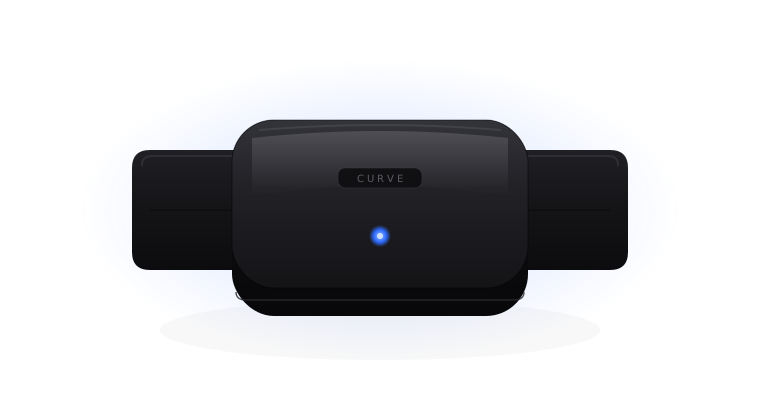
The Auromone Curve is a general wellness device. It is designed to read cortisol from a trace of sweat on your wrist and show you the shape of your own daily rhythm. It ships Q4 2026.
It is not any of the tests on this page, and it is not a cheaper way to get one. It is not a lab test. It is not CLIA-certified, because it is not a clinical laboratory. It does not screen for, detect, rule out or diagnose Cushing's syndrome, adrenal insufficiency, or anything else, and no reading it produces can be substituted for a serum draw, a urinary free cortisol collection, a salivary cortisol, a dexamethasone suppression test or a corticotropin stimulation test. If a clinician has ordered one of those, get it. Nothing here changes that, and the price of the Curve is not comparable to the price of a test, because they are not the same purchase.
What it is for is the ordinary curiosity that most people arriving on a page like this actually have: what does my own cortisol do across a normal day, and what does it look like after a bad night or a hard week. That is a wellness question, not a medical one. If it is the question you came with, Cortisol 101 explains the rhythm itself, and the sharp rise that happens in the first half hour after you wake is the part of it people find most surprising.
This guide is for general wellness education only. The Auromone Curve is a general wellness device, not a diagnostic, and does not replace clinical testing or medical advice. Prices are estimates read from public listings on 13 July 2026 and will differ by country, lab and insurer. If you have symptoms, please talk to a healthcare provider.
References
- Nieman LK et al., Endocrine Society. The Diagnosis of Cushing's Syndrome: An Endocrine Society Clinical Practice Guideline, JCEM 2008. (Four first-line tests; at least two measurements of UFC and late-night salivary cortisol; recommends against random serum cortisol; 50% false-positive DST rate on the oral contraceptive pill; withdraw estrogen 6 weeks before testing; high fluid intake ≥5 L/d raises UFC; salivette contamination by steroid lotions; smokers have higher late-night salivary cortisol; the test may not suit shift workers; refer abnormal results to an endocrinologist; follow up suspected cyclical disease despite negative results; UFC recommended and dexamethasone testing recommended against in pregnancy; phenytoin, phenobarbitone, carbamazepine, rifampicin and alcohol induce CYP3A4 clearance of dexamethasone.)
- Bornstein SR et al., Endocrine Society. Diagnosis and Treatment of Primary Adrenal Insufficiency: An Endocrine Society Clinical Practice Guideline, JCEM 2016. (250 µg corticotropin stimulation test as gold standard; "no evidence to support the use of random cortisol to rule out adrenal insufficiency"; morning cortisol <140 nmol/L; 100 mg hydrocortisone by intravenous or intramuscular injection for adrenal crisis; glucocorticoid injection kit, steroid emergency card and medical alert ID; sick-day rules: replacement doses doubled above 38 °C and tripled above 39 °C until recovery; peak cortisol <500 nmol/L (18 µg/dL) on stimulation testing indicates adrenal insufficiency.)
- StatPearls (NCBI Bookshelf). Adrenal Crisis. (Symptom list; gastrointestinal and flu-like illnesses as the most common precipitant; presentation as an acute abdomen; the initial presentation in about 50% of patients later diagnosed with Addison's disease.)
- NIDDK, National Institutes of Health. Treatment for Adrenal Insufficiency & Addison's Disease. ("You will need immediate medical attention if you have a severe infection or diarrhea, or are vomiting and can't keep your corticosteroid pills down." "You will need to increase your dose if you have a high fever." Crisis treatment is IV corticosteroids and IV saline with dextrose.)
- MedlinePlus, U.S. National Library of Medicine. Cortisol Test. ("A cortisol test alone can't diagnose the cause of abnormal cortisol levels." Blood, urine and saliva samples; timing; birth control pills affect results.)
- Johnson TN, Whitaker MJ, Keevil B, Ross RJ. Bioavailability of Oral Hydrocortisone Corrected for Binding Proteins, J Endocr Soc 2018. ("Ninety percent of serum cortisol circulates bound to cortisol binding globulin, 5% to generic binding proteins, such as albumin and α-1 glycoprotein, and only 5% is unbound or 'free'.")
- Perogamvros I et al. Salivary Cortisone Is a Potential Biomarker for Serum Free Cortisol, JCEM 2010. (Total serum cortisol fell significantly after stopping oral contraceptives, while serum free cortisol, salivary cortisol and salivary cortisone did not change.)
- UCSF Stress Measurement Network. Hair Cortisol. (Cumulative cortisol over up to 6 months; scalp hair grows about 1 cm per month; "Reference values of hair cortisol of typical groups have not yet been determined"; topical, oral, injected, eye-drop and intranasal cortisol-containing medication affects levels.)
- CanAlt Health Laboratories. Hair Cortisol Analysis. ("Hair Cortisol Analysis is offered for educational and research purposes only. Results provided by this service are not intended to diagnose, prevent, or treat any disease or condition, and should not be used as a basis for clinical decision-making.")
- Centers for Medicare & Medicaid Services. Clinical Laboratory Improvement Amendments (CLIA). (CMS fact sheet ICN 006270: "Congress passed CLIA in 1988 to establish quality standards for all non-research laboratory testing performed on specimens derived from humans...")
- Prices read on 13 July 2026 from: Labcorp OnDemand, Cortisol Test (US$89); Quest, Cortisol Test (US$79 + US$6); Walk-In Lab cortisol tests (random serum US$49 + US$6; Genova Adrenocortex Stress Profile US$239 + US$6); Walk-In Lab, 24-hour urinary free cortisol (US$79 + US$6); Walk-In Lab, 4-point cortisol ZRT kit (US$119 + US$6); Cortigenix hair cortisol (£126.75, list £169).