Read this before you buy either one
Neither product is a test for anything. Eli Health says so on its own product page: the Hormometer "is not intended to diagnose, treat, cure, prevent, or manage any disease or medical condition, including adrenal disorders such as Addison's disease, Cushing's syndrome, or medication management." The Auromone Curve is a general wellness device, and exactly the same is true of it. That is not fine print either company is trying to slip past you. It is the real boundary of both products.
Some of this is an emergency, not an appointment. Call emergency services now, 911 in Canada and the US. Do not book, do not test, do not wait for morning, if you have:
- Vomiting or diarrhea you cannot get on top of, especially with sudden severe pain in your lower back, abdomen or legs
- Fainting, collapse, confusion, or loss of consciousness
- Profound weakness, or dizziness so severe you cannot stand up
That is the picture NIDDK gives for an adrenal crisis, and NIDDK does not hedge about it: "If not treated right away, adrenal crisis can cause death." It does not require a prior diagnosis, and it does not require that you take steroids. NIDDK is explicit that the symptoms of adrenal insufficiency "sometimes appear for the first time during adrenal crisis", so "nobody has ever told me I have this" is not a reason to stay home.
If none of that applies but something still feels wrong, the purchase you need is an appointment. See a doctor rather than a checkout page if you have any of these:
- Unexplained weight loss, ongoing nausea, vomiting or diarrhea, abdominal pain, or loss of appetite
- Low blood pressure that drops further when you stand, causing dizziness or fainting
- Craving salty foods, or episodes of low blood sugar
- Darkening of the skin, most visible on scars, skin folds, elbows, knees, knuckles, lips, and the lining of the cheek
- Muscle weakness and long-running fatigue that has been building for months
Those are the symptoms the U.S. National Institute of Diabetes and Digestive and Kidney Diseases (NIDDK) lists for adrenal insufficiency. It is diagnosed with blood tests a clinician orders. It is not diagnosed from a saliva cartridge, and it is not diagnosed from a wrist band, including ours.
Two of those signs only appear in one kind of adrenal insufficiency, so do not use the list as a checklist. Skin darkening and salt craving belong to primary adrenal insufficiency (Addison's disease), where ACTH runs high and aldosterone is lost. In secondary adrenal insufficiency, the kind caused by taking corticosteroids, and by far the most common kind, ACTH is low and mineralocorticoid function is preserved, so you will usually have neither of them, and low blood sugar is more likely instead. Clear skin and no salt craving rule out precisely nothing.
A reading that looks unremarkable rules nothing out. This is the specific way a consumer cortisol device can make things worse instead of better, and it is worth thirty seconds even if you skip everything else on this page. The Endocrine Society's clinical practice guideline on diagnosing Cushing's syndrome says that where initial test results are normal but suspicion is high, including "suspected cyclic hypercortisolism", the person still needs further evaluation by an endocrinologist, because the disorder can test normal while it is quiet. A number in the middle of the range, from their product or from ours, is not permission to stop asking the question. And more readings are not the answer to that problem either. The guideline's remedy for a normal test with high suspicion is an endocrinologist, not a denser sampling schedule from a wellness device. Nothing on this page, ours very much included, changes that.
The emergency hiding inside this topic
This section is not only for people on steroids. An adrenal crisis can be the first sign of an adrenal problem in someone who has never taken a steroid and has never been diagnosed with anything. NIDDK says the symptoms "sometimes appear for the first time during adrenal crisis." If you have never touched a steroid, keep reading anyway. It is, though, especially about you if you are on corticosteroids or coming off them, and steroids by any route count: inhaled, topical, nasal, intravenous and joint-injected, not only tablets.
An adrenal crisis looks like a stomach bug. StatPearls describes the presentation as "weakness, fatigue, nausea, vomiting, fever, lower chest or abdominal pain, anorexia, back pain, dizziness, somnolence, and confusion", and names gastrointestinal and flu-like illness as the most common precipitating cause. So the illness that sets off a crisis and the crisis itself produce the same picture, and it is very easy to decide you have a bad bug and go to bed.
If you are vomiting, you cannot absorb a steroid tablet. A tablet you throw up does nothing at all, and this is the sentence that almost nobody says. Definitive treatment for an adrenal crisis in an adult is 100 mg of hydrocortisone given intravenously or intramuscularly (children are dosed by body size, not by that number), and the guidance is explicit that treatment must never be delayed to get blood work back. If you have an emergency hydrocortisone injection, use it, then call emergency services. Say: "I take steroids. I may have adrenal insufficiency and may need hydrocortisone."
The step before the emergency is the one nobody tells you about. The same StatPearls chapter says people on long-term glucocorticoids should double or triple their usual daily oral dose during an acute illness, the sick-day rule, and should already be carrying an emergency kit: injectable hydrocortisone, saline, syringes. Get your sick-day rules and an emergency injection from your prescriber before you are ill, not while you are. If you are already vomiting, you are past the tablet stage, and the paragraph above is the one that applies.
No fever does not mean no crisis. Corticosteroids inhibit the inflammatory response and blunt fever, which is why StatPearls lists masked signs of infection among their adverse effects. A normal temperature excludes nothing, and neither does the absence of a diagnosis: NIDDK notes that symptoms of adrenal insufficiency sometimes appear for the first time during an adrenal crisis. No cortisol reading from any consumer device is any part of this. Do not test. Call emergency services, 911 in Canada and the US.
If a taper is what brought you here, we wrote it up in full: what coming off steroids does to your cortisol.
What is the Eli Health Hormometer?
It is a single-use saliva cartridge that your phone reads. Eli Health is a Montréal company, founded in 2019 by Marina Pavlovic Rivas and Thomas Cortina, and the Hormometer is its shipping product. Its own product page describes the flow in three steps:
- "Collect your saliva."
- "Scan your test with the Eli app."
- "Visualize your data. Get personalized tips."
Results come back in 20 minutes. Cortisol is the hormone on sale; eli.health lists progesterone and testosterone as coming soon. On its accuracy, the company publishes a single figure and states it plainly:
"97% accuracy, when benchmarked against a laboratory reference method."
Eli Health, product page, retrieved 13 July 2026
Pricing, as listed on eli.health in July 2026: a 24-test plan delivered every 3 months at $199, which the site itself works out to $8.29 per test, and a 48-test plan delivered every 6 months at $349, or $7.27 per test. The storefront switches currency by region, so check the price you are actually shown.
One thing worth saying out loud, because it is a real point in their favour. Saliva is not an improvised medium. Late-night salivary cortisol is one of the four first-line tests the Endocrine Society recommends for diagnosing Cushing's syndrome. The sample type Eli Health chose is one that endocrinology already trusts, in a clinical version of the test. Sweat, which is what our sensor reads, is not on that list. That is a genuine difference in track record, and it runs the other way from the one a competitor page usually admits to. One limit on that point, in fairness to everyone: the clinical late-night salivary cortisol test is a validated laboratory assay with defined diagnostic cut-offs, ordered and interpreted by a clinician. Neither the Hormometer nor the Curve is that test. A night-time reading from either one, however many of them you collect, is not a Cushing's screen.
What is the Auromone Curve, and when can I actually get one?
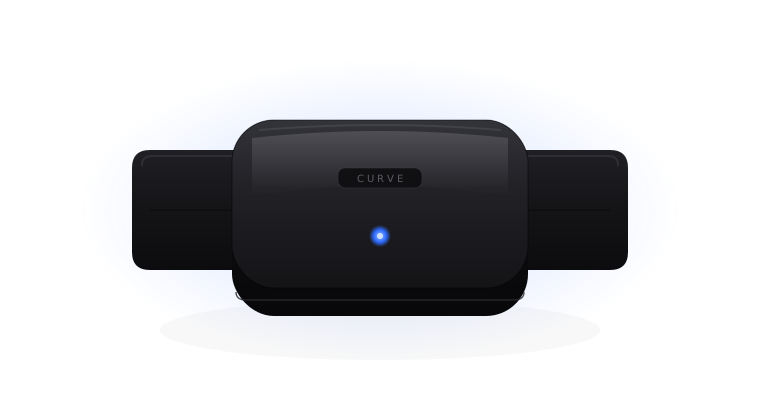
It is a wrist band with a swappable biosensor, and it ships Q4 2026. The Curve is designed to read cortisol from the trace of sweat on your skin, continuously, with a sensor that lasts 14 days and snaps out for a fresh one. The band is $299 and refill the sensor plan is $14.99 a month billed annually ($17.99 month-to-month), or $34 for a one-time 4-pack.
Now the part we are contractually obliged to ourselves to say clearly. Nothing above is a shipping product. We have no accuracy figure to give you. The Curve has not been validated against a laboratory reference, so there is no number here to compare against a figure published for a device that thousands of people are already using. We have no customers, no reviews, and no field data, because the product is not out. A spot on the waitlist measures no cortisol.
What the Curve is designed to do that a cartridge cannot is not an accuracy claim at all. It is a sampling claim, and it is the entire reason the product exists. More on that below.
Is the Auromone Curve more accurate than the Hormometer?
We are not going to tell you that, and you should be suspicious of any comparison page that does. Here is the actual state of the evidence, laid side by side.
| Evidence | Eli Health Hormometer | Auromone Curve |
|---|---|---|
| Published figure | "97% accuracy, when benchmarked against a laboratory reference method" | None published. Not yet validated against a laboratory reference |
| Is the product shipping? | Yes. On sale now | No. Ships Q4 2026 |
| Real-world use behind the number | Yes, customers are using it | None. Zero units in the field |
| Third-party validation | None published. The 97% figure is stated by the company on its own product page; we could not find an independent or peer-reviewed study behind it | None published. No validation study has been run yet |
| Sample type's clinical track record | Saliva, an Endocrine Society first-line sample for Cushing's testing | Sweat, a newer medium with less clinical history behind it |
Read that table honestly and it says one thing: on accuracy evidence, they are ahead of us. They have a number attached to a product in people's hands. We have a number attached to a bench. Those are not the same kind of claim, and the fact that our figure sounds good does not close the gap. Until we publish third-party validation, weight theirs more heavily than ours. We will publish ours, and you are entitled to hold us to it.
Also worth knowing what an accuracy figure is and is not. It describes agreement between one measurement and another measurement. It says nothing about whether either device can tell you what your cortisol means, and neither one can. That is covered in what a "normal" cortisol number actually means.
What does a saliva test see, and what does a continuous sensor see?
This is the real difference between the two products, and it has nothing to do with which one is better built. Cortisol is not a level, it is a curve. It climbs sharply in the first half hour after you wake, falls across the day, bottoms out around midnight, and jumps in response to whatever happens to you in between. Any measurement is a sample of that curve, and the two products sample it very differently.
| Eli Health Hormometer | Auromone Curve | |
|---|---|---|
| Sample | Saliva | Sweat |
| Form | Single-use cartridge, read by your phone camera | Wrist band with a 14-day swappable sensor |
| When you get a reading | When you decide to run a test | Continuously, by design, without you doing anything |
| Readings per day | As many as you run. Plans are sold at 4, 8 or 12 tests per month | Designed to read continuously |
| Time to a result | 20 minutes | Live on the band |
| Readings while you sleep | Only if you wake up and test | Designed to keep reading through the night |
| What you buy | Tests, bought in packs and used one at a time | A band once, then sensors that each read for 14 days |
| Availability | Now | Q4 2026 |
| Other hormones | Progesterone and testosterone listed as coming soon | Sensors for other hormone families planned |
| Regulatory status | Wellness device. Not for diagnosing any condition | General wellness device. Not for diagnosing any condition |
Neither column is the right answer. They are different instruments. A test you run on purpose, twice a day, at times you choose, gives you clean, deliberate points and a per-test cost you can control, and it does that today. A sensor you forget you are wearing gives you the shape between the points, including the hours you were asleep or in a meeting or on a plane, and it does that in Q4 2026 at the earliest.
Everything a wearable other than these two claims about cortisol is a third thing entirely, and mostly it is a guess from your pulse. We took that apart in whether the Apple Watch, Oura or Whoop measure cortisol, and the short version is that they do not. Eli Health and Auromone are, as of July 2026, the two consumer products that read the molecule.
Should I buy the Hormometer or wait for the Curve?
A comparison page that answers this with "ours" is not a comparison page. Here is the honest routing.
| If this is you | What to do |
|---|---|
| You want a cortisol number in the next 20 minutes, or this month | Buy the Hormometer. There is no honest way for us to be the answer to this. We do not ship until Q4 2026 |
| You want to run a defined experiment: 2 tests a day for 4 weeks, before and after a change | The Hormometer suits this well. Deliberate sampling at times you choose, with a cost you can cap |
| You want what happened between the tests, including overnight | That is what the Curve is designed for. It is also the thing it cannot do yet, because it is not out |
| You do not want a test to be a task you have to remember | Join the waitlist and use something else in the meantime. Joining the waitlist is free |
| You are worried something is medically wrong | Neither. See a doctor. Read the section at the top of this page first |
| You want the cheapest possible single cortisol reading | Ask your doctor for a lab test, or compare the at-home options. Neither of these products is the cheapest way to get one number |
Nothing stops you from doing both, and if you are the kind of person who reads a page like this, you probably will. If you want the wider landscape first, including mail-in kits and lab draws, start with what an at-home cortisol test can and cannot tell you, or with Cortisol 101 if you want the hormone itself explained before you spend anything.
What we are not going to do on this page
We are not going to tell you their product is inaccurate, because we have no evidence that it is, and they publish an accuracy figure that says it is not. We are not going to tell you saliva is the wrong sample, because endocrinology uses it. We are not going to tell you a continuous curve would have shown you something a saliva test missed, because that is a claim about your body that neither we nor they are permitted to make, and we would not know whether it was true.
What we will say is the thing that is actually true: they built a good product and it is on sale, and ours is not. That is the state of play in July 2026, and if it changes, it changes because we ship, not because we wrote something clever about a competitor.
This guide is for general wellness education only. The Auromone Curve is a general wellness device, not a diagnostic, and it does not replace clinical testing or medical advice. The Eli Health Hormometer is described by its maker as a wellness device that is not intended to diagnose, treat, cure, prevent or manage any disease. All Eli Health figures are quoted from eli.health as retrieved on 13 July 2026 and may change. Please talk to a healthcare provider about anything that worries you.
References
- Eli Health. Hormometer: Instant Cortisol Monitoring System. (Source for the 3-step flow, 20-minute result, the "97% accuracy, when benchmarked against a laboratory reference method" figure, the 24-test / 48-test plan pricing, and the wellness-device disclaimer naming Addison's disease and Cushing's syndrome.)
- Eli Health. Science. (Source for "The Eli Cortisol Hormometer is a wellness product and is not a substitute for laboratory or clinical testing.")
- Eli Health. First Instant Hormone Monitoring System. (Source for cortisol on sale, progesterone and testosterone listed as coming soon.)
- BetaKit. Eli Health closes $17-million CAD Series A to fuel launch of hormone-monitoring tech. 2025. (Source for Montréal, 2019 founding, and the founders.)
- Nieman LK, et al. The Diagnosis of Cushing's Syndrome: An Endocrine Society Clinical Practice Guideline. JCEM. (Source for late-night salivary cortisol as a first-line test, and for the recommendation of further evaluation by an endocrinologist when results are normal but suspicion is high, including suspected cyclic hypercortisolism.)
- StatPearls (NCBI Bookshelf). Adrenal Crisis. (Source for the presentation, for gastrointestinal and flu-like illness as the most common precipitating cause, for 100 mg hydrocortisone IV or IM in adults, for never delaying treatment to obtain blood work, for doubling or tripling the daily oral glucocorticoid dose during acute illness, and for the contents of an emergency kit.)
- StatPearls (NCBI Bookshelf). Corticosteroid Adverse Effects. (Source for corticosteroids blunting the inflammatory and febrile response and masking the signs of infection.)
- NIDDK, National Institutes of Health. Adrenal Insufficiency & Addison's Disease: Symptoms & Causes. (Source for the symptom list, the skin darkening, and for symptoms sometimes appearing for the first time during an adrenal crisis.)
- NIDDK, National Institutes of Health. Adrenal Insufficiency & Addison's Disease: Definition & Facts. (Source for the adrenal-crisis emergency symptoms, and for "If not treated right away, adrenal crisis can cause death.")
- StatPearls (NCBI Bookshelf). Adrenal Insufficiency. (Source for hyperpigmentation and salt craving belonging to primary adrenal insufficiency, and for preserved mineralocorticoid function in secondary adrenal insufficiency.)