Before the debunk: the part of this that can actually hurt you
The usual criticism of a cortisol detox is that it is a waste of money. That criticism is too gentle, and it stops one step short of the thing that sends people to hospital.
Supplements sold for "adrenal support" or "adrenal fatigue" can contain real hormones. The Endocrine Society states that although these products are "frequently marketed as completely safe and hormone free, many of these supplements do contain unknown amounts of active hormones." It goes on: "If you take adrenal hormone supplements when you don't need them, your adrenal glands may stop working and become unable to make the hormones you need when you are under physical stress," and "when these supplements are stopped, a person's adrenal glands can remain 'asleep' for months." People in that state, it says, "may be in danger of developing a life-threatening condition called adrenal crisis."
This is measured, not theoretical. When researchers bought 12 over-the-counter adrenal support supplements and assayed them (Akturk et al., Mayo Clinic Proceedings, 2018), every single one contained detectable thyroid hormone (triiodothyronine, 63 to 394.9 ng per tablet). 42% contained pregnenolone. 25% contained budesonide, a corticosteroid. 8% contained cortisol itself. None of the labels declared any of it.
If you are already taking one of these, do not stop it abruptly on your own. That is the trap this warning creates, and it needs closing. If a product has quietly been suppressing your adrenal glands, a sudden stop is one of the situations that can precipitate a crisis. Take the bottle to a doctor or a pharmacist, show them the label, and let them tell you how to come off it.
What an adrenal crisis looks like, and why it gets missed
An adrenal crisis is a medical emergency. Per StatPearls, it presents with:
- Vomiting, diarrhea, nausea, abdominal or back pain
- Severe weakness and fatigue, dizziness or fainting from low blood pressure
- Confusion or reduced consciousness, progressing to shock
- Fever, which can be high
- Low blood sugar, meaning shakiness, sweating and confusion, and low blood pressure that does not come back up with fluids alone
Read that list again: it is a stomach bug. And gastrointestinal and flu-like illness is the most common trigger of an adrenal crisis, so it arrives at exactly the moment a stomach bug is the most plausible explanation. This is how people stay home.
Two things a red flag will not do for you. Fever may be present, and it is not required. Its absence rules nothing out. And a crisis is not only an escalation in someone already diagnosed: StatPearls notes it is the initial presentation in roughly 50% of people diagnosed with Addison's disease. Never having been told you have an adrenal problem is not protection.
The exit, and this is the part that matters. If you are vomiting, you cannot rely on a swallowed tablet. It may not be absorbed at all. An adrenal crisis is treated with injected hydrocortisone and intravenous fluids, and clinical guidance for people at risk is explicit that persistent vomiting means an injection, not a pill (Rushworth, Torpy & Falhammar, 2019). Call emergency services. Say the words: "this could be an adrenal crisis, I may need hydrocortisone." Bring the supplement bottle with you.
Does a cortisol detox actually work?
No, and the framing is wrong before you even get to the evidence. A detox implies a toxin. Cortisol is not a toxin. It is a hormone you need to be alive, and your body clears it continuously without any help from a protocol.
On the evidence itself: the most-cited review of the category, Klein and Kiat's critical review in the Journal of Human Nutrition and Dietetics (2015), found that "no randomised controlled trials have been conducted to assess the effectiveness of commercial detox diets in humans." Not weak trials. None. That is a review of detox diets generally. For cortisol specifically, there is no research showing that a cleanse, a reset or a cortisol-lowering diet meaningfully lowers the hormone.
| What the protocol claims | What the evidence shows | |
|---|---|---|
| Cortisol is "built up" and must be flushed | Yes, over months of stress | Cortisol is metabolised and cleared continuously. It does not accumulate like a toxin |
| A 7-day reset lowers cortisol | Yes, measurably | No trial shows this. There are no randomised controlled trials of commercial detox diets in humans at all |
| A cortisol cocktail supports your adrenals | Yes | Cleveland Clinic: no evidence, beyond what a healthy diet already provides |
| "Adrenal fatigue" is what you have | Yes, and this fixes it | The Endocrine Society says adrenal fatigue is not a real diagnosis, and that there is no test for it |
| It is at worst harmless | Yes | No. See the warning above. Hormones have been found in unlabelled products |
What is in a cortisol cocktail, and does it lower cortisol?
There is no evidence that it lowers cortisol. The cortisol cocktail, also marketed as an adrenal cocktail, is a non-alcoholic drink built from a short list of grocery items. Cleveland Clinic is direct about it: "there's no evidence that these cocktails nourish or support the adrenal glands, beyond what a healthy diet provides," and no evidence they reduce cortisol, help with weight, or raise energy.
The ingredients are not fake. They are just doing something much smaller than the label on the trend.
| Ingredient | What it actually is | What it does not do |
|---|---|---|
| Orange juice | Sugar, water, vitamin C | No evidence it lowers cortisol. Cleveland Clinic flags the sugar load for people with diabetes |
| Coconut water | A potassium-containing drink | Nothing adrenal-specific. It is hydration |
| Sea salt or pink salt | Sodium chloride, chemically the same as table salt | Does not "support" an adrenal gland. Cleveland Clinic: the extra sodium "isn't necessary for the average person" |
| Magnesium powder | A mineral supplement, added in some recipes | Not a cortisol treatment. See what the research says about cortisol supplements |
| Cream of tartar | Potassium bitartrate. About 20% potassium by weight | The one ingredient with a documented capacity to do harm. See below |
For scale on the salt: the American Heart Association puts the body's actual sodium requirement at less than 500 mg a day. A quarter teaspoon of salt, roughly what a cocktail recipe calls for, is about 575 mg of sodium on its own, already more than a day's requirement. The AHA also reports that Americans average more than 3,100 mg a day already, against a recommended ceiling of 2,300 mg and an ideal of 1,500 mg. Most people adding salt to a glass of juice each morning are not correcting a deficit.
Is the cortisol cocktail safe to drink every day?
Not for everyone, and "I feel fine" is not the test. This is the section most articles skip, because the drink looks like breakfast. Start with what the drink actually is: a potassium load. Eight ounces of orange juice carries roughly 450 to 500 mg of potassium, and eight ounces of coconut water roughly 400 to 600 mg, so a plain cocktail with no cream of tartar in it is already about a gram of potassium, every morning. The National Kidney Foundation counts anything above 200 mg a serving as a high-potassium food. Leaving out the cream of tartar does not make this a low-potassium drink.
- Undiagnosed adrenal insufficiency, which is to say the exact person this drink is sold to. Primary adrenal insufficiency (Addison's disease) means too little aldosterone, and too little aldosterone means the kidneys hold on to potassium and lose sodium. Those people are already prone to high potassium and low sodium (StatPearls; Merck Manual), and high potassium in that setting can cause a fatal arrhythmia. Now read the cautions below and notice who walks straight through them: someone with untreated Addison's has low blood pressure, no diabetes, no kidney diagnosis, and a powerful craving for salt. They pass every filter, and this is the worst drink on the shelf for them. If you crave salt, go light-headed on standing, and are exhausted, the move is a blood test, not a cocktail. And the reverse trap, for the reader this page is really written for: if you have been taking an "adrenal" supplement or any steroid, you can have adrenal insufficiency with none of those signs, meaning no salt craving, no skin darkening, normal potassium, and still be at risk of a crisis. Absence of the signs is not absence of the disease.
- Kidney disease. Cleveland Clinic advises caution for people with chronic kidney disease, kidney failure or on dialysis, because the drink's potassium load can cause harm. Here is why "I feel fine" fails as a screen: NIDDK reports that CKD affects more than 1 in 7 US adults and that "as many as 9 in 10 adults who have CKD are not aware they have the disease," because early kidney disease usually has no symptoms.
- Cream of tartar, specifically. Potassium bitartrate is roughly 20% potassium. In a case series in the Journal of Medical Toxicology, two people who drank about 6 tablespoons of it to "clean themselves out" arrived with serum potassium of 8.5 and 8.7 mmol/L (normal is 3.5 to 5.1), peaked T waves on their ECGs, vomiting and muscle weakness. Both survived with emergency treatment. A 2025 case report in the Medical Journal of Australia describes a hyperkalemic cardiac arrest after cream of tartar ingestion. Those were large doses, far more than a cocktail, and if your kidneys are healthy and you take no medication, a pinch is not going to stop your heart. That sentence has conditions attached, and the conditions are the entire point. The authors of the case series name people with mild to moderate kidney impairment, and people on drugs that raise potassium, meaning potassium-sparing diuretics such as spironolactone, and ACE inhibitors (and, by the same mechanism, ARBs), as the people who get into trouble at doses that would do nothing to anyone else. This is a potassium salt, not a seasoning. And note what happened in the 2025 Australian case: six hours after ingestion her vital signs and ECG were still normal, shortly before she went into cardiac arrest. You cannot feel your potassium either.
- Diabetes or blood-sugar concerns. Cleveland Clinic flags the sugar in the juice, which arrives without the fibre or protein that would blunt it.
- High blood pressure, and the obvious hazard here is not the dangerous one. Yes, a daily added dose of sodium is the opposite of the advice most people with hypertension are given. The potassium is the part that can hurt you. ACE inhibitors (ramipril, lisinopril, perindopril, enalapril), ARBs (losartan, valsartan, irbesartan), spironolactone and other potassium-sparing diuretics raise your potassium by themselves, and the authors of the cream-of-tartar case series name these drugs, alongside mild-to-moderate kidney impairment, as what turns an ordinary potassium dose into an emergency. If you take anything for blood pressure or heart failure, do not make this a daily drink without asking a pharmacist first.
What to do with that: if you have kidney disease or high blood pressure, or you take any blood-pressure medicine, a diuretic, or anything your pharmacist can tell you raises potassium, ask before you make this a daily habit, and mention the cream of tartar by name. It takes one question at a pharmacy counter, and the answer may be a potassium blood test rather than a simple no.
And if you are already drinking one every day, here is the exit, because "ask a pharmacist" is not an exit for someone who is already unwell. High potassium is usually silent until it is not, so do not wait to feel worse. Stop the drink and ask for an urgent potassium blood test if you notice muscle weakness or heavy legs, cramps, tingling or numbness, nausea, or a slow, skipping or fluttering heartbeat. If you have palpitations, a very slow pulse, weakness that is spreading, or you feel faint, call emergency services and say you may have high potassium. A normal-feeling day, and even a normal ECG, does not mean your potassium is normal.
What is actually inside an "adrenal support" supplement?
This is the section the drink recipes are a gateway to, and it is where the money and the risk both live.
Start with the regulatory reality, in the Endocrine Society's own words: "The U.S. Food and Drug Administration does not oversee nutritional supplements and vitamins. This means there is no guarantee that what's on the label of a supplement is really what's inside the bottle."
Then look inside the bottle. Akturk and colleagues bought 12 over-the-counter adrenal support supplements and measured what was in them (Mayo Clinic Proceedings, 2018):
| Hormone found | In how many of the 12 | Amount per tablet |
|---|---|---|
| Triiodothyronine (T3, a thyroid hormone) | All of them | 63 to 394.9 ng |
| Pregnenolone (a steroid precursor) | 42% | 66.12 to 205.2 ng |
| Budesonide (a corticosteroid) | 25% | 119.5 to 610 ng |
| Androstenedione | 17% | 1.27 to 7.25 ng |
| 17-hydroxyprogesterone | 8% | 30.09 ng |
| Cortisone | 8% | 79.66 ng |
| Cortisol | 8% | 138.5 ng |
None of the labels declared that any of these were present. The authors' conclusion is that all the supplements studied contained a small amount of thyroid hormone and most contained at least one steroid hormone.
So the mechanism of harm is not exotic. A person who believes their cortisol is too high buys a product to lower it, and the product turns out to contain steroid hormone they never agreed to take. Be precise about what this study does and does not show: the per-tablet amounts are small, and Akturk's team did not demonstrate that these particular tablets suppressed anyone's adrenal glands. What they demonstrated is that the label tells you nothing and the dose is unknowable, and unknowable is the hazard, because these products are unstandardised and the next bottle is not this bottle. The Endocrine Society's warning is about the category: adrenal glands that receive a hormone supply from outside wind down. That warning about glands that stay "asleep" for months after stopping is describing exactly that, and it is the same physiology as coming off a course of prescribed steroids, minus the doctor, minus the taper, and minus anyone knowing it is happening.
The symptoms you are trying to fix may not be cortisol
People do not buy a cortisol detox at random. They buy it because they are tired, wired, gaining or losing weight, sleeping badly, craving salt, or getting dizzy when they stand up. Those symptoms are real. They are also the presenting symptoms of several conditions that a drink will not touch, and the Endocrine Society names three of them by name when it tells people to see a doctor instead: adrenal insufficiency, depression, and obstructive sleep apnea.
| What you are trying to fix | What else does exactly this | The sign that changes the picture |
|---|---|---|
| Salt craving | Primary adrenal insufficiency (Addison's disease), per NIDDK | Darkening of the skin on scars, skin folds, pressure points, lips or gums. Nobody's stressful job does that. Its absence rules nothing out. Skin darkening happens only in primary adrenal insufficiency. In secondary adrenal insufficiency, "hyperpigmentation does not occur" (Merck Manual), and salt craving is usually absent too, because aldosterone is preserved |
| You have taken an "adrenal," "glandular" or thyroid supplement, or any steroid (tablet, inhaler, injection, joint shot, strong cream) in the past year | Secondary adrenal insufficiency, the state the Endocrine Society is describing when it says glands can stay "asleep" for months. It ends in adrenal crisis, and this is the exact person the box at the top of this page is about | There is no distinguishing sign. None. No skin darkening, no salt craving, normal potassium, and you can feel ordinary right up until a stomach bug. The only thing that finds it is a doctor and a blood test. Bring the bottle |
| Dizzy or faint on standing | Adrenal insufficiency, where NIDDK describes low blood pressure that drops further on standing | Fainting, or a drop that keeps getting worse |
| Exhaustion and weakness | Adrenal insufficiency, thyroid disease, sleep apnea, depression, anaemia | Weight loss and loss of appetite, which point away from the stress story, not toward it |
| Nausea, vomiting, abdominal pain | Adrenal crisis, at the emergency end. See the box at the top of this page | There is no safe filter in this row. Confusion, fainting, fever or a fast slide over hours all raise the alarm, but none of them is required, and confusion and fainting are late. Vomiting and weakness alone is enough. If you have taken a steroid or an "adrenal" supplement and you are vomiting, call emergency services now |
| Weight gain, puffiness, poor sleep | Cortisol excess is real but uncommon, and it is a clinical diagnosis. See what cortisol face actually is | Purple stretch marks, easy bruising, muscle weakness, new high blood pressure or diabetes |
No item in that middle column can be ruled in or out at home, and none of these can be ruled out by feeling reasonably well. NIDDK notes that adrenal insufficiency "comes on slowly over time" and is therefore "overlooked or confused with other illnesses." That is the whole problem with buying a solution before you have a question: the drink does not care what you actually have.
Who to see, and what to say
If the symptoms above have been going on for weeks, book a doctor rather than a cart. Say plainly: "I have been tired, dizzy on standing, and craving salt. I would like to rule out an adrenal or thyroid cause." Blood tests exist for all of it. There is no test for "adrenal fatigue," which the Endocrine Society states explicitly, and no home protocol substitutes for the tests that do exist.
Bring every bottle you are taking, including anything herbal or labelled adrenal, thyroid or glandular. Given what the assays found, the contents of your supplement cabinet are relevant clinical information, and your doctor cannot guess at it.
So what actually lowers cortisol?
Sleep, exercise, and reducing whatever is driving the stress response. None of them are sold in a bottle, which is precisely why they are not trending. The honest, unglamorous list is covered in how to lower cortisol, and the supplement-by-supplement evidence, including ashwagandha and magnesium, is in cortisol supplements.
There is also a prior question that the detox framing skips entirely. Lower is not automatically better. Cortisol is supposed to be high in the morning and low at night, and a flat curve is not a healthy one. What matters is the shape across the day, not a single number to be driven down. Cortisol 101 covers the daily rhythm, and cortisol and stress covers what actually moves it.
Why a drink can be sold as a cortisol fix at all
Here is the mechanism behind the trend, and it is not chemistry. You cannot feel cortisol move. There is no sensation attached to it, no readout, nothing to check. So a claim about it cannot be contradicted by your own experience, and a product that does nothing to it is indistinguishable from a product that does something. That is a hard market to be honest in, and it is why the "adrenal" shelf exists.
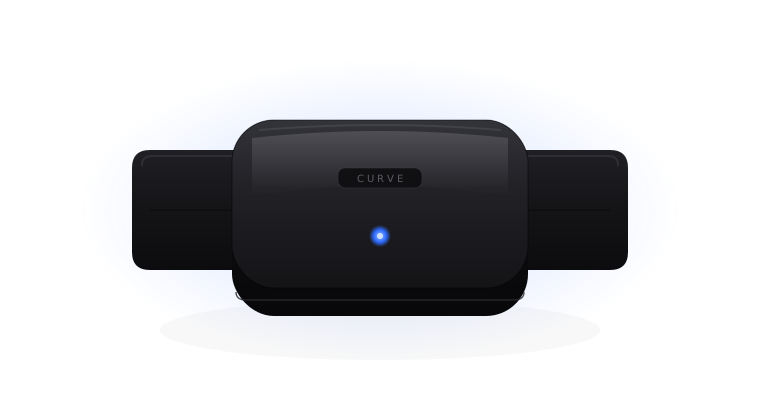
Cortisol itself can be measured, and where it matters, that measurement is a clinician's: a blood, saliva or urine test, ordered because someone asked a clinical question. The Auromone Curve is not that test and does not fill that gap. It is a wellness product, designed to read cortisol from a trace of sweat on your wrist and show you the shape of your own day. It ships Q4 2026.
To be exact about what that is not: it is not a test, it cannot detect or rule out any condition on this page, it cannot tell you whether a supplement is safe, and it will not tell you what your number means about you. Adrenal insufficiency and cortisol excess are diagnosed by clinicians with proper lab testing, never by a wearable, including ours. What the Curve is for is seeing your own pattern. That is all, and it is enough.
This guide is for general wellness education only. The Auromone Curve is a general wellness device, not a diagnostic, and does not replace medical advice or clinical testing. Do not start or stop any supplement or medication based on this page. Please talk to a healthcare provider.
References
- Endocrine Society. Adrenal Fatigue. (Source for the supplement warning, the "asleep for months" quote, the adrenal-crisis risk, the FDA-oversight quote, and the advice to be assessed for adrenal insufficiency, depression and obstructive sleep apnea.)
- Akturk HK, Chindris AM, Hines JM, Singh RJ, Bernet VJ. Over-the-Counter "Adrenal Support" Supplements Contain Thyroid and Steroid-Based Adrenal Hormones. Mayo Clinic Proceedings, 2018. (Source for all per-tablet hormone figures.)
- Klein AV, Kiat H. Detox diets for toxin elimination and weight management: a critical review of the evidence. Journal of Human Nutrition and Dietetics, 2015. (Source for "no randomised controlled trials ... in humans".)
- Cleveland Clinic. Cortisol Cocktail: What Is It and Does It Work? (Source for the ingredients, the absence of evidence, and the kidney-disease, diabetes and sodium cautions.)
- Rusyniak DE, Durant PJ, Mowry JB, et al. Life-Threatening Hyperkalemia from Cream of Tartar Ingestion. Journal of Medical Toxicology, 2013. (Source for the 6 tablespoons, the 8.5 and 8.7 mmol/L potassium values, and the risk in mild to moderate renal insufficiency or on drugs that raise potassium, which the authors name as potassium-sparing diuretics and angiotensin-converting-enzyme inhibitors.)
- Ng J, et al. Hyperkalaemic cardiac arrest due to cream of tartar ingestion. Medical Journal of Australia, 2025.
- StatPearls (NCBI Bookshelf). Adrenal Crisis. (Source for the crisis presentation, the finding that gastrointestinal and flu-like illness is the most common trigger, and that crisis is the initial presentation in about 50% of people diagnosed with Addison's disease.)
- Rushworth RL, Torpy DJ, Falhammar H. Adrenal crisis: prevention and management in adult patients. Therapeutic Advances in Endocrinology and Metabolism, 2019. (Source for the rule that persistent vomiting requires injected, not oral, glucocorticoid.)
- NIDDK, National Institutes of Health. Adrenal Insufficiency & Addison's Disease: Symptoms & Causes. (Source for salt craving, postural low blood pressure, skin darkening, and that symptoms come on slowly and are easily confused with other illnesses.)
- Merck Manual (Professional Edition). Secondary Adrenal Insufficiency. (Source for the fact that hyperpigmentation does not occur in secondary adrenal insufficiency, that electrolytes are relatively normal, and that aldosterone production is preserved.)
- NIDDK, National Institutes of Health. Kidney Disease Statistics for the United States. (Source for "more than 1 in 7 U.S. adults" and "as many as 9 in 10 adults who have CKD are not aware they have the disease".)
- American Heart Association. How much sodium should I eat per day? (Source for the 500 mg requirement, the 2,300 mg ceiling, the 1,500 mg ideal, and the average intake.)