Is "cortisol face" real?
Not as it is described online. "Cortisol face" is a social-media term, not a medical one. There is no diagnostic criterion for it, no test for it, and no clinical literature on it. The specific claim that circulates, that ordinary work stress makes your face puffy and round, is not supported.
What makes the term sticky is that it braids together one true thing and one false one, then sells you a supplement for the false one.
| The claim online | What is actually true | |
|---|---|---|
| Can cortisol change your face? | Yes, and yours has changed | Yes, but only at sustained pathological levels, which is a medical condition, not a hard week |
| Does work stress do it? | Yes | No. Everyday stress does not deposit fat in your cheeks |
| Is there a name for the real thing? | "Cortisol face" | Moon face, and it is diagnosed by a doctor |
| Can a supplement fix it? | Yes, this one | No. If the cause is real, the treatment is medical |
| Is your morning puffiness this? | Yes | Almost certainly not. See below |
What is moon face, then?
Moon face is real, and it is worth knowing about properly. Cleveland Clinic describes it as fat deposits building up along the sides of the face, causing severe swelling. It has a small number of recognized causes:
- Corticosteroid medication. Cleveland Clinic calls steroids such as prednisone one of the most common causes. The effect depends on dose and duration, so it builds up over sustained treatment rather than appearing after a short course.
- Cushing's syndrome, which is what sustained cortisol excess is called whatever its source. This is a point the internet consistently gets wrong: steroid medication does not sit alongside Cushing's syndrome, it is the most common cause of it. Cortisol excess produced by the body itself, usually from a tumour, is the rarer form. If you take long-term steroids, Cushing's is not a separate thing that happens to other people.
- Hypothyroidism, an underactive thyroid. This causes a different kind of facial swelling called myxedema, in which substances build up in the skin and bind water, giving a characteristic puffy, non-pitting look around the eyes. It usually comes with other clues: fatigue, feeling cold, weight gain, constipation, dry skin, and hair thinning. It is easy to miss, it is diagnosed with a simple blood test, and it is very treatable, which is exactly why guessing at home is a poor strategy.
Note what is not on that list: having a demanding job. The cortisol elevations that come with ordinary psychological stress are not in the same territory as the sustained excess that reshapes facial fat.
There is one honest exception, and it matters. A separate condition, sometimes called non-neoplastic hypercortisolism, is recognized in endocrinology: major depression, heavy or chronic alcohol use, and poorly controlled diabetes can produce genuinely raised cortisol and cushingoid features. This is not "a stressful week at work." It is a real medical picture, and it is a reason to talk to a doctor rather than to a comment section. If you are drinking heavily, that belongs in the conversation.
The good news, and it rarely survives the trip to social media: moon face usually improves once the underlying cause is identified and treated, typically over a period of months. It is slower and less complete after prolonged high-dose steroid use, so this is a reason to see a doctor early rather than a reason to relax.
This is a doctor's job, not a wearable's
Moon face, Cushing's syndrome and hypothyroidism are diagnosed by clinicians using proper testing. They are never diagnosed from a symptom list, a mirror, an app, or a wearable, including ours. Nothing on this page is a diagnosis, and the Auromone Curve cannot give you one.
See a healthcare provider if your face has changed persistently over weeks or months, rather than puffing up overnight and settling, and especially if it comes with weight gain concentrated around the middle, skin that bruises easily, purple stretch marks, or muscle weakness. If you take long-term steroid medication, raise it with the doctor who prescribed it, and never stop or reduce a steroid on your own.
Why is my face puffy in the morning?
First, the swelling that is not a search-engine question
Most facial puffiness is harmless. A small amount is not, and it is worth thirty seconds of your attention before you read anything else.
Call emergency services if facial swelling comes with any of:
- Swelling of the lips, tongue, mouth or throat
- Difficulty breathing or swallowing, or a change in your voice
- Swelling that is sudden and rapidly getting worse
That is an allergic reaction or angioedema until proven otherwise, and it is an airway emergency. It can also be a reaction to blood-pressure medication (ACE inhibitors, such as ramipril or lisinopril), and it can start months or years after you began the drug.
See a doctor promptly, today, if the swelling is: on one side only, hot, red, painful, or comes with a fever, which can mean an infection such as cellulitis or a dental abscess. Or if it comes with frothy urine, swollen legs or ankles, or breathlessness, which can point to the kidneys or the heart.
If you are pregnant, sudden swelling of the face and hands is a warning sign of preeclampsia. Contact your maternity care provider the same day. Do not wait, and do not let this page or any other reassure you.
With that said: most morning puffiness is simply because you were lying down. Fluid redistributes toward your face overnight and drains once you are upright and moving, which is why ordinary morning puffiness settles within a few hours. That one mechanism explains most of what sends people searching for this term.
The things that make it more pronounced are mundane, and none of them are a hormone reshaping your face:
| What actually puffs a face | Why |
|---|---|
| Sleeping flat | Fluid pools in the face and around the eyes overnight, then drains once you are upright |
| Salt | A high-sodium meal makes the body hold on to water |
| Alcohol | Disrupts fluid balance and wrecks the sleep that would have cleared the puffiness. Worth flagging: heavy or chronic drinking is a different matter, and can genuinely raise cortisol. See below |
| Allergies and sinus congestion | Overnight exposure to allergens causes real facial swelling. If it involves the lips, tongue or throat, or any breathing difficulty, treat it as an emergency (see above) |
| The menstrual cycle | Normal fluid retention across the cycle. Pregnancy is not on this list, because sudden facial swelling in pregnancy needs a doctor, not a table |
| Poor sleep | Compounds most of the above, and is the one people most reliably underestimate |
Why we are not going to give you a simple "when to relax" rule
The obvious thing for an article like this to say is that puffiness which arrives overnight and clears by mid-morning is nothing to worry about. We are not going to say that, because it is not safe.
Facial swelling that is worst on waking and settles through the day is exactly how kidney problems such as nephrotic syndrome can present, and it is how a serious chest condition called superior vena cava syndrome can present too. They use the same lying-down mechanism as harmless puffiness, which is precisely what makes them easy to dismiss. The medical literature notes that this is routinely misread as a cold or allergies.
So the honest rule is not "if it goes away by lunchtime you are fine." The honest rule is: a face that keeps doing this, day after day, or that changes over weeks and months, or that comes with any of the red flags above, is a question for a doctor and not for the internet.
Does stress do anything to your face at all?
Indirectly, and modestly. This is the honest middle ground that neither the trend nor its debunkers usually bother with.
Stress does not deposit fat in your cheeks. What it does is quietly degrade every single item in the table above. A stressful month is a month of worse sleep, more alcohol, more salt, more takeaway, and more inflammation. The face you see at the end of it is the sum of those, and they are all real. It just is not the mechanism you were sold, and the fix is not a supplement.
There is also a real cortisol story underneath, and it is a more interesting one than the puffiness: chronic stress genuinely changes the shape of your daily cortisol rhythm, and that rhythm influences your sleep, your energy, and where your body stores fat. That is covered in cortisol and weight and in cortisol and sleep. It is a slower, less photogenic story than a puffy face, and it happens to be the true one.
What you can actually see
The reason a term like "cortisol face" spreads is that people want a visible sign of something they cannot otherwise observe. That instinct is sound. The face was just never a good instrument.
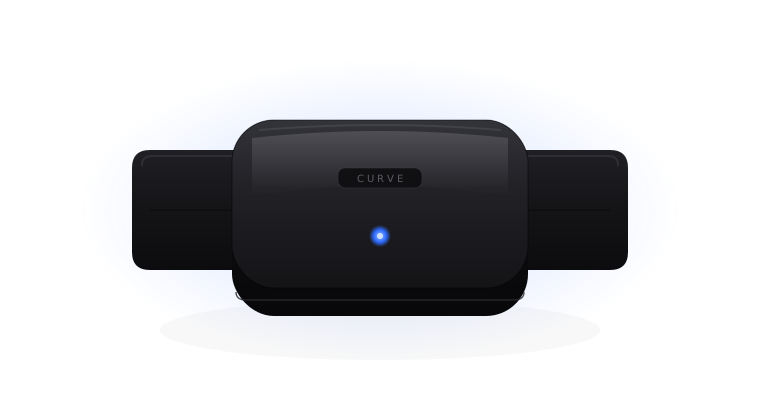
Cortisol itself can be measured. The Auromone Curve is designed to read cortisol from a trace of sweat on your wrist, continuously, so instead of interrogating your reflection you can see your own daily rhythm as it actually moves. It ships Q4 2026.
To be completely clear about what that is not: it will not tell you why your face is puffy, it cannot detect or rule out any of the conditions on this page, and it is not a screening test. Clinicians assess cortisol excess with specific tests, and a wellness reading is not one of them and cannot be compared to one. What the Curve replaces is the guessing about your own daily pattern, and nothing more. For the full picture of what cortisol is and how it is measured, start with Cortisol 101, or see the signs people associate with high cortisol and where those signs actually come from. If you arrived here from a related term, adrenal fatigue gets the same treatment.
This guide is for general wellness education only. The Auromone Curve is a general wellness device, not a diagnostic, and does not replace medical advice. Persistent changes to your face deserve a proper medical assessment. Please talk to a healthcare provider.
References
- Cleveland Clinic. Moon Face: Causes & Treatment.
- MedlinePlus, U.S. National Library of Medicine. Face swelling. (Source for the red flags: sudden, painful or severe swelling, breathing difficulty, and fever or redness suggesting infection.)
- StatPearls (NCBI Bookshelf). Cushing Syndrome. (Iatrogenic corticosteroid use is the most common cause of cushingoid features.)
- Merck Manual, Professional Edition. Angioedema. (Including ACE-inhibitor angioedema, which can begin months or years after starting the drug.)
- Mayo Clinic. Preeclampsia: symptoms and causes. (Sudden swelling of the face and hands is a warning sign.)
- Medical News Today. Puffy face in the morning: causes, treatments, and prevention.
- Cleveland Clinic. Superior Vena Cava Syndrome.
- Endocrine Society / Journal of the Endocrine Society. Non-neoplastic hypercortisolism. (Depression, chronic heavy alcohol use and poorly controlled diabetes can produce cushingoid features.)