See the whole curve.
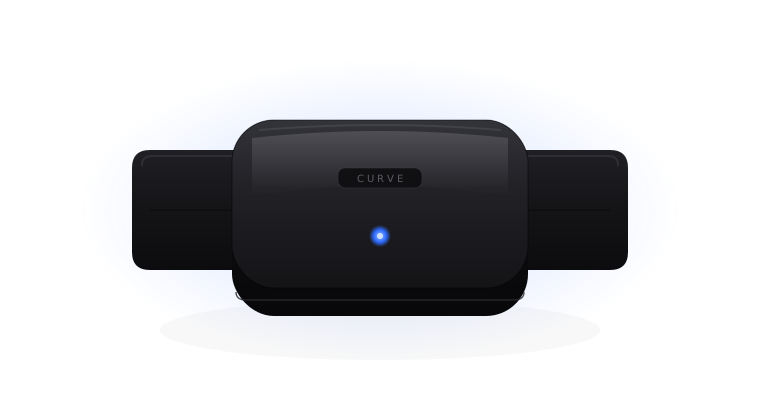
The Curve measures cortisol continuously, on your wrist, and exports the record. It ships Q4 2026, and reserving is free.
Home/Cortisol 101/Cortisol rhythm
Cortisol moves on a daily rhythm. A blood draw catches one point on it. The Curve measures continuously, for fourteen days at a time, so the shape of your own rhythm is something you can actually look at, and bring to the person who reads it with you.
Cortisol is highest in the morning and lowest late at night, and the path between those two points is the part a single draw cannot show. Fourteen days of continuous readings give you the shape, and how much it varies from one day to the next.
A reading every 2 minutes, day and night
Cortisol climbs sharply in the first 30 to 45 minutes after waking. That rise has a size and a shape, and both move day to day, which is exactly why one measurement of it is hard to read and a repeated one is easier.
Clinicians already sample both ends of the curve on purpose: a morning draw asks whether the peak is there, and a late-night sample asks whether the floor is there. Those are the two questions the tests are built around. What a timed sample cannot describe is the run of hours in between, or how much any of it moves from one day to the next.
Every reading is exportable. Fourteen days of your own rhythm is context a consultation does not usually have, and it is the kind of thing that is most useful in the room with someone qualified to interpret it, not instead of them.
Full export · yours to share
Cortisol conditions are genuinely difficult to pin down, and the tests that settle them are ordered and interpreted by a doctor. These explainers cover what those conditions are and how they are actually investigated. None of them is something this device assesses.
Adrenal insufficiency is uncommon, but when it tips into an adrenal crisis it is life-threatening, and it does not wait fourteen days for a record to build. You do not need a diagnosis for this to be about you, because a crisis can be how the condition first announces itself.
The trap: a crisis looks like a stomach bug. The most common trigger is an ordinary gastrointestinal or flu-like illness, and the crisis itself causes vomiting, diarrhea, weakness and abdominal pain. It also causes fever, which is the sign that breaks the misread. But a crisis without a fever is still a crisis, because steroid medication blunts the fever response, so the absence of a fever does not rule one out.
Alongside those: severe weakness, drowsiness or confusion; severe pain in the abdomen, lower back or legs; low blood sugar; collapse or dangerously low blood pressure.
If you take steroids by any route — tablets, inhaler, nasal spray, cream, or joint injection — and you are vomiting, you cannot absorb an oral tablet. Being unable to keep medication down is itself an emergency, not a reason to rest.
Call emergency services and say: “I think I may have adrenal insufficiency. I may need hydrocortisone.” Clinical guidance is explicit that treatment must not wait for test results. The full adrenal-crisis guidance →
This bears repeating, because it is the most important thing on the page. Continuous cortisol is a general wellness measurement. It is not a diagnostic test, and it cannot tell you whether something is wrong. Symptoms that persist, or that worry you, deserve a doctor’s assessment rather than a longer look at your own data.
Context, not a verdict. A timed blood draw is a precise measurement of one moment, and it is the measurement clinicians rely on for good reason. What it does not show is the rest of the day. Continuous readings show the shape of the rhythm and how much it moves day to day. That is information to bring to your doctor, not a second opinion on their result. If your symptoms have persisted despite a normal result, the next step is back to your doctor: a normal cortisol is a reason to widen the search, not to end it, and widening it is a clinician’s job, not a wearable’s.
No. It is a general wellness device and it does not diagnose or screen for anything. Cortisol conditions are identified with specific clinical tests, interpreted alongside symptoms and history by a doctor. If you think something is wrong, that is the route. How these conditions are actually investigated →
It is not a recognized medical diagnosis. A 2016 systematic review in BMC Endocrine Disorders examined 58 studies and found no substantiation that adrenal fatigue exists as a medical condition, and the Endocrine Society takes the same position. The exhaustion people describe under that label is real, and its cause is worth finding. Adrenal insufficiency is a separate condition entirely: it is real, it is diagnosable, and it needs a doctor. Why adrenal fatigue is not a diagnosis · what adrenal insufficiency is, and how it is actually diagnosed
Yes, and that is the situation it suits best. Every reading is exportable. Fourteen days of continuous measurement is context a fifteen-minute appointment does not usually have, though how much weight it carries is your clinician’s call, not ours.
Because it moves. Cortisol changes across the day on a rhythm, responds to stress within minutes, and varies between people, so a single value has to be interpreted against the time it was taken. That is what makes it difficult, and it is the reason a continuous record is a different kind of information from a single one.
The Curve measures cortisol continuously, on your wrist, and exports the record. It ships Q4 2026, and reserving is free.