Home/Cortisol 101/Cortisol for athletes
Hard efforts raise cortisol; easy ones do not. The Curve is a continuous cortisol monitor that measures the hormone directly, every two minutes, worn through every session and every rest day. Not estimated from your pulse.
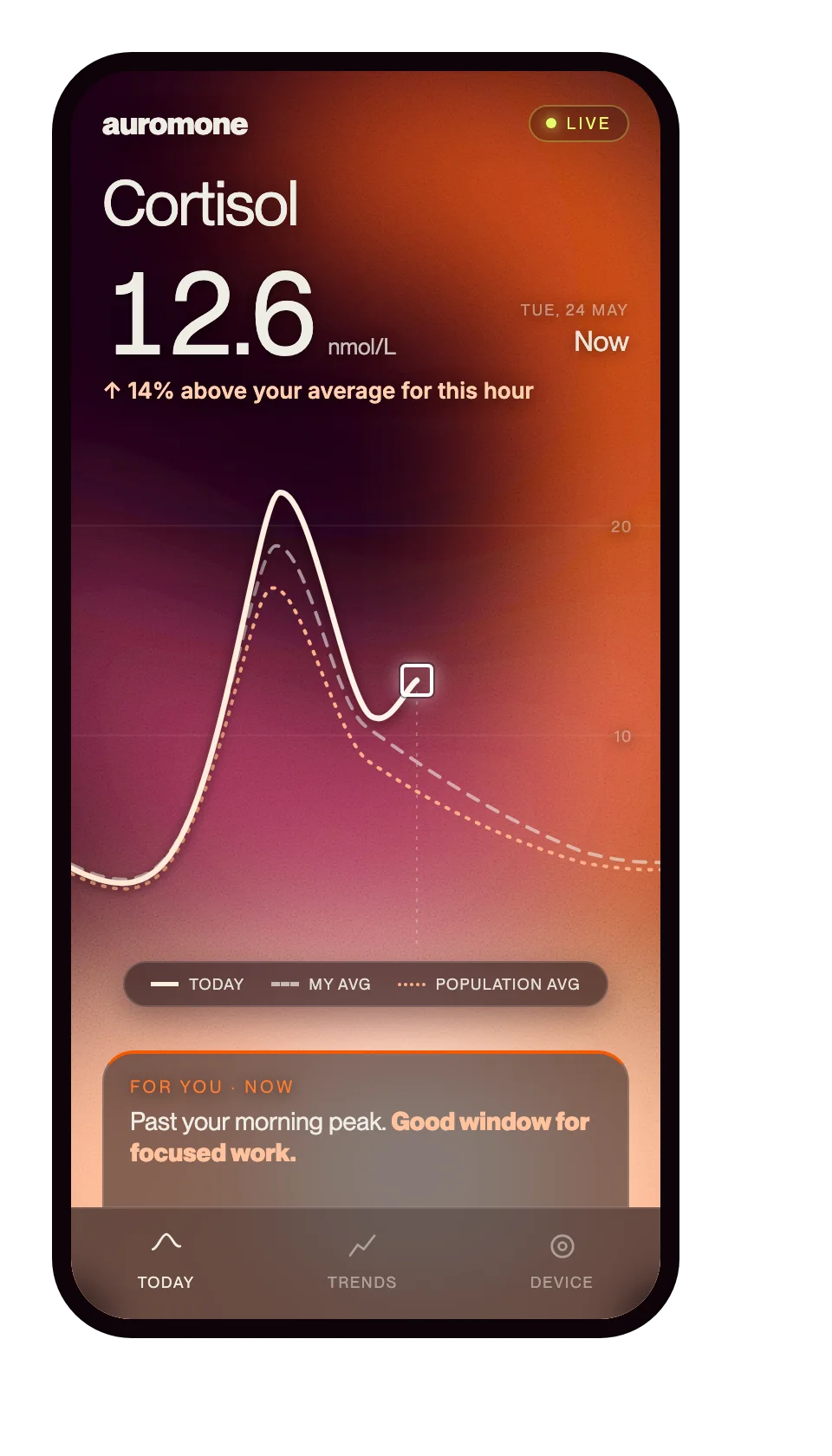
A hard effort raises cortisol while you are still cooling down. At a reading every two minutes you see the rise as it happens, instead of a number waiting for you the next morning.
A reading every 2 minutes · live in the app
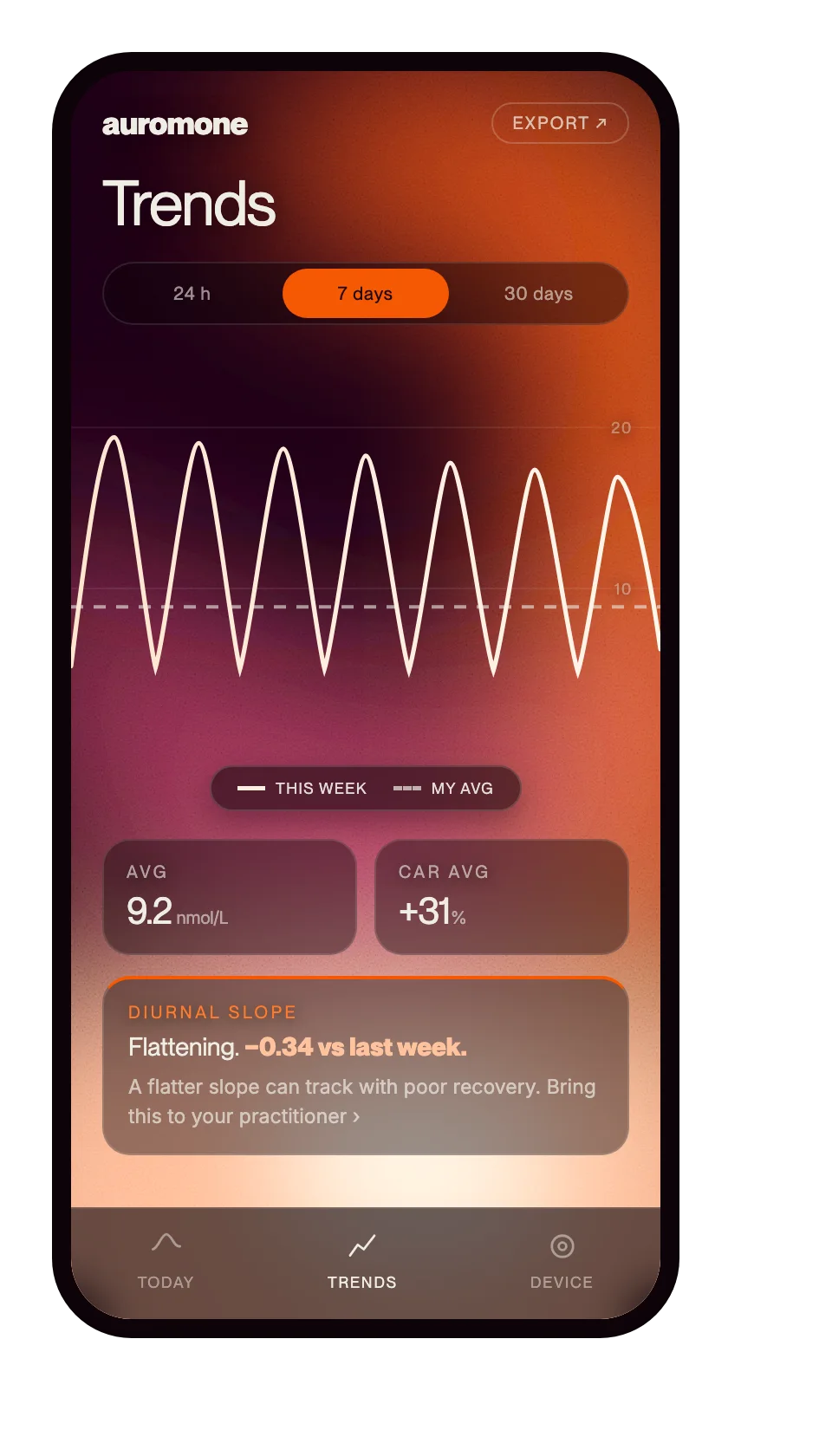
Cortisol varies widely between people, so a reference range tells you very little about you. Two weeks of continuous wear builds your own curve, and every reading after that is read against it.
Personal baseline · rolling 7-day trend
Travel, a short night, a hard week at work. Your body runs one stress axis, not two, and the hormone does not separate them. It is what makes a heavy week after an easy block finally make sense.
24-hour coverage · awake and asleep
Keep the tracker you already own. When your recovery score and your cortisol point the same way, the picture is simple. When they disagree, you are seeing something neither signal shows on its own.
Worn alongside the tracker you already own
The electrode card is the consumable. It lasts fourteen days and changes in seconds, so the band you buy once keeps working as the chemistry underneath it improves.
Sensors from CA$24 · subscribe and save
Your curve for the day, your rolling trend, and a plain export whenever you want it.
No single marker diagnoses overtraining, cortisol included. The ECSS and ACSM joint consensus statement reviewed the markers in use and found none of them meet all the criteria to be generally accepted; overtraining syndrome is diagnosed by exclusion, after organic disease has been ruled out. The Auromone Curve is a general wellness device: it monitors cortisol continuously, and it does not diagnose, treat, or cure any condition. Fatigue and falling performance that do not lift with rest deserve a doctor’s assessment before they get a training label. What to rule out first →
A recovery score is a model built mostly on heart-rate variability, which reflects autonomic tone. Cortisol is a different signal on a different axis. The two can point in opposite directions, and a morning where they disagree is usually the one worth paying attention to.
Only if you want a second, independent signal rather than a verdict. No single marker diagnoses overtraining, cortisol included, and the Curve does not either. What it adds is one objective input, measured rather than inferred, next to load, sleep and how you feel. More on cortisol and overtraining →
Yes. The Curve is worn on the wrist and is designed to sit alongside whatever you already use rather than replace it. Your existing device keeps measuring your heart; the Curve adds the hormone.
They are different samples. Blood carries total cortisol, most of it bound to proteins; sweat carries the free fraction, the portion that is biologically active. In bench testing, the Curve tracked a lab blood test to within about 8% over 14 days of continuous wear. Sweat is also the sample that can be read continuously, all day, without a blood draw. That is a different job from a lab test, not a replacement for one.
The testosterone to cortisol ratio is an established, and debated, marker in sports science. The Curve measures cortisol today. Testosterone sits on the sensor roadmap rather than in the product, so the ratio is not something the device reports yet.
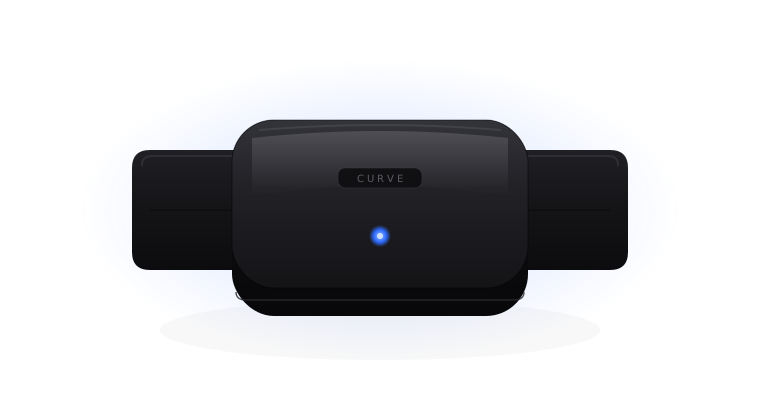
The Curve measures cortisol continuously, on your wrist, alongside whatever you already wear. It ships Q4 2026, and reserving is free.