Which hormones control sleep?
None of them controls sleep on its own. The clock that decides when you are sleepy sits in the brain, in the suprachiasmatic nuclei of the hypothalamus, and it is set by the light and dark cycle. Hormones are how that clock tells the rest of the body what time it is. In the words of one physiology review, melatonin's job is to convey information concerning the daily cycle of light and darkness to body structures.
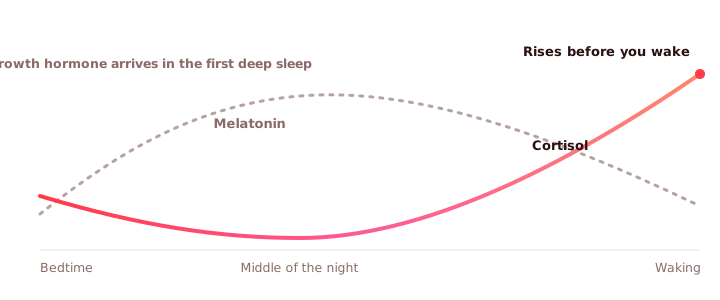
That distinction matters more than it sounds. Ask which hormone makes you sleep and you get a shopping list. Ask what each hormone is doing at 23:00, at 01:00 and at 05:00 and you get something closer to how a night actually works.
Here is the cast, in the order they appear.
| Hormone | When it moves across a night | What the research describes it doing |
|---|---|---|
| Melatonin | Rises after dark, stays up through the night, falls toward morning. | Carries the light and dark cycle to the rest of the body. Claustrat and Leston describe it as a biochemical signal of night. |
| Cortisol | Quiet from about 19:43, lowest at about 00:18, climbing again before you wake, peaking at about 08:32. | Timings from 33 healthy reference subjects sampled around the clock (Debono and colleagues, 2009). |
| Growth hormone | One large pulse shortly after sleep onset, tied to the first phase of slow-wave sleep. | In men, about 70% of the growth hormone pulses during sleep coincide with slow-wave sleep (Van Cauter and Plat, 1996). |
| Thyroid-stimulating hormone | A nocturnal surge around 02:00 to 04:00, with its low point during the day. | The single largest source of within-person variation in TSH, per a 2021 review in Frontiers in Endocrinology. |
| Ghrelin and leptin | Not timed to the night so much as changed by it. Two short nights are enough to shift both. | Leptin down 18%, ghrelin up 28% after 2 days of restricted sleep in 12 young men (Spiegel and colleagues, 2004). |
| Testosterone | Falls across the following day when sleep is cut short. | Daytime levels 10% to 15% lower after 8 nights of 5-hour bedtimes in 10 young men (Leproult and Van Cauter, 2011). |
| Estrogen and progesterone | Change across the menstrual cycle and the menopausal transition rather than within one night. | The luteal phase brings more sleep spindle activity, a flatter temperature rhythm and less REM sleep (Baker and Lee, 2018). |
Two things are worth noticing about that table. The first is how little of it happens at bedtime. The second is that most of the numbers in the right-hand column come from experiments that took sleep away and measured what moved, which is the cleanest evidence available and also its main limitation. More on that below.
What hormone makes you sleepy?
Strictly speaking, none of them. The pressure to sleep builds the longer you have been awake, and that pressure is not hormonal. It is why a nap at 16:00 costs you at 23:00, and why no amount of correct timing rescues a night after a day spent in bed.
The popular answer is melatonin, and it is wrong in an interesting way. Melatonin is not the thing pushing you toward sleep. It is the thing telling your body which part of the 24-hour cycle you are currently in. The pressure and the timing are two different systems, and they usually agree, which is exactly why they are so easy to confuse.
The practical version: if you are tired at the wrong hour, that is a timing problem. If you are tired at every hour, timing is probably not your issue.
What melatonin actually does, and what it does not
Melatonin is a clock signal, not a sedative. It is made by the pineal gland at night, its rhythm is generated by the brain's central clock and set by the light and dark cycle, and light can either suppress it or shift it depending on when the light arrives. That is the description in Claustrat and Leston's review of melatonin physiology, and it is a description of a messenger rather than a drug.
Light is the lever. In a study of 116 healthy adults living under controlled conditions, ordinary room light below 200 lux in the 8 hours before bed delayed the onset of melatonin in 99.0% of people and shortened the duration of melatonin production by about 90 minutes, compared with dim light below 3 lux. Light during the usual hours of sleep suppressed melatonin by more than half in 85% of trials. Your evening lighting is doing something measurable to this hormone every single night.
Does a melatonin supplement work?
It does something, and the something is smaller than most people expect. A 2013 meta-analysis pooled 19 trials in 1,683 people and found melatonin shortened the time taken to fall asleep by about 7 minutes and added about 8 minutes of total sleep, with a small improvement in rated sleep quality. The authors put that next to prescription sleep medication, which in the same literature shortens sleep onset by roughly 10 to 20 minutes, and noted that melatonin's benefit over placebo is the smaller of the two.
The clinical guidance follows the evidence. The American Academy of Sleep Medicine's 2017 guideline on drug treatment for chronic insomnia states: "We suggest that clinicians not use melatonin as a treatment for sleep onset or sleep maintenance insomnia (versus no treatment) in adults." The guideline grades that recommendation as weak, which means the evidence is limited rather than that melatonin has been shown to be useless.
Where melatonin has its clearest support is where the problem is genuinely the clock. The US National Center for Complementary and Integrative Health reports that for jet lag, studies of 142 to 234 travellers suggest melatonin may be better than a placebo. In a 2019 review of 1,021 children, those with autism fell asleep 37 minutes earlier and those with ADHD 20 minutes earlier.
Three cautions from the same NIH source, none of which are usually printed on the box. Short-term use appears safe for most adults, but information on long-term safety is lacking. Some products do not contain what the label says. And a 2024 CDC report counted about 11,000 emergency department visits between 2019 and 2022 for unsupervised melatonin ingestion by children aged 5 and under, which is an argument for storing it like medicine rather than like a vitamin.
The exit from all of this is not a supplement decision. If you have been sleeping badly for weeks, the thing that changes the outcome is a clinician who can look at why, because several of the causes are treatable and none of them are fixed by 7 minutes.
What is cortisol doing while you sleep?
Falling, bottoming out, and then climbing back before your alarm. In 33 healthy adults sampled around the clock, cortisol entered its quiet phase at about 19:43, reached its lowest point at about 00:18, and peaked the next morning at about 08:32. The climb is not a response to waking up. It starts in the dark, several hours before it.
This is the part that surprises people who think of cortisol as a stress hormone that should be absent at night. It is a clock hormone at least as much as a stress hormone, and its overnight trough is one of the most reliable features of human physiology. The steep rise in the 30 to 45 minutes after you open your eyes is a separate and well-studied phenomenon, covered in the cortisol awakening response.
The relationship runs both ways, and it has its own guide. How an evening that ends with cortisol still elevated relates to a shorter and poorer night, with the studies behind it, is set out in cortisol and sleep. If the specific thing you notice is waking in the small hours, why do I wake up at 3am is the page for that, and it deals with the causes that are not cortisol at all.
Why does growth hormone come out in the first hours?
Because it is bound to deep sleep, and deep sleep is front-loaded. Van Cauter and Plat's review of the physiology describes the most reproducible pulse of growth hormone as occurring shortly after the onset of sleep, in step with the first phase of slow-wave sleep. In men, about 70% of the growth hormone pulses during sleep coincide with slow-wave sleep, and the amount released in those pulses matches the amount of slow-wave sleep happening at the same time.
That is a mechanism with a consequence: the early hours of a night and the late hours are not interchangeable. Going to bed at 02:00 and sleeping until 10:00 is eight hours, but it is eight hours in which the deep-sleep window sits somewhere different relative to your own clock.
The same review notes that the total amount of growth hormone secreted over 24 hours falls by two to three times across the fourth decade of life, between roughly ages 30 and 40, and that slow-wave sleep declines sharply over the same narrow range. The authors treat the two as linked. That is a stated association in a review, not a demonstrated cause, and it is worth reading it as the authors wrote it.
What happens to hunger hormones after a short night?
They move within two days, and they move in the direction that makes you eat. In a crossover study at the University of Chicago, 12 healthy young men were put through 2 days of restricted sleep and 2 days of extended sleep under controlled food intake and activity. After the short nights, leptin fell 18%, ghrelin rose 28%, self-rated hunger rose 24% and appetite rose 23%, with the largest appetite increase, 33% to 45%, for calorie-dense foods high in carbohydrate.
Leptin is the signal that says there is enough energy on board. Ghrelin is the signal that says there is not. Short sleep turned one down and the other up at the same time, without any change in what the men were actually fed.
The honest caveats belong next to the numbers, and the authors listed them: 12 young men, and no measurement of energy expenditure. It is a clean demonstration that the hormones move. It is not a measurement of how much weight anyone gains, and it says nothing specific about women or older adults. The relationship between cortisol, appetite and body composition is a separate argument with its own evidence, handled in cortisol and weight.
Do thyroid hormones follow the same clock?
Yes, and the thyroid axis has one of the sharper night-time rhythms in the body. A 2021 review of within-person variation in thyroid-stimulating hormone concluded that of all the things that make one person's TSH differ from their own result last week, the circadian rhythm has the greatest effect, with a nocturnal surge around 02:00 to 04:00 and a low point during the day.
Sleep loss interferes with it. In the Chicago sleep-debt study, 11 young men restricted to 4 hours in bed for 6 nights had lower thyrotropin concentrations and lower glucose tolerance than after a recovery period of 12 hours in bed. A much larger observational analysis of 9,564 adults in the Brazilian ELSA-Brasil cohort found that both men and women reporting short sleep had lower TSH than those sleeping normally. That is an association in a cohort, not an experiment, and cohort findings and laboratory findings are different kinds of evidence.
The practical note is about testing rather than wearables. Because TSH swings on a daily rhythm, the hour of your blood draw is part of your result, which is a conversation for the clinician ordering it. The Auromone Curve measures cortisol. It does not measure thyroid hormones.
How do the menstrual cycle and menopause change sleep?
First, a scoping note, because search terms narrow audiences unhelpfully. Plenty of people arrive at a page like this from the phrase "hormones and sleep women". The hormonal architecture above applies to everyone. Melatonin, cortisol, growth hormone and the thyroid axis do not sort by sex. What follows is the part that does.
Reproductive hormones change the structure of sleep, not only the mood around it. Baker and Lee's review of menstrual cycle effects reports poorer sleep quality premenstrually and during menstruation, most consistently in women who have premenstrual symptoms or painful cramps. Across the cycle they describe increased sleep spindle activity from the follicular to the luteal phase, possibly related to progesterone, and a luteal phase with a blunted temperature rhythm and reduced REM sleep. The same review advises that women with polycystic ovary syndrome be checked for sleep-disordered breathing, and notes that short sleep duration is associated with irregular cycles.
The menopausal transition is where this becomes loudest. In a review of sleep problems across that transition, 26% of women experience symptoms severe enough to qualify for a diagnosis of insomnia. The difficulties track menopausal stage and changes in follicle-stimulating hormone and estradiol over and above the effect of age, and hot flashes are a major contributor, with many of them linked to awakenings recorded in the sleep laboratory. What actually changes in cortisol during that period, and the several conditions that get misattributed to it, are covered in cortisol and perimenopause.
One boundary, stated plainly: Auromone is not a fertility, contraception or pregnancy product, and the Curve does not measure reproductive hormones of any kind.
What does losing sleep do to your hormones?
The effects arrive faster than the folklore suggests, and they show up the next evening rather than the next morning. The table below collects the laboratory findings referenced above in one place. Each row is an experiment in which sleep was taken away deliberately and the hormone was measured.
| Hormone | What changed after short sleep | The study |
|---|---|---|
| Cortisol | Levels between 18:00 and 23:00 the following evening were 37% higher after one night of 4 hours in bed and 45% higher after a night with no sleep. The start of the quiet phase was pushed back by at least an hour. | Leproult and colleagues, 1997, in normal young men. |
| Cortisol, over a week | Evening levels raised again after 6 nights of 4 hours in bed, alongside lower glucose tolerance and increased sympathetic nervous system activity. | Spiegel, Leproult and Van Cauter, 1999, in 11 young men. |
| Leptin | Down 18%. | Spiegel and colleagues, 2004. 12 young men, 2 days restricted against 2 days extended, food and activity held constant. |
| Ghrelin | Up 28%, with hunger up 24% and appetite up 23%, rising 33% to 45% for calorie-dense high-carbohydrate food. | |
| Testosterone | Daytime levels 10% to 15% lower, 16.5 against 18.4 nmol/L across 08:00 to 22:00, with the gap widest between 14:00 and 22:00. | Leproult and Van Cauter, 2011. 10 healthy men, mean age 24, after 8 nights of 5-hour bedtimes. |
| Thyrotropin | Lower after 6 nights of 4 hours in bed. A cohort of 9,564 adults separately found lower TSH in short sleepers, which is an association rather than an experiment. | Spiegel and colleagues, 1999; Silva Junior and colleagues, 2026. |
Read the right-hand column before the middle one. These are small, tightly controlled studies, most of them in young men, several of them from the same laboratory. They demonstrate that the hormones move and roughly how fast. They do not establish the size of the effect in women, in older adults, or in anyone whose short nights come from a newborn, a roster or a condition rather than from a research protocol.
Does sleep set the hormones, or the hormones set sleep?
Both, and the evidence is lopsided. The direction from sleep to hormone is easier to prove, because you can take sleep away on purpose and watch what happens, which is exactly what every study in the table above did. The direction from hormone to sleep is harder to isolate, because you cannot ethically run most of the reverse experiment in healthy people.
Where the reverse direction is visible, it is convincing. Hot flashes in the menopausal transition are driven by the reproductive hormones and are linked to awakenings recorded in the sleep laboratory, which is a hormonal change producing a sleep change rather than the other way round.
For most people the two directions are not competing explanations. They are the same loop observed from different sides, and a loop has no first cause to find. The practical implication is that intervening anywhere in it is reasonable, and that the intervention with the best evidence is usually the one that changes the sleep. If your schedule is the thing bending the loop, night shift work and cortisol deals with what happens when the clock and the roster disagree, and the wider sleep and cortisol cluster collects the rest.
What can a wearable tell you about your night, and what can it not?
A sleep-tracking watch or ring is not measuring a hormone. It estimates sleep stages from movement and heart rate and gives you a reconstruction of your night. That reconstruction can be genuinely useful, and it is an inference from mechanical and cardiac signals rather than a measurement of anything in your blood, saliva or sweat.
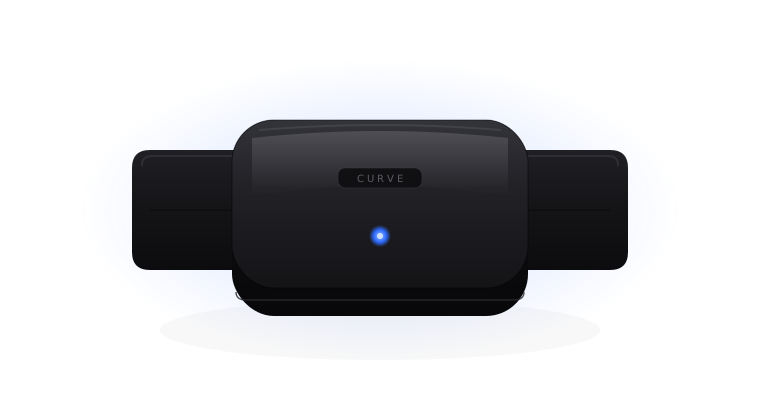
So the honest scope statement, which is short: the Auromone Curve measures cortisol continuously from sweat. It does not measure melatonin, growth hormone, ghrelin, leptin, thyroid hormones or reproductive hormones. Cortisol is the first sensor we built, and it is the only one the band reads today. Anything you see described as a multi-hormone platform is a direction of work, not a feature you can buy.
What continuous measurement changes for cortisol specifically is the coverage of the hours you are asleep. A blood draw at 08:30 samples 08:30. A four-point saliva profile samples four moments, which is more shape than a single point but still not a night. Since the trough sits around 00:18 and the climb begins in the dark, the hour you test determines most of what a timed test can show you, and the measurement guide compares the available methods including the ones we do not sell.
What no wearable does, ours included, is tell you what your night means about your health. That is not modesty, it is the line between an instrument and a clinician. The physiology on this page is general background, and the rest of the hormone cluster sits under beyond cortisol.
When broken sleep needs a doctor
Hormone explanations are interesting, and they are also where genuinely treatable sleep disorders go to hide. If your nights have been bad for weeks, the question is not which hormone to blame. It is which of the things below is happening.
Take these to a clinician rather than to a supplement aisle
- Breathing that starts and stops during sleep, or waking gasping or choking. Those are symptoms of sleep apnea, and the NHLBI states plainly that untreated sleep apnea increases the risk for stroke, heart attack and other serious problems. A sleep study is what settles it.
- No snoring does not rule sleep apnea out. The NHLBI lists loud snoring as more common in men, while fatigue, headache and insomnia are listed as more common in women. The version without snoring is the version that gets missed, and the daytime symptoms are the ones easiest to blame on hormones.
- Chest pain or pressure, breathlessness that wakes you or is worse lying flat, or sudden weakness, numbness or drooping on one side on waking. Call emergency services. A night waking can be the presenting sign of something acute, and the sourced version of that list is in why do I wake up at 3am.
- Melatonin in a house with young children. A 2024 CDC report counted about 11,000 emergency department visits between 2019 and 2022 for unsupervised melatonin ingestion by children aged 5 and under. Store it as you would any medicine, and speak to a provider before giving it to a child.
- Insomnia that has lasted weeks, or sleepiness that makes driving unsafe. Both are clinical problems with real treatments, and both are routinely self-managed for years first.
- Thoughts of harming yourself. This is an emergency, and it is treatable. In Canada and the United States you can call or text 988, free and confidential, 24 hours a day. You do not have to be in immediate danger to use it.
None of this is a decision a device makes. A wearable measures. A clinician diagnoses, and the list above calls for the second one.
This guide is for general wellness education only. The Auromone Curve is a general wellness device: it monitors continuously; it does not diagnose, treat, or cure any condition. It does not replace medical advice. Persistent sleep problems deserve a proper medical assessment. Please talk to a healthcare provider.
References
- Claustrat B, Leston J. Melatonin: physiological effects in humans. Neurochirurgie. 2015. (Secreted principally at night; rhythm generated by the suprachiasmatic nuclei and entrained to the light and dark cycle; conveys information about the daily cycle of light and darkness.)
- Gooley JJ, et al. Exposure to room light before bedtime suppresses melatonin onset and shortens melatonin duration in humans. J Clin Endocrinol Metab. 2011. (n = 116; room light under 200 lux delayed melatonin onset in 99.0% and shortened duration by about 90 minutes.)
- Ferracioli-Oda E, Qawasmi A, Bloch MH. Meta-analysis: melatonin for the treatment of primary sleep disorders. PLoS One. 2013. (19 studies, 1,683 subjects; sleep latency reduced 7.06 minutes; total sleep time increased 8.25 minutes.)
- Sateia MJ, Buysse DJ, Krystal AD, Neubauer DN, Heald JL. Clinical practice guideline for the pharmacologic treatment of chronic insomnia in adults. J Clin Sleep Med. 2017. (Recommendation 12, graded WEAK.)
- National Center for Complementary and Integrative Health. Melatonin: what you need to know. (Jet lag evidence; 2019 review of 1,021 children; long-term safety information lacking; 2024 CDC report on paediatric emergency visits.)
- Debono M, et al. Modified-release hydrocortisone to provide circadian cortisol profiles. J Clin Endocrinol Metab. 2009. (n = 33 healthy reference subjects; acrophase 08:32, nadir 00:18, quiescent phase 19:43 to 05:31.)
- Van Cauter E, Plat L. Physiology of growth hormone secretion during sleep. J Pediatr. 1996. (Largest pulse shortly after sleep onset with the first phase of slow-wave sleep; about 70% of sleep GH pulses coincide with slow-wave sleep in men; 24-hour secretion falls two- to three-fold between ages 30 and 40.)
- Spiegel K, Tasali E, Penev P, Van Cauter E. Sleep curtailment in healthy young men is associated with decreased leptin levels, elevated ghrelin levels, and increased hunger and appetite. Ann Intern Med. 2004. (12 men; leptin down 18%, ghrelin up 28%, hunger up 24%, appetite up 23%, calorie-dense carbohydrate up 33% to 45%.)
- Spiegel K, Leproult R, Van Cauter E. Impact of sleep debt on metabolic and endocrine function. Lancet. 1999. (11 young men, 4 hours in bed for 6 nights; lower glucose tolerance, lower thyrotropin, raised evening cortisol.)
- Leproult R, Van Cauter E. Effect of 1 week of sleep restriction on testosterone levels in young healthy men. JAMA. 2011. (10 men, mean age 24.3; 8 nights of 5-hour bedtimes; daytime testosterone 10% to 15% lower.)
- Leproult R, Copinschi G, Buxton O, Van Cauter E. Sleep loss results in an elevation of cortisol levels the next evening. Sleep. 1997. (Evening cortisol 37% and 45% higher after partial and total sleep deprivation; quiescent phase delayed by at least an hour.)
- van der Spoel E, Roelfsema F, van Heemst D. Within-person variation in serum thyrotropin concentrations. Front Endocrinol. 2021. (Circadian rhythm with a nocturnal surge around 02:00 to 04:00 and a daytime nadir has the greatest impact on TSH variation.)
- Silva Junior JF, et al. Effects of short sleep and sleep deprivation on thyroid hormones and indices: ELSA-Brasil. Cad Saude Publica. 2026. (9,564 participants; lower TSH in short sleepers of both sexes. Observational.)
- Baker FC, Lee KA. Menstrual cycle effects on sleep. Sleep Med Clin. 2018.
- Baker FC, de Zambotti M, Colrain IM, Bei B. Sleep problems during the menopausal transition. Nat Sci Sleep. 2018. (26% meet criteria for insomnia; difficulties linked to menopausal stage and to changes in follicle-stimulating hormone and estradiol over and above age.)
- NHLBI. Sleep apnea and sleep apnea symptoms. (Symptom list, sex differences, and the risk of stroke and heart attack when untreated.)