
Measure it.
Stop inferring it.
You have data on sleep, glucose, HRV and training. Cortisol is the one input your stack still estimates. The Curve is designed to read the hormone itself, continuously, and hand you the raw numbers. The other groups it was built around are in who it is for.
Cortisol baseline: why measure the hormone, not a proxy?
The short answer
Because a proxy cannot show the hormone's own shape. A recovery score is built mostly on heart-rate variability, which reflects the autonomic nervous system, not cortisol. Cortisol runs on a separate axis with its own daily pattern: a marked rise in the 30 to 45 minutes after waking, then a fall to its lowest point around midnight. An n=1 experiment needs a baseline of the variable you are changing, so the honest version measures the hormone. (Source: ISPNE expert consensus, 2016; Debono et al., 2009; Shaffer and Ginsberg, 2017.)
Where the two signals part ways is covered in how cortisol and HRV differ. If you want a number today, at-home cortisol tests compares the saliva, urine and blood-spot kits on sale, and what one timed sample can and cannot tell you.
How do you run an n=1 experiment on a hormone?
Baseline before you change anything.
Cortisol varies enough between people that a population reference range tells you very little about you specifically. Two weeks of continuous wear is designed to give you your own curve first, so anything you change after that has something to be measured against.
Two weeks · designed for continuous readings
Change one thing. Watch the curve.
You already change one thing and watch what happens. A continuous read is designed to give that method two things a controlled study has: repetition, and samples fixed to the clock. It cannot give you a control day, so a shift in your own curve is a lead worth following, not proof. And choose the input carefully: of the five inputs in our evidence guide, four have put people in hospital.
One variable at a time · measured, not inferred
See the awakening response, not only the wake time.
Cortisol climbs sharply in the first 30 to 45 minutes after you wake. That rise has a shape, and a saliva kit samples it at a few set times. A continuous read is designed to give you the whole curve, every morning, without setting an alarm to spit in a tube.
The CAR, designed to be measured daily
Take the raw numbers with you.
Every reading is exportable. Pull the series out, join it to your sleep and glucose data, and run whatever analysis you were going to run anyway. It is your data, and it leaves in a format you can actually use.
Full export · your data, your tooling
One band. More analytes over time.
Cortisol is the first sensor, not the only one. The electrode card is the consumable and the band is the platform, so the hardware you buy once keeps working as the chemistry underneath it grows. Each sensor has to earn its place first: how a cortisol wearable is validated, and the stage the Curve has reached.
Sensor plan from CA$14.99/mo, billed annually
 Electrode array · swappable card
Your curve, your trend, your file.
Enough interface to read the day at a glance, and a clean way out when you want the numbers themselves.
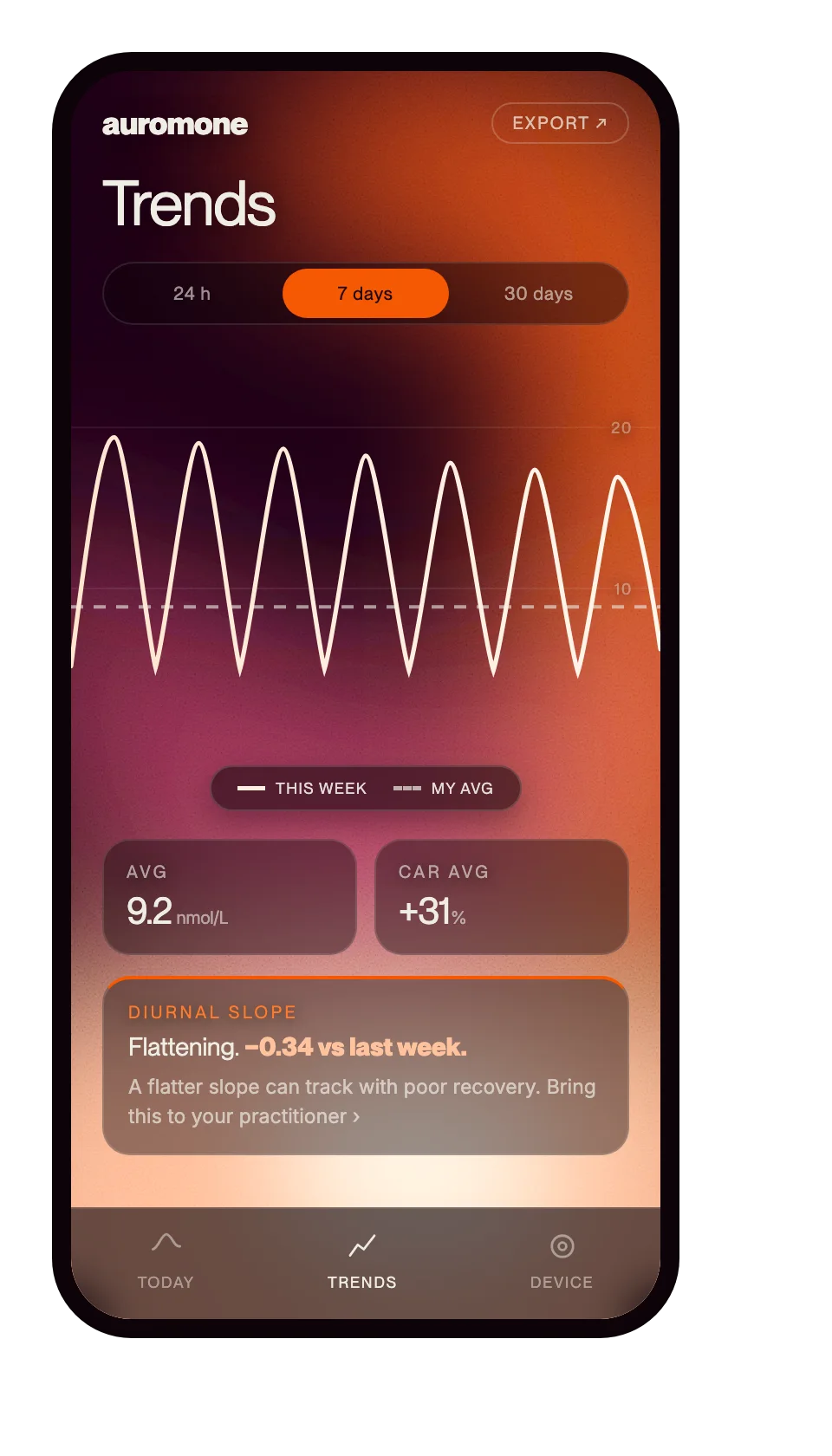
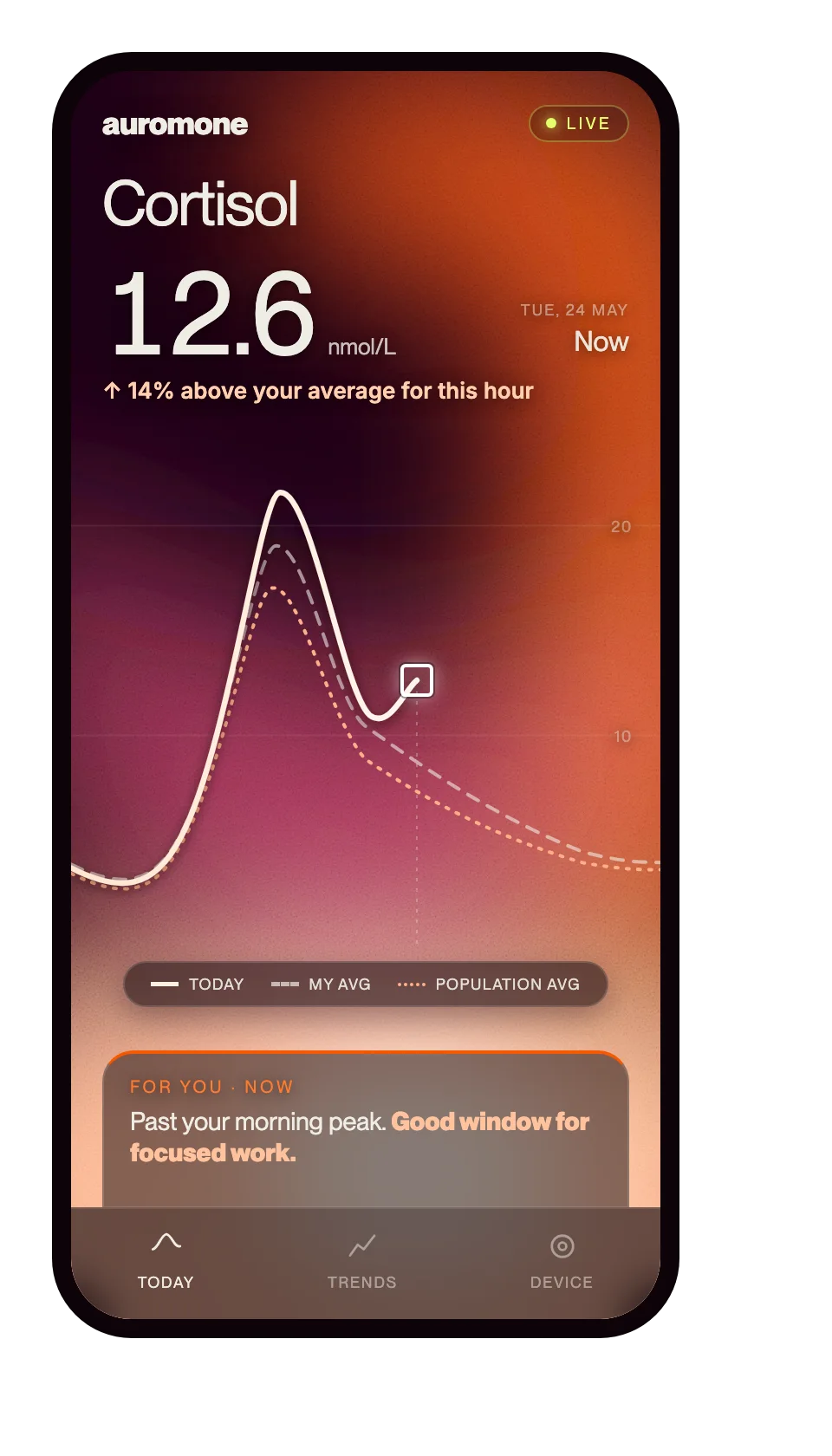
- TodayThe full curve as it builds, designed to read continuously.
- TrendYour rolling baseline, so one odd morning does not read as a shift.
- ExportThe raw series, out of the app and into whatever you use.
What it will not do.
The Auromone Curve is a general wellness device: it is designed to monitor cortisol continuously, and it does not diagnose, treat, or cure any condition. A number outside your usual band is a prompt to look, not a result to act on alone. If something in your data worries you, that is a conversation with a doctor, not a protocol change.
- Diagnose a condition, or screen for one.
- Tell you a single reading is abnormal.
- Replace testing ordered by a clinician.
- Tell you which protocol to run next.
- Measure the hormone itself, not a proxy for it.
- Do it continuously, for about two weeks per sensor (our target).
- Build a baseline from you rather than a population.
- Hand you the raw series to analyse yourself.
Questions from people who track everything.
How do I get a continuous cortisol reading?
Not from anything on sale yet. Cortisol is measured today as single samples: a blood draw, or saliva or urine collected at set times, each one a point rather than a series. How the at-home kits compare. The Curve is being built for the series: a band designed to read cortisol from passive sweat at the skin's surface, so nothing breaks the skin. It is a general wellness device in development, and it does not diagnose anything.
How long does it take to establish a cortisol baseline?
Longer than you would think, and we are not going to pretend there is a validated number. Cortisol swings on a daily rhythm and responds to sleep, illness and stress, so a two- or three-day sample mostly measures the days you happened to pick. We suggest fourteen because that is about the span one sensor is designed to cover (our target) and it puts two of every weekday in the same window. That is a practical choice, not a clinical threshold.
Can I export the raw data?
Yes. Every reading is exportable, and the export is designed to be joined to other series rather than read on its own. It is your data.
What should my cortisol awakening response look like?
Typically cortisol climbs sharply in the first 30 to 45 minutes after waking, then declines through the day. The size of that rise varies a lot between people and from day to day, which is exactly why a single measurement is hard to interpret and a repeated one is not. (Source: ISPNE expert consensus guidelines, Stalder et al., 2016.) More on the awakening response →
Does morning sunlight raise cortisol?
In laboratory studies, light does. Petrowski and colleagues (2019) gave healthy men bright versus dim light for the hour after waking and measured a significantly larger awakening response under bright light, and larger again under blue or green light than under red; a dawn-simulation study of 12 people found more total cortisol across the first 45 minutes. Those were controlled light boxes under lab conditions, which is not the same as stepping outside. Whether your own curve moves is something you would have to measure, and one morning’s before-and-after is a lead, not proof. (Source: Petrowski et al., 2019; Thorn et al., 2004.)
References
- Stalder T, Kirschbaum C, Kudielka BM, et al., Clow A. Assessment of the cortisol awakening response: expert consensus guidelines. Psychoneuroendocrinology. 2016;63:414-432. (International Society of Psychoneuroendocrinology panel; the marked rise over the first 30 to 45 minutes after waking; why timed saliva sampling depends on exact adherence.)
- Debono M, Ghobadi C, Rostami-Hodjegan A, et al., Ross RJ. Modified-release hydrocortisone to provide circadian cortisol profiles. Journal of Clinical Endocrinology and Metabolism. 2009;94(5):1548-1554. (Reference profile from 33 healthy adults; peak around 8:30 a.m., lowest point around midnight.)
- Shaffer F, Ginsberg JP. An overview of heart rate variability metrics and norms. Frontiers in Public Health. 2017;5:258. (Heart-rate variability is the variation between heartbeats, generated by heart-brain interactions and autonomic nervous system processes.)
- Petrowski K, Schmalbach B, Niedling M, Stalder T. The effects of post-awakening light exposure on the cortisol awakening response in healthy male individuals. Psychoneuroendocrinology. 2019;108:28-34. (Sleep-laboratory light for one hour after waking; larger awakening response under bright than dim light, and under blue or green than red.)
- Thorn L, Hucklebridge F, Esgate A, Evans P, Clow A. The effect of dawn simulation on the cortisol response to awakening in healthy participants. Psychoneuroendocrinology. 2004;29(7):925-930. (Twelve healthy participants; more total cortisol across the first 45 minutes after waking on dawn-simulation days.)
This page is for general education and is not medical advice. The Auromone Curve is designed as a general wellness device, not a diagnostic, and does not replace clinical testing. It is in development and not yet on sale.
Add the input you have been estimating.
The Curve is designed to measure cortisol continuously, on your wrist, and to give you the raw series. It isn't on sale yet, and reserving is free.