
The signal your
training has been
missing.
Hard efforts raise cortisol; easy ones do not. The Curve is a continuous cortisol monitor designed to measure the hormone directly, worn through every session and every rest day. Not estimated from your pulse.
Cortisol for athletes: what does training do to it?
The short answer
Hard sessions raise cortisol; easy ones do not. In a controlled study of 12 trained men, 30 minutes at low intensity did not significantly change blood cortisol, while moderate and high-intensity sessions raised it by about 40% and 83%. After a 30-minute run, cortisol stayed above a matched no-exercise day for about two and a half hours. Trained runners respond less to the same absolute workload. A short rise after a hard session is normal physiology. (Source: Hill et al., 2008; Kanaley et al., 2001; Luger et al., 1987.)
| 30-minute session | Change in blood cortisol |
|---|---|
| Rest, no exercise | −6.6% |
| 40% of maximal oxygen uptake (low) | +5.7% (not significant) |
| 60% of maximal oxygen uptake (moderate) | +39.9% |
| 80% of maximal oxygen uptake (high) | +83.1% |
Mean change from before to after each session in 12 active, moderately trained men, Hill and colleagues, 2008. Part of the rise is the blood becoming more concentrated as fluid shifts out of it during exercise, and part is a signal from the brain to the adrenal glands.
Timing, lifting and fitness all change that response, and the evidence for each is in does exercise raise cortisol. The questions athletes ask next have their own guides: whether a sauna lowers cortisol, whether creatine raises it, and what a long-haul flight does to it. When fatigue does not lift with rest, start with cortisol and overtraining, which explains why no single hormone diagnoses it.
What does continuous cortisol actually show an athlete?
Watch the session land.
A hard effort raises cortisol while you are still cooling down. A continuous read is designed to show the rise as it happens, instead of a number waiting for you the next morning. What the studies show about intensity, timing and lifting is in does exercise raise cortisol. The other groups the band was built around are in who it is for.
Designed for a continuous read · live in the app
Your baseline, not a population’s.
Cortisol varies widely between people, so a reference range tells you very little about you. Two weeks of continuous wear is designed to build your own curve, with every reading after that read against it.
Personal baseline · rolling 7-day trend
The load you never wrote down.
Travel, a short night, a hard week at work. Your body runs one stress axis, not two, and the hormone does not separate them. It is what makes a heavy week after an easy block finally make sense.
Designed for 24-hour coverage · awake and asleep
Two signals, read together.
Keep the tracker you already own. When your recovery score and your cortisol point the same way, the picture is simple. When they disagree, you are seeing something neither signal shows on its own. For the other half of that question, why a recovery score reads low goes through what each vendor feeds into the number.
Worn alongside the tracker you already own
Swap the sensor, keep the band.
The electrode card is the consumable. It is designed to last about two weeks (our target) and changes in seconds, so the band you buy once keeps working as the chemistry underneath it improves.
Sensor plan from CA$14.99/mo, billed annually
 Electrode array · swappable card
The morning after a hard session.
Your curve for the day, your rolling trend, and a plain export whenever you want it.
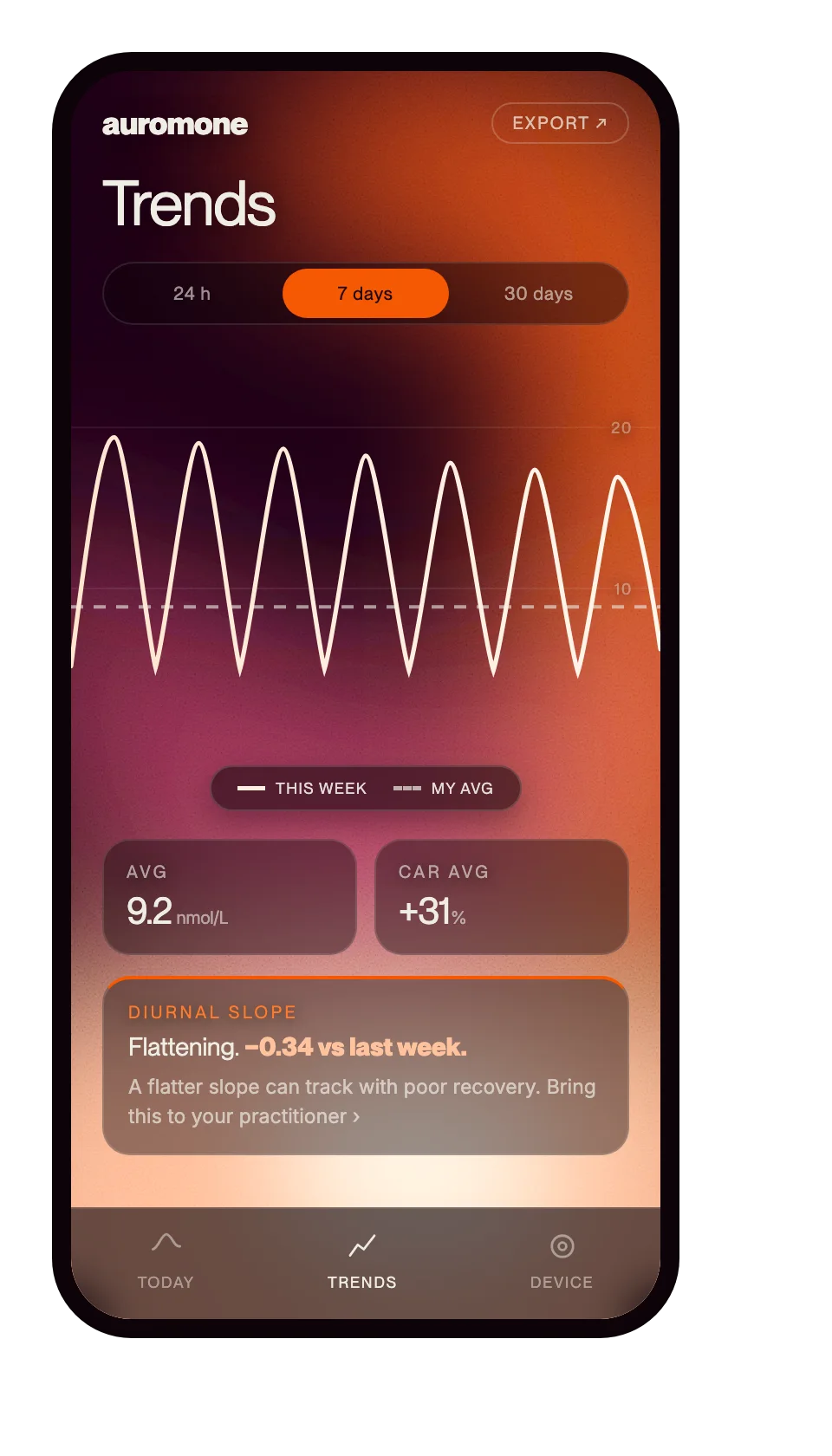
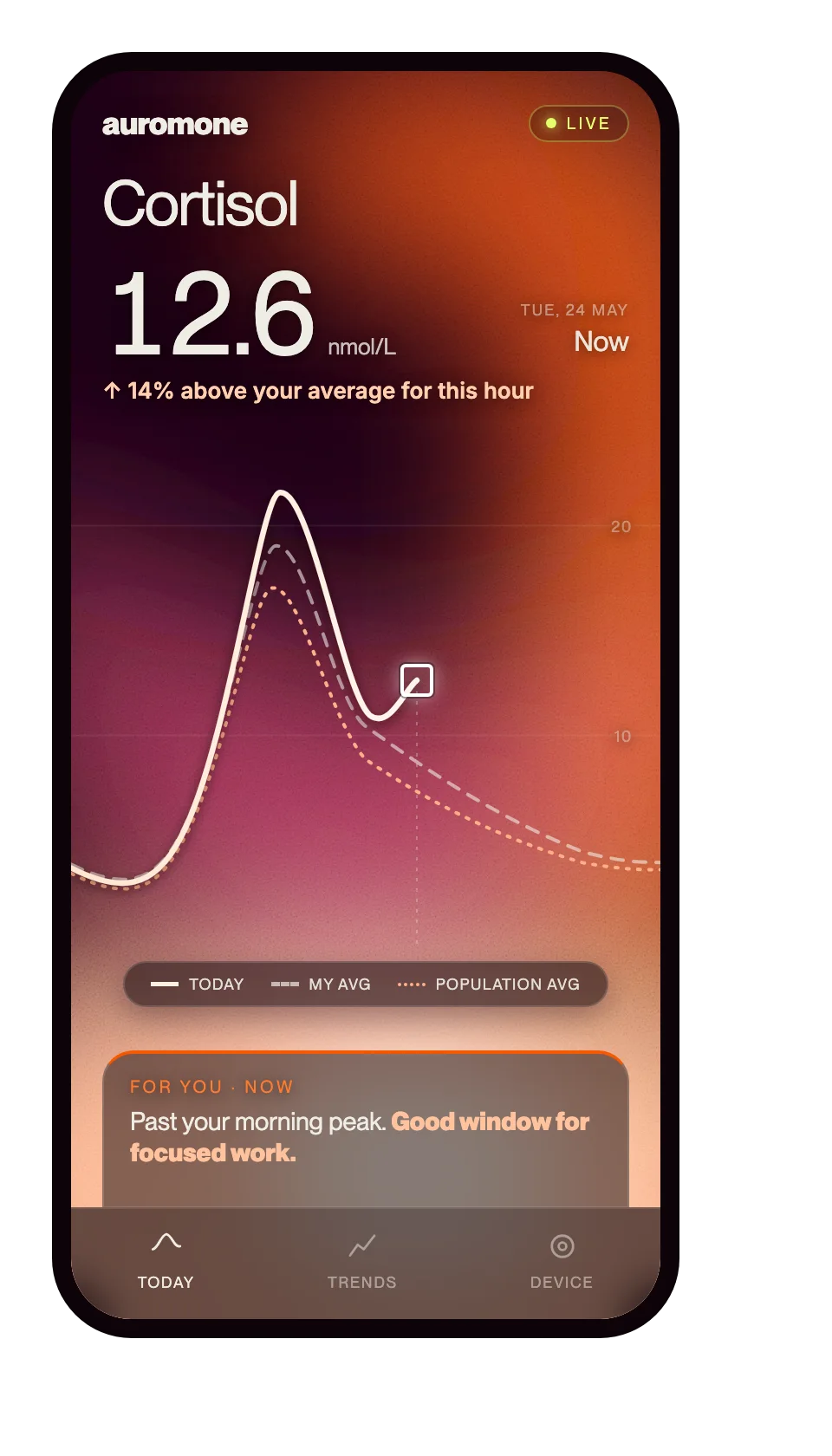
- TodayThe full day as it builds, with the session marked where it landed.
- TrendYour rolling baseline, so a single odd morning does not read as a pattern.
- Your data, exportedTake the raw readings with you whenever you want. It is your data.
What it will not do.
No single marker diagnoses overtraining, cortisol included. The ECSS and ACSM joint consensus statement reviewed the markers in use and found none of them meet all the criteria to be generally accepted; overtraining syndrome is diagnosed by exclusion, after organic disease has been ruled out. The Auromone Curve is a general wellness device: it is designed to monitor cortisol continuously, and it does not diagnose, treat, or cure any condition. Fatigue and falling performance that do not lift with rest deserve a doctor’s assessment before they get a training label. What to rule out first →
- Diagnose overtraining syndrome, or any condition.
- Tell you whether to train tomorrow.
- Tell you a single reading is abnormal.
- Replace testing ordered by a clinician.
- Measure the hormone itself, not a proxy for it. (What the proxy is made of: an energy score, taken apart.)
- Do it continuously, for about two weeks per sensor (our target).
- Show it against a baseline built from you.
- Carry load your training log never recorded.
The Curve is in development, and we publish no accuracy figure for it. How a cortisol wearable is validated, and the stage the Curve has reached.
Athlete questions.
Why does my recovery score say rested when I feel wrecked?
A recovery score is a model built mostly on heart-rate variability, which reflects autonomic tone. Cortisol is a different signal on a different axis. The two can point in opposite directions, and a morning where they disagree is usually the one worth paying attention to.
Should I add cortisol to a stack that already tracks HRV and sleep?
Only if you want a second, independent signal rather than a verdict. No single marker diagnoses overtraining, cortisol included, and the Curve does not either. What it is designed to add is one objective input, measured rather than inferred, next to load, sleep and how you feel. More on cortisol and overtraining →
Can I wear the Curve alongside my current tracker?
Yes. The Curve is worn on the wrist and is designed to sit alongside whatever you already use rather than replace it. Your existing device keeps measuring your heart; the Curve is designed to add the hormone.
Why read cortisol from sweat instead of blood?
They are different samples. Blood carries total cortisol, most of it bound to proteins; sweat carries the free fraction, the portion that is biologically active. We publish how the measurement works, and how a cortisol wearable is validated, and where the Curve stands. Sweat is also the sample that can be read continuously, all day, without a blood draw. That is a different job from a lab or at-home cortisol test, not a replacement for one.
Does the Curve measure the testosterone to cortisol ratio?
The testosterone to cortisol ratio is an established, and debated, marker in sports science. The Curve is designed to measure cortisol, and only cortisol, so the ratio is not something the device reports. What the two hormones actually do to each other, and how long it takes, is covered in cortisol and testosterone.
References
- Hill EE, Zack E, Battaglini C, Viru M, Viru A, Hackney AC. Exercise and circulating cortisol levels: the intensity threshold effect. Journal of Endocrinological Investigation. 2008;31(7):587-591. (Twelve active, moderately trained men, 30 minutes at 40%, 60% and 80% of maximal oxygen uptake; the percentage changes in the table; part of the rise from fluid shifts, part from the brain's signal to the adrenals.)
- Kanaley JA, Weltman JY, Pieper KS, Weltman A, Hartman ML. Cortisol and growth hormone responses to exercise at different times of day. Journal of Clinical Endocrinology and Metabolism. 2001;86(6):2881-2889. (Ten moderately trained men, 30-minute runs at 7 a.m., 7 p.m. and midnight against matched no-exercise days; cortisol raised for about 150 to 155 minutes.)
- Luger A, Deuster PA, Kyle SB, et al., Chrousos GP. Acute hypothalamic-pituitary-adrenal responses to the stress of treadmill exercise: physiologic adaptations to physical training. New England Journal of Medicine. 1987;316(21):1309-1315. (Responses proportional to relative intensity in every group, and smaller in trained runners at a given absolute workload.)
- Meeusen R, Duclos M, Foster C, et al. Prevention, diagnosis, and treatment of the overtraining syndrome: joint consensus statement of the European College of Sport Science and the American College of Sports Medicine. Medicine and Science in Sports and Exercise. 2013;45(1):186-205. (No marker, hormones included, meets all the criteria to be generally accepted; diagnosis by exclusion of organic disease.)
- Hamrahian AH, Oseni TS, Arafah BM. Measurements of serum free cortisol in critically ill patients. New England Journal of Medicine. 2004;350(16):1629-1638. (More than 90% of circulating cortisol in serum is protein-bound, which is why total and free cortisol are different measurements.)
This page is for general education and is not medical advice. The Auromone Curve is designed as a general wellness device, not a diagnostic, and does not replace clinical testing. It is in development and not yet on sale.
The science underneath
Train with the hormone in view.
The Curve is designed to measure cortisol continuously, on your wrist, alongside whatever you already wear. It isn't on sale yet, and reserving is free.