
What is a wearable biosensor?
It is an analytical instrument small enough to wear, pointed at one molecule. Grieshaber and colleagues, in a much-cited 2008 review of electrochemical biosensors, define a biosensor as "an analytical device which converts a biological response into a quantifiable and processable signal". Their anatomy of one has five parts: bioreceptors that bind the target, an interface where that binding happens, a transducer that picks the event up, a detector circuit that amplifies it, and software that turns the result into something a person can read.
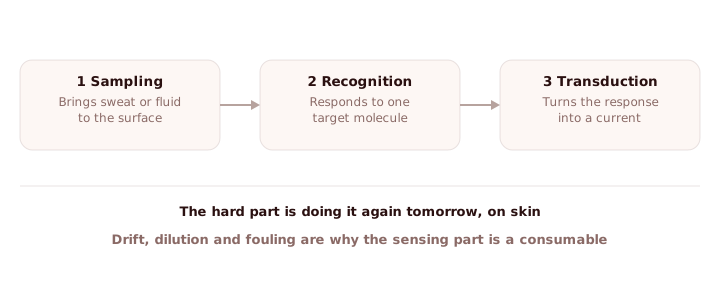
Making it wearable adds one requirement, and it is the one that does most of the damage: nobody takes a sample. In a laboratory, a technician brings the fluid to the instrument. On a wrist, the fluid has to arrive at the sensor by itself, in whatever volume the body happens to be producing, carrying whatever the skin has left on it.
The underlying idea is older than the wearables industry by half a century. The same review traces the field to Leland Clark's oxygen electrode of 1955 and 1956, his 1962 paper describing the first glucose sensor, and the commercial launch of the first dedicated glucose biosensor in 1975. Everything since has been an argument about how to keep that trick working outside a laboratory.
How is a biosensor different from a heart-rate wearable?
A heart-rate wearable measures a physical signal and a model infers a state from it. A biosensor measures a chemical quantity and reports it. An optical pulse sensor shines light into the skin and reads what comes back; an accelerometer reads movement; a thermistor reads temperature. Those are real measurements, and the instruments are good at them. What they are not is chemistry, so anything chemical they tell you is a model's inference rather than a reading. That distinction is the whole subject of which wearables measure cortisol and which estimate stress from a pulse.
| Physical sensor (pulse, motion, temperature) | Chemical sensor (a biosensor) | |
|---|---|---|
| What it senses | Light reflected from blood vessels, acceleration, heat | The concentration of one molecule in a body fluid |
| What has to reach it | A signal, which travels through skin | A fluid sample, which has to physically arrive |
| What the output is | A measured signal, usually fed to a model that infers a state | A measured concentration |
| What limits it | Motion, skin tone and fit, and the model's assumptions | Sample volume, dilution, fouling and drift |
| What wears out | Battery and adhesive | The chemistry itself |
The last row is the one people find surprising. An optical sensor can be washed and worn for years. A chemical sensor is consumed by the act of sensing, which is why a glucose sensor has an expiry date and a heart-rate strap does not.
The three layers: sampling, recognition, transduction
Every chemical wearable has these three, whatever it is measuring, and each one has its own way of going wrong.
| Layer | What it does | How it fails |
|---|---|---|
| Sampling | Brings a body fluid from skin to the sensing surface, through a microfluidic channel, a wick, or a needle into the tissue | Too little fluid, old fluid mixing with new, contamination picked up from the skin surface |
| Recognition | Responds to one target molecule and ignores everything else in the sample | Other molecules bind too, or the layer stops binding as it ages |
| Transduction | Converts that response into a current, a voltage, an impedance change or a colour | The baseline drifts, so the same concentration reads differently tomorrow |
Sampling is the layer most people skip and most devices die on. Koh and colleagues in the Rogers lab published a soft microfluidic patch in Science Translational Medicine in 2016 that bonds to skin over a small set of sweat glands, so that, in their words, "perspiration spontaneously initiates routing of sweat through a microfluidic network and set of reservoirs". No pump, no prompt: the gland's own pressure does the work.
Recognition is what makes a biosensor specific rather than merely sensitive. The 2008 review lists the usual choices as "enzymes, nucleic acids, antibodies, whole cells, and receptors", with enzymes the most common. It also names the requirement that nobody can design around: the surface has to suppress non-specific binding, and keep suppressing it while sitting in a biological fluid.
Transduction is the part that produces a number, and it is the subject of the next section.
How does an electrochemical sensor turn binding into a number?
The binding event changes an electrical property at an electrode, and the device measures that change. The 2008 review sorts the options by what is being measured: amperometric sensors measure a current, potentiometric sensors a potential or accumulated charge, conductometric sensors a change in the conductivity between electrodes, impedimetric sensors the impedance, and field-effect devices use transistor technology to read a potential change at a gate.
Glucose is the textbook case because it has an enzyme. An enzyme electrode converts glucose into a reaction the electrode can see, and the resulting current scales with concentration. That is a clean, self-referencing chain from molecule to number, and it is the reason glucose got a wearable 40 years before anything else did.
Optical transduction is the other route, and it trades continuity for simplicity. The 2016 microfluidic patch holds sweat in small reservoirs where "embedded chemical analyses respond in colorimetric fashion to markers such as chloride and hydronium ions, glucose, and lactate", and a phone camera does the quantifying. Worn during indoor cycling and a long-distance road race, it returned values for sweat rate, total sweat loss, pH, chloride and lactate. A colour is cheap to read and hard to run continuously, because once the reservoir has filled and reacted, that measurement is finished.
The one-sentence version
A biosensor is a translator with three stages: fluid arrives, something in it is recognised, and the recognition becomes a signal. Break any stage and the number is still produced, which is exactly why these devices need validating rather than demonstrating.
What can sweat actually carry?
Small things, well. Large things, badly or not at all. The reference work here is a 2019 Nature Biotechnology review by Heikenfeld and colleagues on accessing analytes in biofluids, which compares interstitial fluid, saliva, sweat and tears on the properties that decide whether a wearable can work at all. For sweat it gives a molecular weight cutoff in the hundreds of daltons and a maximum dilution of more than 1,000 times relative to blood.
That cutoff is a consequence of the route a molecule takes. Most analytes reach sweat by squeezing between the cells lining the gland, a path guarded by tight junctions that filter by size. Small fat-soluble molecules skip the queue and pass straight through the cell membranes instead, which is why the review reports that small lipophilic molecules such as cortisol, at one to tens of nanomolar, show strong correlation between sweat and blood plasma, while glucose, which is water-soluble, arrives at roughly 1% of its concentration in the fluid surrounding the gland.
| In sweat | Roughly how much | How it got there |
|---|---|---|
| Sodium and chloride | Tens of millimolar | Actively secreted, so it tracks the sweating process rather than blood sodium |
| Potassium | About 5 to 15 mM, and the review calls it under debate | Unclear, and blood correlation remains to be demonstrated |
| Lactate | About 5 to tens of millimolar | Partly from blood, partly made locally by the gland, and flow-rate dependent |
| Glucose | About 1% of plasma | Filtered between cells, and flow-rate dependent |
| Cortisol | Unbound fraction, similar to unbound plasma | Passes through cell membranes directly, being small and fat-soluble |
| Cytokines, antibodies | Under 0.1% of plasma, or locally produced | Too large for the paracellular route, so very highly diluted |
Two things follow. The first is that a sweat sensor is not a blood test with better manners: it sees a different subset of the same body. The second is the one that matters for hormones, and it is worth stating precisely. The review notes that blood-plasma correlation "should only be expected for unbound (active) fractions", since a hormone bound to a large carrier protein partitions no more readily than the protein does. Sweat therefore carries the free fraction, which is also the fraction that acts on tissue. What that hormone then does across a day is the subject of cortisol 101.
What about interstitial fluid, saliva and tears?
Four fluids, four different bargains. The same review tabulates them, and the table explains most of the industry's shape without anyone needing to name a company.
| Fluid | Molecular weight cutoff | Maximum dilution | How much is produced | Lag behind blood | Commercial maturity |
|---|---|---|---|---|---|
| Interstitial fluid | About 1 MDa | Up to 10 times | Tens of µL per minute per cm² by extraction | About 5 to 15 minutes | High |
| Saliva | Hundreds of daltons | More than 1,000 times | Tens to hundreds of µL per minute | Tens of minutes | Moderate |
| Sweat | Hundreds of daltons | More than 1,000 times | 0.1 to 2 µL per minute per cm² | Ones to tens of minutes | Low |
| Tears | Hundreds of daltons | More than 1,000 times | About 1 µL per minute | Not stated | None |
Maturity ratings are the review's own, as of its 2019 publication.
Interstitial fluid is the fluid between your cells, and it is the best-behaved of the four: little dilution, and for most analytes a concentration close to 1:1 with blood plasma. The price is that you have to breach the skin to reach it. Saliva is the easiest to collect and the hardest to standardise, because concentration depends on flow rate, and the review warns that unbound charged steroid hormones are influenced by flow rate, so samples should avoid stimulated flow. Saliva flow is also highest in the morning and close to absent at night, which is an awkward property for anything trying to watch an overnight rhythm. Tears are produced at about a microlitre a minute and had no commercial biochemical sensing products at all.
How those trade-offs cash out for one hormone in practice, against blood draws, saliva kits and mail-in panels, is laid out in the guide to measuring cortisol.
Why do sweat rate and dilution change a reading?
Because concentration is an amount divided by a volume, and the body controls the volume. The review puts sweat generation at 0.1 to more than 10 nanolitres per minute per gland, with gland densities from tens to hundreds per square centimetre, so total output across a patch of skin can vary from about 1 nanolitre per minute per square centimetre to thousands.
That range moves readings in two opposite directions at once, which is the part worth understanding:
- Some things get more concentrated as you sweat harder. The gland's duct normally reclaims sodium and chloride on the way out. At high sweat rates there is less time to reclaim them, so sodium climbs from roughly 10 mM to roughly 100 mM. That is a property of the plumbing, not of your blood sodium.
- Some things get more dilute. Analytes that arrive by filtering between cells, glucose among them, drop in concentration as the water flow rises.
- Volume itself is a constraint. The review works the arithmetic: at 1 nanolitre per minute per gland with 100 active glands per square centimetre, it takes 100 minutes to accumulate a layer of sweat 100 micrometres thick. Dead volume inside a device can therefore add hours of delay unless the design removes it.
- The skin surface is a contaminant. Sweat that sits on the stratum corneum picks up what is already there, which is why wicking designs try to move fluid off the surface within minutes.
The published fixes are to hold the secretion rate steady, or to measure the rate and correct the dilution, and the review argues that this is where sweat has an advantage over saliva and tears, since its secretion rate can be measured with microfluidic flow meters and stimulated to a steady value with an iontophoretically delivered cholinergic agent such as pilocarpine or carbachol. That last point also explains a gap between research and daily life: for people who are not actively perspiring, many published devices need to provoke sweat before they can read anything.
Timing behaves better than you would expect. Because the secretory coil is densely supplied with blood vessels, the review reports that sweat can reflect changes in circulating blood within 2 to 5 minutes, while also noting that solid lag data exists for very few analytes.
Why does a chemical sensor wear out?
Because the recognition layer lives in a biological fluid, and biological fluids coat surfaces. Proteins and cell debris adsorb onto the sensing surface, a process called biofouling, and as the coating builds up the same concentration produces a smaller signal. The 2008 review frames the countermeasure as a standing research problem: finding surface chemistries that keep their specific binding "over prolonged periods of time in biological fluids".
A 2026 review of near-field-communication wearable chemical sensors in Chemistry, an Asian Journal lists what is still open across the field, and the list is worth quoting rather than paraphrasing: "calibration drift, biofouling, inter-device and smartphone-dependent variability, and limited real-world or clinical validation". The same review calls for standardised validation "before biofluid measurements are assigned clinical significance", which is the right order of operations and not the usual one.
You can see the consequence in what people actually buy. The US National Institute of Diabetes and Digestive and Kidney Diseases says disposable glucose sensors "should be replaced every 7 to 14 days, depending on the model", with some implanted sensors lasting up to 180 days. Dexcom's own page for its 15-day sensor states that 73.9% of sensors lasted the full 15 days, and that roughly 26% may not. Abbott's site describes its FreeStyle Libre Plus sensors as 15-day sensors. Nobody in this category has made the chemistry permanent, and the honest reading is that nobody expects to soon.
So every chemical wearable is really two products: an instrument you keep, and a sensor you consume. That is a structural fact about measuring molecules on skin, and any device claiming otherwise deserves a hard question.
Which wearable biosensors are shipping, and which are still in the lab?
Shipping: glucose in interstitial fluid, and sweat patches for fluid and electrolyte loss. Still research: most of the rest, hormones included. Descriptions below are from each company's own published pages or from the cited papers, as of September 2026.
- Continuous glucose monitors (Dexcom, Abbott). The proof that the whole category is possible. A small filament sits under the skin and, as the NIDDK puts it, the sensor "estimates the glucose level in the fluid between your cells, which is very similar to the glucose level in your blood", reporting "every few minutes". These are regulated medical devices, prescribed and labelled as such, which is a different classification from a general wellness device.
- The sweat chloride test, in clinics. Sweat sensing has a clinical use that predates all of this: stimulating sweat and measuring chloride in it, used in testing for cystic fibrosis. The 2019 review describes it as the only major application of sweat analysis at the time of writing.
- Sports and workplace sweat patches. Gatorade's Gx Sweat Patch page says it "measures your sweat rate, fluid loss, and sodium loss", is worn during a workout and scanned with the app afterwards, and is listed as "Single-use only". Nix Biosensors says its hydration biosensor "continuously measures fluid and electrolyte losses throughout your session" and sells patch refills alongside it. Epicore Biosystems describes workplace devices built on "continuous monitoring of sweat and electrolyte losses, skin temperature, and motion data".
- Research sweat sensing, including hormones. The Wei Gao lab at Caltech published a laser-induced graphene sensing array for sweat cortisol in Matter in 2020; the authors report what they describe as the first cortisol diurnal cycle constructed from human sweat, and call the serum-to-sweat agreement in their pilot study a strong empirical correlation. The Rogers lab's 2016 microfluidic patch, above, was field-tested on cyclists. Both are published research rather than products on sale, and the Caltech lab's own page lists publications, not a shop.
- Tears. As of the 2019 review, no commercial biochemical sensing products existed for tears at all.
The gap between the fourth bullet and the first three is the real state of the art. Demonstrating a measurement in a study and shipping a device that holds its calibration on a stranger's arm for two weeks are different accomplishments, and the second one is mostly missing outside glucose.
What does this mean for reading a hormone continuously?
A hormone is a harder target than glucose, and the difficulty is mostly arithmetic. The review's own figures put resting venous glucose at 4.1 to 6.9 millimolar and the unbound cortisol fraction in plasma at tens of nanomolar. That is a difference of about five orders of magnitude. A sensor for the second job is not a smaller version of a sensor for the first, and the review is blunt that continuous sweat sensing had been demonstrated for electrolytes and micromolar metabolites, with anything below that requiring a different class of sensor entirely.
Cortisol does have two properties in its favour, both discussed above. It is small, at 362 daltons, and fat-soluble, so it crosses into sweat directly rather than being filtered. And the fraction it delivers is the unbound one, which is the fraction that acts on tissue, while a standard serum test usually reports total cortisol with most of that total bound to carrier protein. Those are different quantities, not better and worse versions of one quantity, which is why comparing them takes a study designed for the purpose rather than an assumption.
Against that, the difficulties are exactly the ones this page has been listing: dilution, flow-rate dependence, fouling, drift, and a field-wide shortage of published blood-correlation data. Anyone who tells you those have been solved should be asked for the method.
Where Auromone sits in this
The Auromone Curve is a band designed to measure cortisol continuously from a trace of sweat at the wrist. It is a general wellness device rather than a medical one. It is designed to measure cortisol and no other analyte: it is not a glucose sensor, it does not read any other hormone, and it does not compute a stress number from your pulse. The hardware side of that, the durable band and the sensor that is consumed by use, is described on the Curve product page. Cortisol is the first sensor, not the last. The Curve is still in development.
Two things we do not publish, and the reasons are different. There is no accuracy figure, because none has been earned: the device has not been validated against a laboratory reference, and the science page says so in plain terms and will carry the number and the method together when that work runs. And we do not describe the Curve's recognition chemistry while patent filings are in progress, which is a choice we would rather state than disguise. Everything on this page about how sensing works in general is sourced to the published literature, not to our own bench.
If the practical question is what a continuously read hormone actually looks like across a day, the cortisol meter page plots the shape from published data rather than from any device of ours.
This guide is for general wellness education only. The Auromone Curve is a general wellness device, not a diagnostic, and does not replace medical advice or clinical testing. Nothing here is guidance about diabetes care: if you use a glucose sensor or any other medical device, follow its labelling and your clinician rather than anything on this page. Dexcom, FreeStyle Libre, Gatorade, Gx, Nix and Epicore are trademarks of their respective owners, and each description above reflects that company's own published pages as of September 2026. If you have symptoms that concern you, talk to a healthcare provider.
References
- Heikenfeld J, Jajack A, Feldman B, Granger SW, Gaitonde S, Begtrup G, Katchman BA. Accessing analytes in biofluids for peripheral biochemical monitoring. Nature Biotechnology. 2019. (Table 1 comparison of interstitial fluid, saliva, sweat and tears; sweat generation of 0.1 to more than 10 nL per minute per gland; sodium rising from about 10 to about 100 mM with sweat rate; sweat glucose at about 1% of surrounding interstitial fluid; cortisol at 362 Da, one to tens of nanomolar, strongly correlated between sweat and plasma for the unbound fraction only; the 100-minute volume calculation; stratum corneum contamination; pilocarpine and carbachol stimulation; sweat reflecting blood changes within 2 to 5 minutes; saliva flow-rate effects on charged steroid hormones; cystic fibrosis sweat chloride as the only major sweat application; no commercial tear sensing products; continuous sweat sensing demonstrated only for electrolytes and micromolar metabolites.) The paper discloses that its authors include employees of Abbott Diabetes Care and Salimetrics and a cofounder of Eccrine Systems.
- Grieshaber D, MacKenzie R, Vörös J, Reimhult E. Electrochemical Biosensors - Sensor Principles and Architectures. Sensors. 2008;8(3):1400-1458. (The definition of a biosensor; the five-part anatomy; recognition elements as "enzymes, nucleic acids, antibodies, whole cells, and receptors"; amperometric, potentiometric, conductometric, impedimetric and field-effect transduction; Clark's oxygen electrode of 1955 and 1956, the 1962 glucose sensor and the first commercial glucose biosensor in 1975; the requirement to suppress non-specific interaction in biological fluids.)
- Koh A, Kang D, Xue Y, et al., Rogers JA. A soft, wearable microfluidic device for the capture, storage, and colorimetric sensing of sweat. Science Translational Medicine. 2016;8(366):366ra165. (Soft microfluidics bonded to skin; perspiration spontaneously routing sweat through a network and reservoirs; colorimetric response to chloride and hydronium ions, glucose and lactate; digital image capture for quantitation; values for sweat rate, total sweat loss, pH, chloride and lactate during indoor cycling and long-distance racing.)
- Torrente-Rodríguez RM, Tu J, Yang Y, et al., Gao W. Investigation of cortisol dynamics in human sweat using a graphene-based wireless mHealth system. Matter. 2020. (Laser-induced graphene sensor array for sweat cortisol; the authors' description of the first cortisol diurnal cycle constructed from human sweat; a pilot study reporting a strong empirical correlation between serum and sweat cortisol.)
- Che H, Gao S, Chen S, et al. Near-Field Communication-Enabled Wearable Chemical Sensors for Bioanalytical Monitoring. Chemistry, an Asian Journal. 2026;21(17):e70975. (Open limitations across wearable chemical sensing, quoted above, including calibration drift and biofouling; the call for standardised validation before biofluid measurements are assigned clinical significance.)
- National Institute of Diabetes and Digestive and Kidney Diseases. Continuous Glucose Monitoring. (Sensors estimating glucose in the fluid between your cells; readings every few minutes; disposable sensors replaced every 7 to 14 days depending on the model; some implantable sensors lasting up to 180 days.)
- Dexcom. Dexcom G7 CGM system, accessed September 2026. (A 15-day sensor; "73.9% of sensors lasted the full 15 days" and approximately 26% may not; fingersticks required when symptoms do not match readings.)
- Abbott. FreeStyle Libre, accessed September 2026. (FreeStyle Libre Plus described as 15-day sensors; fingersticks required if alarms and readings do not match symptoms.)
- Gatorade. Gx Sweat Patch, accessed September 2026. (Measures sweat rate, fluid loss and sodium loss; worn during a workout and scanned with the app; listed as single-use only.)
- Nix Biosensors. Nix Hydration Biosensor, accessed September 2026. (Continuous measurement of fluid and electrolyte losses through a session, with patch refills sold separately.)
- Epicore Biosystems. Connected Hydration, accessed September 2026. (Continuous monitoring of sweat and electrolyte losses, skin temperature and motion data, for workplace hydration.)
- Gao Research Group, California Institute of Technology. Research, accessed September 2026. (Laser-engraved skin-interfaced sensing; a publication list rather than a product line.)
