How cortisol runs your sleep-wake clock
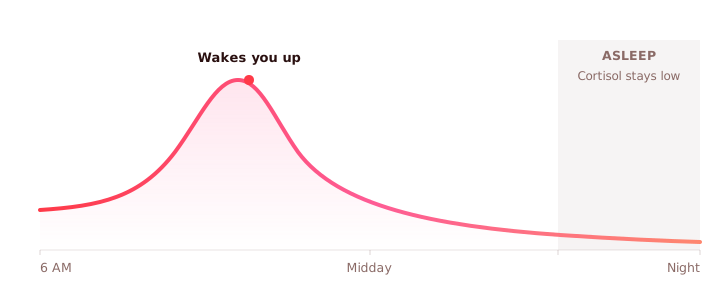
Cortisol is your body's main stress hormone, and it follows a daily rhythm. It rises sharply in the morning to help you wake up and feel alert, drifts down through the afternoon, and reaches its lowest point late at night. That nighttime low is part of what lets your body wind down and stay asleep.
Think of it as the opposite curve to the one that helps you sleep. When cortisol is doing its job, it steps back in the evening so rest can take over. When it doesn't step back, sleep gets harder, and the day that goes with it is the one people describe as tired but wired.
Why you wake up at 3 a.m.
A lot of people wake in the small hours for no obvious reason. If you are a woman in your 40s or 50s, perimenopause is a common and under-recognised cause, and it is worth reading about what else gets missed alongside it. One common explanation is an early or raised overnight cortisol rise that pulls you out of deeper sleep before your body is ready. Ongoing stress, late caffeine, alcohol before bed, and an irregular schedule can all push that rise earlier or higher; if you work nights, how night-shift work disrupts cortisol is its own distinct pattern.
The frustrating part is that you can't feel cortisol moving. You only feel the result: lighter sleep, early waking, or a mind that switches on at 3 a.m. If your tracker also shows a stress reading climbing overnight, that number is measuring arousal rather than the hormone.
A single test can't see your night
Cortisol is a pattern, not a single number. A blood test at 8 a.m. tells you nothing about what happened at 2 a.m. To understand how cortisol and sleep interact, you need the shape of the whole night, not one daytime snapshot. That is exactly what a one-off test misses, and why people are turning to continuous monitoring.
How to see your cortisol-sleep pattern
The Auromone Curve reads cortisol from a trace of sweat on your wrist continuously, overnight included. Instead of a single morning value, you see the evening drop and the morning rise lined up against your sleep. Over a couple of weeks you can watch whether a late workout, a glass of wine, or a stressful day changes the shape of your night.
For the full picture of what cortisol is and how it's measured, start with Cortisol 101, or see how the measurement methods compare.
Habits that support a healthy evening drop
These are general wellness habits, not medical advice, but they tend to support the natural evening decline:
- Get daylight early in the morning, which helps anchor the rhythm.
- Move your last caffeine earlier in the day.
- Keep a steady wake time, even on weekends.
- Give yourself a real wind-down before bed and limit late alcohol.
The point of measuring is to stop guessing. When you can see your own pattern, you can tell which of these actually moves it.
The cortisol–melatonin seesaw
Cortisol doesn't run your nights alone. It works in counterpoint with melatonin, the hormone that rises in darkness and helps you feel sleepy. Across the night the two sit roughly opposite each other: melatonin climbs in the evening and peaks in the small hours, while cortisol bottoms out around midnight, then begins its long climb toward morning as melatonin fades. Growth hormone, thyroid-stimulating hormone and the appetite hormones sit on the same overnight schedule, set out in the hormonal order of a night.
They aren't a perfect mirror image. Melatonin leads by several hours, so the handover is gradual rather than a switch. But the practical takeaway is simple: an evening when cortisol refuses to come down is an evening working against your own wind-down. That tug-of-war is often what "tired but wired" actually feels like.
What keeps cortisol up at night
A handful of everyday things tend to hold cortisol higher than it should be in the evening. None is a villain on its own; the point is to find out which one is yours.
| Evening habit | What it tends to do | A simpler swap |
|---|---|---|
| Late caffeine | Keeps cortisol and alertness up for hours after the last cup | Move your cut-off to early afternoon |
| Alcohol before bed | Can disrupt the overnight pattern and fragment sleep | Leave a few hours before lights-out |
| Late or intense workouts | Raise cortisol when it should be winding down | Shift hard sessions earlier; keep evenings gentle |
| Bright screens late | Delay the melatonin rise that offsets cortisol | Dim the room and the screen an hour before bed |
| Replaying the day in bed | Triggers a stress response right at wind-down | A short brain-dump or slow breathing before you lie down |
There's real science under this. In a well-known study, cutting sleep short raised cortisol the following evening, exactly when it should be at its lowest (Leproult and colleagues, Sleep, 1997). Poor nights and high evening cortisol feed each other, which is why breaking the loop matters more than any single fix.
A two-week experiment for better nights
Because you can't feel cortisol move, the only honest way to know what's helping is to change one thing at a time and watch. Here's a simple loop:
- Wear the Curve for a few nights first, to see your normal evening drop and overnight low.
- Change a single lever from the table above, and keep everything else the same.
- Watch the shape of your nights for about two weeks.
- Keep what visibly moved your evening down, and drop what didn't.
One change, two weeks, one clear answer. It's a long way from swallowing advice off the internet and hoping it's working.
This guide is for general wellness education only. The Auromone Curve is a general wellness device, not a diagnostic, and does not replace medical advice. If sleep problems persist, talk to a healthcare provider.
References
- StatPearls (NCBI Bookshelf). Physiology, Circadian Rhythm.
- Hirotsu C, et al. Interactions between sleep, stress, and metabolism: from physiological to pathological conditions. Sleep Science. 2015.
- StatPearls (NCBI Bookshelf). Physiology, Cortisol.