What the cortisol awakening response is
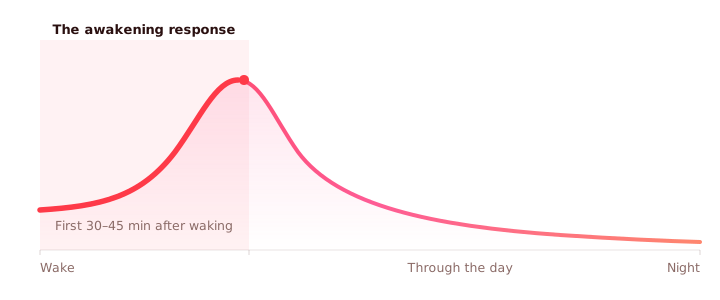
The cortisol awakening response, often shortened to CAR, is the steep rise in cortisol that happens in the first 30 to 45 minutes after you wake up. It sits at the start of your daily cortisol curve, just before the morning high, and it is the last event in a longer overnight sequence that runs through melatonin, growth hormone and the thyroid axis. It's normal, it's expected, and it's part of how your body gets going.
If cortisol is your built-in alarm, the awakening response is the alarm actually going off.
Why it matters
A clear morning rise lines up with feeling awake, focused, and ready for the day. When the rise is there and well-timed, mornings tend to feel easier. When it's flat or off, mornings can feel foggy and slow, even after a full night in bed.
Researchers pay attention to the awakening response because its shape tracks with stress and recovery over time. The goal is not a single "good number," it's a rise that shows up at the right time and settles into a healthy daily curve.
What a healthy rise looks like, and what changes it
A typical pattern is a quick climb after waking, a morning peak, then a slow drop across the day. Two common ways it shifts:
- An exaggerated rise can show up with ongoing stress.
- A flat or blunted rise can show up with burnout, poor sleep, or night-shift work.
You can't feel any of this happening. It's invisible unless you measure it, which is why the awakening response is usually missed.
How it's measured, and the easier way
The traditional way to capture the awakening response is several saliva samples in the first hour after waking, on a strict timer. It works, but few people keep it up. A single blood test can't capture it at all, because it's one moment and the response is a short curve. That strict timing is also why the best time to test cortisol is so particular for the morning rise.
The Auromone Curve reads cortisol from a trace of sweat continuously, so your morning rise simply appears as part of your daily curve, no timed spitting required. Over a couple of weeks you can see whether your awakening response is consistent and well-timed. For the basics, see Cortisol 101; for how methods stack up, see the comparison.
What a typical awakening response looks like
Researchers who study the awakening response describe a fairly consistent shape:
- A steep climb that begins the moment you wake.
- A peak about 30 to 45 minutes later, often around 50% above your waking level.
- A gradual settle into the slow daytime decline that carries cortisol down toward its nighttime low.
The exact numbers vary from person to person and day to day. That roughly 50% rise over the waking baseline in healthy adults comes from decades of saliva-sampling research (Clow and colleagues, 2004). What matters for you isn't hitting a specific figure, it's whether the rise reliably shows up at all.
What shifts your CAR
The morning rise is sensitive to how you're living. A few of the things that reliably move it:
| Factor | How it can change the morning rise |
|---|---|
| Chronic stress | Can exaggerate the rise, or over time flatten it |
| Poor or short sleep | Often blunts the rise the next morning |
| Night-shift work | Shifts or dampens it, out of step with the clock |
| Weekday vs weekend | The rise is often larger on workdays than rest days |
| The time you wake | Waking earlier tends to produce a larger rise |
Because the response is so tied to stress and recovery, a flat or missing rise is one of the patterns associated with burnout. That is not a diagnosis, and no wearable can tell you whether you are burned out. What a continuous reading can show you is the shape of your own morning rise.
How to read your own morning rise
The traditional research method is precise but demanding: several timed saliva samples in the first hour after waking, following an expert protocol (Stalder and colleagues, 2016). Continuous monitoring gets you the shape without the stopwatch.
- Wear the Curve overnight, so it's already reading when you wake.
- Look at the first hour after waking, where the rise lives.
- Compare a run of mornings: is the rise consistent, or all over the place?
Over a couple of weeks you stop guessing whether your mornings are "off" and start seeing it.
This guide is for general wellness education only. The Auromone Curve is a general wellness device, not a diagnostic, and does not replace medical advice.
References
- Stalder T, et al. Assessment of the cortisol awakening response: expert consensus guidelines. Psychoneuroendocrinology. 2016.
- StatPearls (NCBI Bookshelf). Physiology, Cortisol.
- StatPearls (NCBI Bookshelf). Physiology, Circadian Rhythm.