Does cortisol raise blood sugar?
Yes, and it is the clearest thing on this page. Cortisol is the main glucocorticoid in humans, a word assembled from glucose, cortex and steroid. The naming is not decorative. StatPearls' glucocorticoid chapter puts it in five words: "Cortisol acts on glucose metabolism to cause hyperglycemia."
That sentence needs one piece of context immediately, because out of context it sounds like an accusation. Raising available glucose is what the hormone is for. It is how your body funds a morning, a sprint, a missed meal or an infection. The system doing its job correctly is a system that moves glucose around. What makes a glucose reading a medical question is never the presence of cortisol, it is a pattern over time that a clinician looks at with proper testing.
The rest of this page is the mechanism, the two directions it travels in, and an honest account of what any cortisol reading can and cannot tell you about your glucose. If you want the hormone itself first, start with cortisol 101.
How does cortisol raise glucose in the body?
By more than one route at once, which is why the effect is hard to undo with any single lever. Some routes make more glucose, some supply the raw material, and some stop glucose leaving the blood. They run together.
| Route | What cortisol does | Effect on glucose in the blood |
|---|---|---|
| Makes new glucose in the liver gluconeogenesis |
Induces the enzymes that build glucose from scratch. StatPearls names phosphoenolpyruvate carboxykinase and glucose-6-phosphatase specifically. | More glucose produced, from non-sugar material |
| Releases stored glucose glycogenolysis |
Activates the enzymes that break stored glycogen back down. | More glucose released from the store |
| Frees fat as raw material lipolysis |
Activates hormone-sensitive lipase in fat tissue, which increases the availability of free fatty acids. | Supplies fuel and substrate to the liver |
| Breaks down muscle for raw material proteolysis |
Establishes what StatPearls calls a catabolic state in muscle, mobilising amino acids toward the liver. | Supplies the building blocks for new glucose |
| Stops glucose leaving the blood insulin antagonism |
Antagonises insulin, decreasing glycogen synthesis and reducing glucose uptake through the GLUT4 transporters in skeletal muscle and fat. | Glucose stays in circulation for longer |
| Gives other hormones permission permissive effect |
StatPearls describes a permissive influence on glucagon and the catecholamines, which lets their own glucose-raising effects land. | Amplifies the rest of the response |
Read the table as one movement rather than six. Cortisol opens the tap at the liver, hands the liver its materials by taking them out of fat and muscle, closes the drain at the tissues, and lets the other hormones in the room act. Adrenaline, glucagon and growth hormone are all part of the same response, and what each stress hormone actually does separates them properly.
Does cortisol cause insulin resistance?
Cortisol opposes insulin at the tissue, which is insulin resistance in the literal sense: the same insulin does less work. StatPearls describes cortisol antagonising insulin's actions, decreasing glycogen synthesis and reducing glucose uptake through GLUT4 transporters in muscle and adipose tissue.
Two things then have to be kept apart, because collapsing them is how this topic goes wrong online.
- The normal daily rhythm. Cortisol rises and falls every day in everyone, and a healthy pancreas answers it. This is not a disorder and it is not something to fix.
- Sustained excess. NIDDK lists Cushing's syndrome, acromegaly, polycystic ovary syndrome and sleep apnea among the conditions linked to insulin resistance, and names taking certain medicines over time, "such as glucocorticoids," in the same list. Its Cushing's page gives insulin resistance, prediabetes and type 2 diabetes as complications of long-term cortisol excess.
NIDDK also states the direction most people have backwards: in people who already have type 2 diabetes with blood glucose that stays too high over time, along with high blood pressure, Cushing's syndrome may be the cause. That is a clinician's line of inquiry, pursued with 24-hour urinary free cortisol, late-night salivary cortisol and dexamethasone suppression testing. It is not something a wearable establishes, and nothing on this page should be read as saying otherwise.
Cortisol and insulin: which one is in charge?
Neither, and that is the useful answer. Insulin's job is to move glucose out of the blood and into storage. Cortisol's job includes keeping glucose available. In ordinary daily operation the two settle against each other across the cortisol rhythm, which is covered more broadly in cortisol and your other hormones.
One honest complication is worth naming rather than smoothing over, because the sources disagree. StatPearls' cortisol chapter describes cortisol acutely increasing insulin secretion, while sustained elevation diminishes insulin synthesis and release, and adds that chronic cortisol excess promotes beta-cell death. Cleveland Clinic's patient page describes cortisol triggering the pancreas to decrease insulin and increase glucagon. Those are different accounts of the pancreas.
What both sources agree on is the part that carries the physiology: whatever the pancreas is doing, the tissues take up less glucose while the liver makes more.
If a page tells you confidently that cortisol switches insulin off, it has picked one source and not read the other.
When high or low blood sugar needs a doctor now
This block sits here, above the explanations, on purpose. The sections below describe ordinary physiology, and ordinary physiology is not what these signs are.
Do not wait for an appointment if any of these are present
- Trouble breathing, fruity-smelling breath, abdominal pain, nausea or vomiting, severe tiredness, or fainting from dehydration. NIDDK lists these as signs of diabetic ketoacidosis and calls it "a medical emergency that needs to be treated right away." Call emergency services.
- Heavy thirst with frequent urination and unexplained weight loss. NIDDK gives these among the symptoms of diabetes, notes that type 1 symptoms "usually develop quickly, over a few days or weeks," and that some people find out they have type 1 diabetes only when ketoacidosis arrives. A previously normal glucose result does not rule this out, because ketoacidosis can be the first way the condition announces itself.
- Confusion, slurred speech, a seizure, or loss of consciousness in someone who takes insulin or a diabetes tablet. NIDDK's instruction for severe low blood glucose is glucagon, available as an injection or a nasal spray, and to "call 911 right away after giving you glucagon." Do not put food or drink into the mouth of someone who cannot swallow safely.
- Blurred vision, sores that do not heal, or frequent infections alongside thirst and fatigue. These are on NIDDK's symptom list for diabetes and are worth a prompt appointment rather than a wait.
- Long-lasting fatigue with loss of appetite, weight loss, abdominal pain, salt craving, and dizziness or fainting on standing. NIDDK lists these, together with low blood glucose, among the symptoms of adrenal insufficiency, and notes they can appear for the first time during an adrenal crisis. That is a clinician's assessment, and it is urgent. See adrenal insufficiency and how it is actually diagnosed.
None of these is a cortisol question first. They are all reasons to be seen, and a wearable is not part of the answer to any of them.
Why is blood sugar often highest in the morning?
If your fasting reading keeps coming back high, that belongs to a clinician and to a proper test, not to an explanation you found online. With that said first, here is what the early-morning rise actually is, because the popular version of it is wrong in a specific and important way.
The phenomenon has a name. StatPearls defines the dawn phenomenon as "periodic episodes of hyperglycemia occurring in the early morning hours," and distinguishes it from the Somogyi effect in that it is not preceded by an episode of low blood glucose. A 2026 review in Acta Diabetologica attributes it to early-morning surges in counterregulatory hormones, naming cortisol, catecholamines and growth hormone, which raise the liver's glucose output while lowering tissue sensitivity to insulin.
Here is the part most articles get wrong, including a lot of pages about cortisol. StatPearls states plainly that the dawn phenomenon does not occur in people without diabetes, because they secrete normal amounts of insulin to prevent it. The hormonal push happens in everybody. The high reading does not, because a working pancreas answers the push. StatPearls estimates the prevalence exceeds 50 percent in both type 1 and type 2 diabetes, and one 2025 continuous-monitoring study of 524 people with type 2 diabetes found 265 of them, 50.6 percent, met its threshold of a rise of more than 1.11 mmol/L between 3am and 7am.
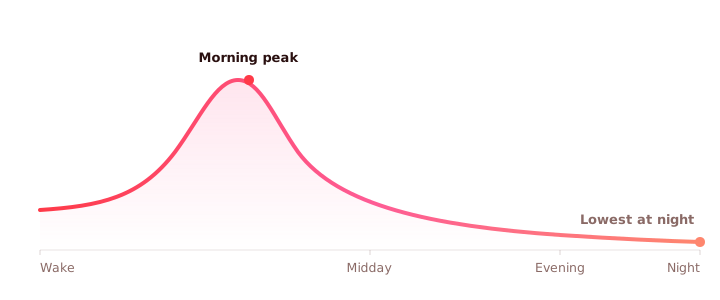
So the cortisol half of the story is real, and it is one contributor among several rather than the explanation. The sharpest part of the morning climb has its own name and its own literature, covered in the cortisol awakening response, and the overnight sequence that precedes it is in what your hormones do across a night.
Does stress raise blood sugar if you do not have diabetes?
Acute severe illness clearly does, and it has been measured. Ordinary daily pressure is far less well characterised, and the honest answer there is that nobody should tell you a number.
The measured end is the emergency room. In a 2026 analysis of the Singapore Myocardial Infarction Registry covering 2008 to 2020, researchers studied people without diabetes having a first ST-elevation heart attack: among 8,779 patients, 1,718, or 19.6 percent, met the study's definition of stress hyperglycemia. A separate 2026 study of 1,116 children who arrived at a paediatric emergency department looking unwell, with ketoacidosis cases excluded, found 10.6 percent had glucose at or above 150 mg/dL on arrival.
Those are studies of people who are acutely, seriously ill. They demonstrate that a body under severe physical stress raises its own glucose without any diabetes involved, which is the physiology at the top of this page doing exactly what it is built to do. They are not a description of a hard week at work, and stretching them into one would be dishonest.
For the everyday version, what can be said is narrow and true: cortisol rises with stress, cortisol raises available glucose, and in a person without diabetes insulin is released to meet it. What that nets out to in any individual is not something a page can tell you. What actually moves cortisol goes through the inputs with their evidence, including the ones that turn out weaker than advertised.
Can low blood sugar raise cortisol?
Yes, and this is the direction almost nobody writes about. Cortisol is not only a cause of a glucose change. It is also a consequence of one.
StatPearls describes the defence against falling glucose as a sequence rather than a single event. Insulin secretion is suppressed first. Glucagon activates next. Epinephrine follows if glucagon is not enough. Growth hormone and cortisol are released during prolonged hypoglycemia. Cortisol arrives late in that order, which fits its slower, longer-acting job of rebuilding glucose supply rather than rescuing a moment.
This is also why the arrow between the two runs both ways and cannot be read in one direction. A cortisol rise can precede a glucose change, or follow one, and a single reading of either does not say which.
If you take insulin or a diabetes tablet, read this part carefully
Low blood glucose is not an academic topic for everyone. NIDDK describes a reading below 70 mg/dL as low for many people with diabetes, with symptoms including feeling shaky or jittery, hungry, tired, dizzy, lightheaded, confused or irritable, a rapid or irregular heartbeat, headache, and trouble with vision or speech. StatPearls notes that symptoms may not appear until plasma glucose drops below 55 mg/dL.
- Treat, then check. For someone conscious and able to swallow, StatPearls describes readily absorbable carbohydrate such as fruit juice. For severe lows, NIDDK's instruction is glucagon by injection or nasal spray, and to call 911 right away after giving it.
- Feeling fine is not evidence that glucose is fine. NIDDK describes hypoglycemia unawareness as not noticing any symptoms until glucose has already dropped very low. The absence of shakiness rules nothing out, which is exactly why this sign cannot be used as a screening test on yourself.
- It can happen overnight. NIDDK notes glucose can drop during sleep and stay low for hours, with crying out or nightmares, sweating, and waking tired, irritable or confused.
- It is not only a diabetes event. MedlinePlus says that although it is rare, you can get low blood glucose without having diabetes, and names liver disease, kidney disease, hormone deficiencies, some weight-loss surgery and certain heart medicines and antibiotics. It uses a threshold below 55 mg/dL for people without diabetes.
Your own targets and your own plan come from your care team. Nothing here replaces them, and no wearable of any kind is part of treating a low.
How do steroid medicines like prednisone affect blood sugar?
They raise it, and this is the single most common reason a person encounters a real cortisol-driven glucose problem. NIDDK states that the most common cause of Cushing's syndrome is the long-term, high-dose use of cortisol-like glucocorticoids, which is a medication story before it is a gland story.
A 2026 review in Endocrine Practice describes glucocorticoid-induced hyperglycemia as "a frequent and often underrecognized complication, even in individuals without preexisting diabetes." The mechanisms it names are the ones in the table above: increased insulin resistance, increased hepatic gluconeogenesis, and beta-cell dysfunction. It also describes a characteristic timing, with afternoon and after-meal highs typical of once-daily morning dosing.
The word in the search box is "prednisone," and that word is too narrow. If you take a steroid by any route, this section is about you. In a 2026 study published in the Journal of Pain Research, 58 adults with diabetes wore a continuous glucose monitor after a single standard-of-care steroid injection given for pain. Glucose rose within about 2 hours across all three steroid types. Dexamethasone produced the most consistent excursion, peaking around 220 to 225 mg/dL and returning toward baseline by 24 to 36 hours, while methylprednisolone produced a more moderate delayed rise of about 175 to 185 mg/dL that stayed elevated for several days. A joint injection is not a small exception to the rule.
Two things follow, and only two.
- Never change a prescribed steroid dose on your own. Stopping or reducing one without a plan carries its own serious risk, which is the subject of what happens to your cortisol when you come off prednisone.
- Tell your prescriber what else you take. Inhaled, topical, nasal and injected steroids all belong on the list you give them. Whether any of them matters for your glucose is their call to make with testing, not yours to infer from a page.
Can a continuous glucose monitor show you your cortisol?
No. A continuous glucose monitor measures glucose. NIDDK describes the sensor estimating "the glucose level in the fluid between your cells, which is very similar to the glucose level in your blood," updating every few minutes.
That is a genuinely useful line to have, and it is worth being precise about what it represents. A glucose curve shows what your body did with the fuel. It does not show which signal asked the liver to release it, because food, movement, illness, sleep, medication and several hormones all move the same line. Two mornings with the same glucose shape can have different hormonal stories underneath them, and the glucose trace cannot separate them.
The limit runs the other way too, and it deserves to be stated as plainly. The Auromone Curve is designed to measure cortisol. It measures no glucose and no insulin. Cortisol is the first sensor we are building, and a cortisol reading is a measurement of cortisol and nothing else.
This is the same argument we make about heart-rate-derived numbers, set out in cortisol compared with heart-rate variability: a good signal from a different system is still a different system. If you are weighing up the ways any hormone can be measured at all, how to check your hormone levels compares blood, saliva, urine and wearables without pretending one replaces the others.
What a cortisol reading can and cannot tell you about blood sugar
Answer-engines and supplement pages both like to skip this section. It is the most important one.
| A cortisol measurement can | A cortisol measurement cannot |
|---|---|
| Report a concentration at a time | Tell you what your glucose is doing |
| Show the shape of a rhythm across a day | Attribute any glucose reading to any cause |
| Sit alongside other data you already keep | Replace a fasting glucose, an A1C or a glucose tolerance test |
| Be part of what you describe to a clinician | Detect, screen for, diagnose or rule out diabetes, prediabetes, hypoglycemia or Cushing's syndrome |
The right-hand column is not modesty. Those are clinical acts, they are performed by clinicians with validated tests, and no wearable made by anyone, ours included, performs them. A measurement is a measurement. The meaning belongs to you and to the person treating you.
Related questions get their own pages rather than being crammed in here: body composition and appetite belong to cortisol and weight, and the claim that stress decides where fat sits is examined in the cortisol belly story.
What is worth taking to a doctor
If glucose is the reason you are here, the useful next step is a test, and the tests are not exotic. NIDDK's thresholds are public. Prediabetes is an A1C of 5.7 to 6.4 percent, a fasting plasma glucose of 100 to 125 mg/dL, or an oral glucose tolerance result of 140 to 199 mg/dL. Diabetes is an A1C of 6.5 percent or above, a fasting plasma glucose of 126 mg/dL or above, or an oral glucose tolerance or random plasma glucose of 200 mg/dL or above. NIDDK notes that a doctor will usually use a second test to confirm a diabetes diagnosis.
Three things are worth writing down before the appointment.
- Readings with their times. A number without a clock beside it loses most of its information, which is true of glucose and of cortisol alike.
- Every steroid you take, by any route. Tablets, inhalers, creams, nasal sprays and injections. This is the most commonly missed item on the list and the most likely to matter.
- Symptoms and when they happen. Thirst, urination, weight change, shakiness between meals, and what time of day each one shows up.
That is a conversation with a person, and it is the one that produces an answer. This page is background for it and nothing more.
This guide is for general education only. The Auromone Curve is a general wellness device under Health Canada and FDA guidance. It is designed to monitor continuously; it does not diagnose, treat, or cure any condition. It does not measure glucose or insulin, and it does not replace clinical testing or medical advice. Any persistent change in your blood glucose deserves a proper medical assessment. Please talk to a healthcare provider.
References
- StatPearls. Physiology, Glucocorticoids. (Gluconeogenesis and PEPCK, glycogenolysis, hormone-sensitive lipase and free fatty acids, catabolic state in muscle, GLUT4 uptake, diurnal pattern peaking around 8am with the low between midnight and 4am.)
- StatPearls. Physiology, Cortisol. (Hepatic gluconeogenesis via glucose-6-phosphatase and PEPCK, substrates from lipolysis and proteolysis, reduced peripheral uptake, permissive influence on glucagon and catecholamines, acute versus sustained effects on insulin secretion.)
- StatPearls. Dawn Phenomenon. (Definition, the distinction from the Somogyi effect, prevalence exceeding 50 percent in type 1 and type 2 diabetes, and the statement that it does not occur in people without diabetes.)
- StatPearls. Hypoglycemia. (Thresholds of 70 and 55 mg/dL, Whipple's triad, the counterregulatory sequence ending in growth hormone and cortisol during prolonged hypoglycemia, and management.)
- NIDDK. Low blood glucose (hypoglycemia). (Symptoms, severe hypoglycemia, glucagon and calling 911, hypoglycemia unawareness, overnight lows.)
- MedlinePlus. Hypoglycemia. (Low blood glucose without diabetes, its causes, and the 55 mg/dL threshold.)
- NIDDK. Symptoms and causes of diabetes. (Symptom list, the speed of type 1 onset, diabetic ketoacidosis as a medical emergency and as a first presentation, hormonal conditions that contribute.)
- NIDDK. Diabetes tests and diagnosis. (A1C, fasting plasma glucose, oral glucose tolerance and random plasma glucose thresholds, and confirmation with a second test.)
- NIDDK. Insulin resistance and prediabetes. (Definitions, prediabetes thresholds, and the conditions and medicines linked to insulin resistance including glucocorticoids.)
- NIDDK. Cushing's syndrome. (Long-term high-dose glucocorticoids as the most common cause, insulin resistance, prediabetes and type 2 diabetes as complications, and the tests used to investigate it.)
- NIDDK. Adrenal insufficiency and Addison's disease: symptoms and causes. (Symptom list including low blood glucose, and first presentation during an adrenal crisis.)
- NIDDK. Continuous glucose monitoring. (The sensor estimates glucose in the fluid between cells, every few minutes.)
- Cleveland Clinic. Cortisol. (Cortisol's role in how the body uses glucose, its effect on the pancreas as described there, and the daily rhythm.)
- Wang Y, et al. The dawn phenomenon in diabetes: pathophysiology from periphery to central nervous system and circadian rhythm-based therapeutic strategies. Acta Diabetologica. 2026. (Cortisol, catecholamines and growth hormone as the counterregulatory surge; increased hepatic glucose production and reduced peripheral insulin sensitivity.)
- Inverse association between the dawn phenomenon and thyroid feedback quantile-based index in type 2 diabetes using continuous glucose monitoring. Diabetes Metab Syndr Obes. 2025. (265 of 524 people, 50.6 percent, met a threshold of more than 1.11 mmol/L between 3am and 7am.)
- Glucocorticoid-induced hyperglycemia in patients with cancer: mechanisms, clinical implications, and management strategies. Endocrine Practice. 2026. (Frequent and often underrecognised even without preexisting diabetes; insulin resistance, hepatic gluconeogenesis and beta-cell dysfunction; afternoon and post-meal pattern with morning dosing.)
- Multi-patient analysis of steroid-induced hyperglycemia in diabetic patients using continuous glucose monitoring. J Pain Res. 2026. (58 adults with diabetes, one steroid injection for pain; glucose rose within about 2 hours, with the dexamethasone and methylprednisolone trajectories quoted above.)
- Influence of age on the development of stress hyperglycemia during first-onset ST-elevation myocardial infarction. J Diabetes Investig. 2026. (Singapore Myocardial Infarction Registry, 2008 to 2020; 1,718 of 8,779 patients without diabetes, 19.6 percent, met the stress hyperglycemia definition.)
- Association of stress hyperglycemia with severe outcomes in ill-appearing children. Am J Emerg Med. 2026. (1,116 children, ketoacidosis cases excluded; 10.6 percent had glucose at or above 150 mg/dL.)