What is the Hume Band?
A wrist-worn tracker sold by Hume Health, alongside a smart scale called the Body Pod and an app that ties the two together. The current model is the Band 2.0. Hume's product page headline describes it as "The wearable designed to extend your lifespan and detect early illness", and the specification block lists "5 LEDs and 4 photodiodes", "Up to 14 days of battery life with typical use", and Bluetooth Low Energy. Hume Health, Hume Band, Hume Body Pod, Health Score, Metabolic Capacity and Metabolic Momentum are their marks, and everything quoted here is their wording.
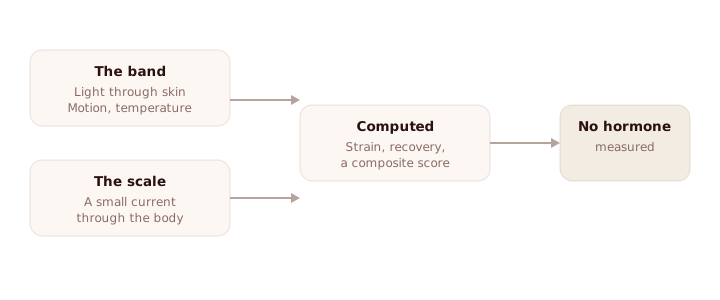
Two things make the product worth a careful read rather than a shrug. The first is that it spans two very different sensing methods, optical at the wrist and electrical on the scale, so it is a useful way to see what each can and cannot resolve. The second is the size of the output: Hume's metrics catalogue groups the band's readouts under cardiovascular, sleep, activity and strain, recovery and metabolic headings, and the Body Pod page lists 45 metrics, including per-limb fat, muscle and water figures.
A long list of outputs is not the same as a long list of measurements. A handful of raw signals can generate dozens of derived numbers, and the derivation is where the interesting questions live. So the useful way to read any wearable's spec sheet, including the one I am building, is to sort every line into sensed or computed.
What does the Hume Band measure?
Four physical things: light returned from your skin, motion, skin temperature and time. Everything below that line in the table is arithmetic performed on those four.
The optical part is photoplethysmography. An LED shines into the skin, a photodiode counts the light that comes back, and because blood absorbs light, the returning signal rises and falls with each heartbeat. The 2023 wearable photoplethysmography roadmap in Physiological Measurement describes it as "a key sensing technology which is used in wearable devices such as smartwatches and fitness trackers", currently used to monitor "heart rate and heart rhythm" and to track sleep and exercise. Add more wavelengths and the ratio of absorption at each gives an estimate of how saturated your blood is with oxygen.
| What the band reports | Where it comes from | Sensed or computed |
|---|---|---|
| Heart rate, resting heart rate | Pulses counted in the optical signal | Sensed, closest to raw |
| Heart-rate variability | Timing differences between consecutive pulses | Computed from pulse timing |
| Blood oxygen (SpO2) | Ratio of light absorbed at different wavelengths | Modelled from absorption |
| Skin temperature | Temperature sensor against the wrist | Sensed, and it is skin, not core |
| Steps, activity, movement patterns | Accelerometer | Sensed, then classified |
| Sleep stages, sleep quality | Model trained to predict stage labels from the above | Computed |
| Strain, Recovery, Metabolic Capacity | Proprietary combination of the above | Computed |
| Biological Age, Pace of Aging, Metabolic Momentum | Proprietary models over trends in the above | Computed |
| Health Score | Composite of other scores | Computed from computed values |
| Blood Pressure Insights | Modelled from the optical pulse waveform, with no cuff | Computed, see below |
Hume's FAQ answer to what raw data does the Hume Band track and measure lists continuous heart rate, heart-rate variability, blood oxygen, sleep stages, sleep quality and efficiency, activity and movement patterns, strain and recovery, skin temperature, and Blood Pressure Insights. One version of that FAQ on the same page also lists respiratory rate. Sleep stages sit in that list beside heart rate, which is worth noticing, because a sleep stage from any wrist or finger device is a prediction of what a sleep technician would have scored, not a reading of brain activity.
What does the Body Pod measure, and how does impedance work?
It measures your weight and your body's resistance to a small electrical current. Fat, muscle, bone and visceral fat are estimated from those two numbers plus an equation.
Lean tissue holds most of the body's water and dissolved salts, so it conducts. Fat and bone hold much less water and resist more. Pass a small alternating current between electrodes, measure the opposition it meets, and you have a number that correlates with how much conductive tissue is in the path. You then feed that number, with height, weight, age and sex, into a prediction equation built from a population that was measured by a reference method.
That last step is the whole game, and the European Society for Clinical Nutrition and Metabolism review by Kyle and colleagues is blunt about it. Impedance "allows the determination of the fat-free mass (FFM) and total body water (TBW) in subjects without significant fluid and electrolyte abnormalities, when using appropriate population, age or pathology-specific BIA equations", while the technique as a whole "suffers from a lack of standardized method and quality control procedures". On the finer splits that consumer devices now advertise, the same review says determining changes in intracellular and extracellular water "requires further research using a valid model", and that segmental and multi-frequency impedance in altered hydration states "also requires further research". That review is from 2004 and hardware has moved on, but the dependence on a population equation has not.
Hume's hardware is at the serious end of the consumer category. Its accuracy article describes the Body Pod as "8-electrode segmental BIA architecture, measuring independently through both arms, both legs, and the trunk", running "at multiple frequencies across a 20kHz to 100kHz spectrum" and performing "64 individual bioelectrical impedance scans per session" combined with a Kalman filter. Eight electrodes genuinely does address a real limitation, which is that a foot-to-foot scale sends current through your legs and infers your torso.
How accurate is body-composition measurement at home?
Good enough to follow your own trend, not good enough to treat one reading as your body fat percentage. That is true of the category, and the useful part is knowing the size of the gap.
Hume publishes figures for both. Its accuracy article states that "most consumer smart scales fall within ±3–8 percentage points of DEXA for body fat" and that "the Hume Body Pod has been independently validated by Socotech to within 3% of DEXA accuracy". I have not seen the Socotech report itself and could not find it published on their site, so I can report that Hume says it, and no more.
Independently, Li and colleagues in PLOS ONE compared impedance against DXA in 189 adults during a six-month weight-loss trial. Against DXA, impedance underestimated body fat by a mean of 4.6 percentage points in men and 5.1 in women at baseline, with 95% limits of agreement of −2.4 to 11.7 and −2.4 to 12.7 respectively. Their conclusion is the practically important one: impedance gave a relatively accurate estimate at the end of the programme, but was less accurate for obese individuals at baseline and for the amount of change during the intervention. In other words the error is not a fixed offset that cancels out when you subtract two readings.
Credit where it is due: Hume's own article names four reasons consumer impedance goes wrong, single-path measurement, single-frequency measurement, population equations and hydration sensitivity, and states plainly that "if you are dehydrated, your body fat will likely be overestimated". Its internal analysis of members using GLP-1 medication carries a disclosure saying the work "has not undergone independent peer review" and that "Investigators have an inherent commercial interest in the outcomes described". Publishing the limitations and the conflict is more than the category usually does.
How to get a usable number from any impedance scale
Because the reading moves with your water, hold everything else still. Same time of day, ideally first thing. Similar hydration, before rather than after a long training session or a salty meal. Bare feet, same scale, same spot on the floor. Then read the trend over weeks and ignore day-to-day wobble. A single reading is an estimate with a wide error bar. Twenty readings in a row are a line.
What is the Hume Health Score made of?
Other numbers, weighted in a way the company does not publish, on a 0 to 900 scale. Two different descriptions of it were live on Hume's site when I read them in September 2026, and they do not describe the same thing.
The older article, dated March 2023, says Hume offers "a single, comprehensive number calculated every Monday, based on your individual scores from the previous week", invites you to "think of it like a credit score for your health", and says it "is calculated out of 900 and is built on four essential health pillars: body composition, activity, nutrition, and sleep".
The Health Score FAQ, dated March 2026, describes "a 0–900 metric" that summarises physiological signals from the band, and lists the inputs as resting heart rate, heart-rate variability, heart rate stability, blood oxygen, and sleep quality and recovery patterns, with Body Pod body composition adding "additional depth" when available. Nutrition and activity apps are in one description and not the other. I do not know which one governs the score in the current app, and Hume does not publish the weightings in either.
This is not a criticism unique to Hume, because every composite score in this category works this way. It is worth understanding what follows from it. A sleep stage can be checked against a sleep lab, so people can argue about the number. A composite wellbeing score has no reference standard anywhere in medicine, so there is nothing to be right or wrong against. It can be a perfectly reasonable thing to watch against your own history, and it cannot carry an accuracy figure, because an accuracy claim for a score with no gold standard is undefined rather than unproven. Hume states the limit directly in the same article: "our Health Score is not intended to provide medical advice or diagnose any health conditions".
Does the Hume Band measure stress?
It reports numbers about stress that are built from your heartbeat, your sleep and your movement. As of September 2026 Hume does not present any single number as a stress estimate. What it publishes instead is a framework of three ideas.
- Metabolic Capacity. Hume's guide calls it "the ceiling of combined physical and mental stress your body can productively handle on any given day", expressed "as a score from 1 to 100", rising and falling with sleep quality and accumulated stress.
- Strain. "The total stress placed on your body", split into positive strain from training and negative strain from psychological stress, illness and overtraining, then classified as muscular, cardiovascular or mental.
- Recovery. How the body restores itself after strain, with sleep as the primary driver, applied to positive strain first.
The inputs are real physiology. Hume's own explainer says heart-rate variability "reflects how well your nervous system adapts to stress", and that is a fair description of what variability tracks. Two things follow. Beat-to-beat variability moves on the timescale of a single breath while the hormonal response runs on a slower clock, so a strain number and a hormone reading taken at the same moment are not two views of one event. The hormone is also choosier than the number. Dickerson and Kemeny's meta-analysis of 208 laboratory studies of acute stressors reports that cortisol responses "varied widely across tasks", with the largest changes where a task was uncontrollable or carried social-evaluative threat, and the authors write that their findings "contradict the belief that cortisol is responsive to all types of stressors". A hard training session and a hostile meeting can both dent a recovery number. Only one of them is the kind of thing the cortisol system is built to answer, which is the argument of cortisol versus HRV.
A calm strain number is also not evidence that nothing is wrong. No consumer band is designed to detect a heart attack, and if you have symptoms that worry you, they go to a doctor regardless of what any device shows.
How accurate are wrist SpO2 and heart-rate readings?
Pulse rate from a wrist device is the strongest of these signals. Blood oxygen is the weakest, across every device and every skin tone.
Singh and colleagues, in a 2024 systematic review and meta-analysis in the Journal of Medical Internet Research covering 23 pulse-oximetry studies and 4 wearable pulse-rate studies, concluded that "SpO2 and PR measurements may be inaccurate across all skin pigmentation groups, breaching U.S. Food and Drug Administration guidance and industry standard thresholds", that pulse oximeters "significantly overestimate SpO2 for both light and dark skin pigmentation, but this overestimation may not be clinically relevant", and that pulse rates from wearables "exhibit no statistically or clinically significant bias based on skin pigmentation". Read that carefully, because it cuts both ways: the wearable pulse-rate result is reassuring, and the oxygen result is not, for anyone.
In hospital, where the stakes are different, Sjoding and colleagues found in the New England Journal of Medicine that among inpatients whose oximeter read 92 to 96%, arterial blood gas showed oxygen saturation below 88% in 11.7% of measurements in Black patients and 3.6% in White patients. Those were clinical finger oximeters on ill patients, not consumer wrist bands, so it does not transfer directly. It does establish that optical oxygen estimates can miss in a direction that matters, which is why a consumer SpO2 trend is not a substitute for a medical assessment if you are breathless.
One more piece of physics, and it is the one people miss: skin temperature is not core temperature. A wrist sensor reads the surface, which moves with room temperature, blankets and blood flow to the skin. It is useful as a relative trend against your own nights and it is not a thermometer for fever.
What do blood-pressure insights from a wrist band mean?
A band has no cuff, so it cannot squeeze an artery and feel when flow stops. Any blood-pressure number from a wrist device is modelled from the timing and shape of the pulse waveform. That modelling is an active research field, and the bodies that write the validation standards have not yet endorsed it for clinical use.
Hume's marketing for the Band 2.0 puts the feature confidently: "Blood pressure. Watched daily, no cuff required." and "Continuous blood pressure monitoring without the hassle." On the same product page, in one of two FAQ blocks listing what the band tracks, the entry reads "Blood Pressure (To be released in future app update, pending FDA approval)", while the other block lists "Blood Pressure Insights (NEW)" as a current biomarker. Both statements were on the page when I read it on 16 September 2026. I have not tested the device and I do not know which reflects what ships today, so I am reporting the contradiction rather than resolving it. Hume's own blood-pressure page is the clearest text of the three: "Hume Band 2.0 does not replace a doctor, blood-pressure cuff, ECG, or medical advice."
The independent picture is consistent. Parati and colleagues, in a 2026 scientific statement in the European Journal of Preventive Cardiology, write that "due to insufficient accuracy validation, this scientific statement does not recommend their use in clinical decisions in spite of their potential interest, in line with international guidelines not recommending their use in hypertension management". Mukkamala and colleagues, in Hypertension, add the structural problem: the 2018 universal validation standard for automated blood-pressure devices "is inappropriate for the validation of cuffless devices", so a cuffless device can pass a test that was never designed to catch how it fails, most obviously through drift away from whatever reading it was calibrated against.
If blood pressure is why you are shopping
Never change, reduce or stop a blood-pressure medication because of a number from a wearable. That decision belongs to the prescriber who can see a validated reading.
High blood pressure usually produces no symptoms at all, so feeling fine rules nothing out, and neither does a flat or reassuring trend on a wrist device. If you want to know your blood pressure, use a validated upper-arm cuff at home, take readings the way your clinician asks, and bring the log to the appointment. A wearable trend can be a prompt to do that. It is not a substitute for it.
Does the Hume Band measure cortisol?
No. As of September 2026, cortisol does not appear on Hume's product page, its specification list, its metrics catalogue or its Health Score documentation as something the band or the Body Pod measures. The only hormone mentioned anywhere in its band explainers is growth hormone, and that appears as background physiology about deep sleep, not as an output.
That is not a gap in Hume's engineering. It is the nature of the two sensing methods. Light returning from your skin carries information about blood volume and the colour of haemoglobin. A current crossing your torso carries information about how much salty water is in the way. Cortisol is a steroid molecule circulating at very low concentrations, and no amount of signal processing on a pulse waveform will pick it out, because its signature is not in that signal.
Measuring a hormone means two things: getting a sample that physically contains the molecule, and running an assay that binds or separates that molecule from everything else. In clinical practice that means blood, saliva or urine. MedlinePlus describes the usual arrangement: blood samples "usually taken twice during the day, once in the morning when cortisol levels are normally at their highest, and again around 4 p.m., when levels are normally much lower", saliva collected at several points, or all urine collected across 24 hours. The timing is part of the test, because cortisol is a hormone with a daily shape rather than a fixed level. If that is new, cortisol 101 covers the rhythm, and the measurement guide compares the collection methods against each other.
Sweat is the fourth fluid on that list, and it is the one you can sample continuously without a needle or a collection tube. The Auromone Curve is a band built around that: it measures cortisol from a trace of sweat at the wrist and shows you the shape of your own curve as it moves through the day. What it does not do is most of this page. It computes no strain, recovery or readiness number, it does not estimate blood pressure or body composition, it does not stage your sleep, and it measures no other hormone today. It is a general wellness device rather than a diagnostic, it will not tell you whether a reading is normal, and the first units ship in Q4 2026. The Curve band page has the detail.
How the Hume Band compares with other bands and rings
At the sensor level, far less separates these products than the marketing suggests. A ring, a band and a watch nearly all start from the same raw material: an optical pulse signal, an accelerometer, a skin thermometer, and on some models an electrical contact for an ECG trace or a body-composition estimate. The Oura Ring, WHOOP, Garmin, Apple Watch and the Hume Band differ mainly in where the sensor sits, how often it samples, and what the company chooses to compute and show.
So the honest comparison questions are not which one measures more. They are narrower. Which signals does it actually sense, as opposed to derive? Has the derivation been checked against a reference standard, and does that reference standard exist at all? Does the number change your decisions, or only your mood? For the device-by-device version of the first question, see what the Apple Watch, WHOOP, Oura and Garmin are actually sensing, and the wearable comparison puts a continuous hormone reading beside them.
Where Hume is genuinely doing something the ring and watch makers are not is the scale. Pairing a wrist band with an 8-electrode impedance platform gives it a body-composition trend that a wrist alone cannot produce, and that is a real product decision rather than a marketing one. It is also a different question from the one this site is about, which is what your hormones are doing between the readings.
This guide is for general wellness education only. The Auromone Curve is a general wellness device, not a diagnostic, and does not replace medical advice or clinical testing. Hume Health, Hume Band, Hume Body Pod, Health Score, Metabolic Capacity and Metabolic Momentum are trademarks of their owner, and product descriptions here quote Hume's own published pages as they stood in September 2026, which may change. I have not tested either Hume device. If you have symptoms that concern you, talk to a healthcare provider.
References
- Hume Health. The Hume Band 2.0, product page. (Read 16 September 2026. "5 LEDs and 4 photodiodes"; "Up to 14 days of battery life with typical use"; the biomarker list; "Blood pressure. Watched daily, no cuff required."; both FAQ blocks, one listing "Blood Pressure Insights (NEW)" and one listing "Blood Pressure (To be released in future app update, pending FDA approval)"; "The wearable designed to extend your lifespan and detect early illness".)
- Hume Health. What Does the Hume Band Measure? 19 January 2026. (The metric list; "HRV reflects how well your nervous system adapts to stress".)
- Hume Health. The Complete Guide to the Hume Band. 16 March 2026. (Metabolic Capacity as "the ceiling of combined physical and mental stress your body can productively handle on any given day", "a score from 1 to 100"; Strain as "the total stress placed on your body", positive and negative; the Cardiovascular Health Score as a 0 to 100 assessment.)
- Hume Health. Hume Band metrics catalogue. (The grouping of band outputs under cardiovascular, sleep, activity and strain, recovery and metabolic headings.)
- Hume Health. Hume Health Score. 16 March 2023. ("A single, comprehensive number calculated every Monday"; "calculated out of 900"; the four pillars; "our Health Score is not intended to provide medical advice or diagnose any health conditions".)
- Hume Health. Your Hume Health Score: FAQ. 18 March 2026. ("A 0–900 metric"; the cardiovascular and sleep inputs; Body Pod data adding "additional depth".)
- Hume Health. Smart Scale Accuracy: How BIA, DEXA, and the Hume Body Pod Compare. 26 March 2026. ("±3–8 percentage points of DEXA"; "independently validated by Socotech to within 3% of DEXA accuracy"; 8 electrodes, 20kHz to 100kHz, 64 scans, Kalman filtering; the single-path, single-frequency, population-equation and hydration limitations.)
- Hume Health. What Does the Hume Body Pod Track? (The 45-metric list; the Pod described as "a bioelectrical impedance analysis device measuring whole-body and segmental lean mass, fat mass, and total body water"; the internal GLP-1 outcomes analysis and its disclosure that it "has not undergone independent peer review" and that "Investigators have an inherent commercial interest in the outcomes described".)
- Hume Health. Hume Band Blood Pressure Insights. ("Hume Band 2.0 does not replace a doctor, blood-pressure cuff, ECG, or medical advice."; "Hume Band 2.0 is not a diagnosis.")
- Charlton PH, et al. The 2023 wearable photoplethysmography roadmap. Physiol Meas. 2023;44. (Photoplethysmography as "a key sensing technology which is used in wearable devices such as smartwatches and fitness trackers", monitoring "heart rate and heart rhythm" and tracking sleep and exercise.)
- Kyle UG, Bosaeus I, De Lorenzo AD, Deurenberg P, et al. Bioelectrical impedance analysis, part I: review of principles and methods. Clin Nutr. 2004;23:1226-1243. (Fat-free mass and total body water determination conditional on appropriate population-specific equations; "suffers from a lack of standardized method and quality control procedures"; intracellular and extracellular water changes, segmental and multi-frequency impedance in altered hydration states "requires further research".)
- Li YC, Li CI, Lin WY, et al. Percentage of Body Fat Assessment Using Bioelectrical Impedance Analysis and Dual-Energy X-ray Absorptiometry in a Weight Loss Program for Obese or Overweight Chinese Adults. PLoS One. 2013;8(4):e58272. (n = 189, 73 men and 116 women; impedance underestimated body fat versus DXA by a mean 4.6 points in men and 5.1 in women at baseline, 95% limits of agreement −2.4 to 11.7 and −2.4 to 12.7; less accurate at baseline in obese participants and for change during the intervention.)
- Singh S, Bennett MR, Chen C, Shin S. Impact of Skin Pigmentation on Pulse Oximetry Blood Oxygenation and Wearable Pulse Rate Accuracy: Systematic Review and Meta-Analysis. J Med Internet Res. 2024;26:e62769. (23 pulse-oximetry studies and 4 wearable pulse-rate studies; "SpO2 and PR measurements may be inaccurate across all skin pigmentation groups"; oximeters "significantly overestimate SpO2"; wearable pulse rates show "no statistically or clinically significant bias based on skin pigmentation".)
- Sjoding MW, Dickson RP, Iwashyna TJ, Gay SE, Valley TS. Racial Bias in Pulse Oximetry Measurement. N Engl J Med. 2020. (Among inpatients with an oximeter reading of 92 to 96%, arterial oxygen saturation below 88% in 11.7% of measurements in Black patients and 3.6% in White patients, University of Michigan cohort.)
- Parati G, Ochoa JE, Abreu A, et al. Cuffless Blood Pressure Monitoring Devices: Technical Foundations and Clinical Implications. Eur J Prev Cardiol. 2026. ("Due to insufficient accuracy validation, this scientific statement does not recommend their use in clinical decisions in spite of their potential interest, in line with international guidelines not recommending their use in hypertension management.")
- Mukkamala R, Yavarimanesh M, Natarajan K, et al. Evaluation of the Accuracy of Cuffless Blood Pressure Measurement Devices: Challenges and Proposals. Hypertension. 2021. (The 2021 European Society of Hypertension guidelines do not recommend cuffless devices for clinical use; the 2018 AAMI, ESH and ISO Universal Standard "is inappropriate for the validation of cuffless devices".)
- MedlinePlus, National Library of Medicine. Cortisol Test. Last updated 24 September 2026. (Blood samples "usually taken twice during the day, once in the morning when cortisol levels are normally at their highest, and again around 4 p.m."; saliva collection at several times; 24-hour urine collection.)
- Dickerson SS, Kemeny ME. Acute stressors and cortisol responses: a theoretical integration and synthesis of laboratory research. Psychol Bull. 2004;130(3):355-391. (Meta-analysis of 208 laboratory studies of acute psychological stressors; "Psychological stressors increased cortisol levels; however, effects varied widely across tasks"; the largest cortisol and adrenocorticotropin changes and the longest recovery times came from tasks that were both uncontrollable and social-evaluative; the findings "contradict the belief that cortisol is responsive to all types of stressors". Effect sizes and response timing from the full text are quoted on cortisol vs HRV; this page states only what the abstract records.)