What does "tired but wired" actually mean?
It describes a day where your tiredness and your alertness stop agreeing with each other. The usual version runs like this: you wake unrefreshed no matter how long you slept, you flag badly in the afternoon, and then somewhere in the evening a second wind arrives that you did not ask for and cannot dismiss. You are too tired to do anything useful with it and too alert to sleep.
People reach for the phrase because the ordinary words fail. "Tired" suggests you would sleep if you lay down, and you would not. "Anxious" suggests you are worried about something specific, and often you are not. What is actually wrong is the timing: the energy is real, it is just arriving at the wrong hour.
That timing is the useful part of the complaint, and it is the part most articles throw away. It is also why this page is about the shape of a day rather than a list of symptoms.
Is tired but wired a diagnosis or a description?
A description. No medical body recognises it as a condition, there is no test for it, and no treatment is indicated by the phrase alone. You will see it used as though it were a diagnosis, usually as the opening move of a supplement pitch, and it is worth being clear that it is not one.
That does not make it meaningless. A description of a pattern is a good starting point, because a pattern is something you can investigate. What it cannot do is pick between the several ordinary things that produce the same pattern, and several of them are both more common and more treatable than the ones the internet suggests.
What is a normal cortisol day supposed to look like?
Cortisol runs on a daily rhythm rather than sitting at one level. It is highest in the morning and lowest late at night, and the shape of that arc is more informative than any single reading.
The numbers are reasonably well characterised. In a study of healthy adults that sampled serum cortisol around the clock, the peak fell at about 08:32 in the morning, and the low point of the day landed at 00:18, just after midnight. There is also a distinct climb right at the start of the day: cortisol rises sharply over the first 30 to 45 minutes after you wake, a feature researchers call the cortisol awakening response. In pooled data from just over 500 adults, the average rise in the first half hour was around 50%, though about 75% of people show a clear response at all, so it is a typical pattern rather than a universal one.
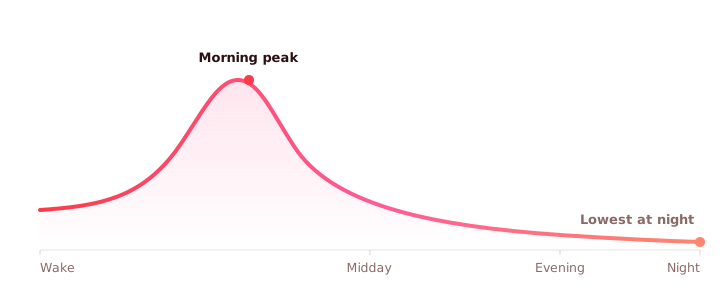
Hold that shape in mind, because the complaint describes something close to its mirror image: flat when the curve is usually high, and busy when it is usually near its floor. More on the arc itself in cortisol 101, and on the morning climb in the cortisol awakening response.
Why am I tired all the time but wired at night?
The honest answer is that several different mechanisms end at the same feeling, and the feeling cannot tell you which one you have.
The cortisol version is straightforward to describe. Cortisol is meant to be near its floor in the late evening. If it is still up when you are trying to wind down, you get alertness at exactly the hour you want none. There is evidence that this runs in both directions: an evening that ends with cortisol still high is associated with a shorter, poorer night, and a short poor night is associated with a changed rhythm the following day. That loop, and the research behind it, is covered with its sources in cortisol and sleep.
But the same evening alertness is produced by caffeine still on board, by alcohol earlier in the evening, by an anxious mind, by a thyroid running fast, and by simple sleep debt. If the thing you notice most is waking in the small hours rather than struggling to fall asleep, that is a slightly different question with its own answers, and it is worth reading why you wake up at 3am instead.
Is tired but wired a sign of high cortisol?
It can fit a mistimed cortisol rhythm. It is not proof of one. The pattern fits, which is exactly why the phrase and the hormone get bound together online, but fitting is not the same as showing.
Two things are worth separating. Cortisol that is high at the wrong time is a timing question and is what this complaint actually describes. Cortisol that is genuinely elevated overall is a medical question with a short list of causes, most commonly steroid medication, and it is diagnosed with clinical testing rather than inferred from how you feel. What causes high cortisol covers that split, and high cortisol symptoms covers why the everyday signs are so unreliable on their own.
Only a clinician's test can establish that your cortisol is high. No wearable, ours included, can tell you that you have it.
Could it be thyroid rather than cortisol?
Yes, and this is the differential most worth ruling out first, because it is common, it is treatable, and it produces the tired-but-wired combination almost exactly.
An overactive thyroid can bring fatigue together with nervousness, irritability, trouble sleeping, shaky hands, a rapid or irregular heartbeat, sweating or trouble tolerating heat, and weight loss despite an increased appetite. Read that list back against the complaint and the overlap is close to total. It is settled with a blood panel, in either direction, and that is a conversation with a clinician rather than a thing to measure at home.
To be explicit about scope: the Auromone Curve measures cortisol. It does not measure thyroid hormones.
What else produces the same combination of exhaustion and alertness?
Quite a lot, which is the point. The table below is not a checklist to score yourself against; it is a list of things a clinician would want to exclude before anyone starts talking about hormones.
| What else fits | Why it produces the same feeling | What tends to separate it |
|---|---|---|
| Obstructive sleep apnea | Sleep is broken hundreds of times without waking you properly, so hours in bed do not convert into rest. | Snoring, witnessed pauses, waking unrefreshed after a full night. But no snoring does not exclude it: women more often present with insomnia, fatigue and low mood and no reported snoring, which is part of why, in a 1997 US study of employed adults, an estimated 82% of men and 93% of women with moderate to severe sleep apnea had not been diagnosed. A sleep study is what settles it. |
| Caffeine timing | Caffeine is a stimulant with a long tail, and it also acts on the stress axis. In caffeine-abstinent men at rest, a dose equivalent to 2 to 3 cups of coffee raised cortisol about 30% above placebo an hour later. | Try the timing, not the total. The same research group later found no acute cortisol rise from caffeine in the absence of stress, so the effect is conditional rather than automatic. See what moves your cortisol. |
| Alcohol | A drink consolidates the first half of the night and fragments the second half. It delays the first REM period at any dose, and at moderate or higher doses it reduces total REM as well. You fall asleep quickly and get poor sleep anyway. | The pattern follows drinking days. Heavier drinking is separately associated with changes in the cortisol rhythm, though that evidence is observational. |
| Anxiety or depression | Both list fatigue and restlessness together. The NIMH description of generalised anxiety pairs trouble sleeping with feeling fatigued in a single line. More in cortisol and anxiety. | Persistent low mood, loss of interest, or worry that is hard to control. This is a clinical conversation, and an effective one. |
| An overactive thyroid | Fatigue plus tremor, palpitations, heat intolerance and weight loss. | A blood panel. See the section above. |
| Low iron | Fatigue can appear before anaemia does. In a randomised trial of menstruating women with ferritin under 50 µg/L and normal haemoglobin, iron reduced fatigue significantly more than placebo. | A ferritin test, not just a haemoglobin result. Note the trial studied menstruating women, so do not generalise it. |
| The menopausal transition | Sleep gets measurably worse. About 26% of women in this stage have symptoms severe enough to meet criteria for insomnia. | Hot flushes and cycle changes. Worth knowing: cortisol in this period tracks the underlying reproductive hormones, and the transition stage on its own is not a reliable predictor of it. See cortisol and perimenopause. |
| Shift work and jet lag | Your body clock and your schedule disagree, so alertness arrives on the clock's timetable rather than yours. | The pattern follows the roster. Night work alters the normal cortisol rhythm, including the timing of the morning rise. See night shift and cortisol. |
Is "adrenal fatigue" the answer people are looking for?
It is the answer most often offered, and it is not one. "Adrenal fatigue" is not a recognised medical diagnosis. A 2016 systematic review sifted 3,470 articles, examined the 58 that qualified, and concluded there was no substantiation for it as a medical condition. The Endocrine Society's position is blunter still: no scientific proof exists to support adrenal fatigue as a true medical condition, and there is no test that detects it.
The Society also names the real cost, which is not academic. If you are told you have this, the actual cause of your symptoms may go unfound and untreated. Every entry in the table above is something that gets missed while a label is being managed.
None of that means the experience is invented. The tiredness is real, and so is the evening alertness. The full argument, including why the term persists and what people are usually describing when they use it, is in adrenal fatigue: is it real.
When should you see a doctor about feeling tired but wired?
Fatigue is worth a clinician's time when it lasts more than a few days, when it has no clear cause such as a recent illness, when it comes on suddenly, when it makes work or daily activities hard, when you are over 65, or when you are also losing weight.
Do not wait for an appointment if any of these are present
- Shortness of breath, or pain in your chest, arm or upper back. Call emergency services. In women a heart attack often presents as unusual fatigue and breathlessness rather than crushing chest pain, so do not wait for it to look like the version in films.
- A heartbeat that is unusually fast or slow, pounding, fluttering or irregular. Seek urgent care.
- Fainting. It is often harmless, but it can signal a heart-rhythm or neurological problem, so it always needs to be looked into.
- A fast or irregular heartbeat with tremor, heat intolerance and unexplained weight loss. That combination points at an overactive thyroid rather than at anxiety, and it is a blood test away from an answer. The reverse does not hold: NIDDK notes that in older adults hyperthyroidism is sometimes mistaken for depression or dementia, and a beta-blocker can flatten a racing heart, so a calm pulse does not rule it out. Ask for the panel anyway.
- Exhaustion with heavy thirst, frequent urination and unexplained weight loss. Those are symptoms of new diabetes and should be checked promptly.
- Fatigue that is constant, has no clear cause, or arrives with weight change, and does not lift with rest.
- Thoughts of harming yourself. This is an emergency, and it is treatable. In Canada and the United States you can call or text 988, free and confidential, 24 hours a day. You do not have to be in immediate danger to use it.
Nothing you can wear substitutes for any of that. A wearable measures; a clinician diagnoses, and only one of those two things is what these signs call for.
How would you see your own pattern instead of guessing at a label?
The complaint is about timing, so timing is the thing to look at. The difficulty is that the two windows that define it, the climb in the first hour after waking and the late evening, are precisely the windows a single timed test does not sample. A morning blood draw tells you about that morning. It has nothing to say about the evening you are actually complaining about, which is why when you test changes the answer you get.
A four-point saliva profile does better, because it samples the shape rather than a point on it, and the measurement guide compares the options honestly, including the ones we do not sell.
What none of them give you is an ordinary day, unplanned, with the evening included. That is the gap a continuous cortisol meter is built to close.
This guide is for general wellness education only. The Auromone Curve is a general wellness device: it monitors continuously; it does not diagnose, treat, or cure any condition. It does not replace medical advice. Persistent fatigue deserves a proper medical assessment. Please talk to a healthcare provider.
References
- Debono M, et al. Modified-release hydrocortisone to provide circadian cortisol profiles. J Clin Endocrinol Metab. 2009. (Cortisol peak at 08:32, nadir at 00:18.)
- Stalder T, et al. Assessment of the cortisol awakening response: expert consensus guidelines. Psychoneuroendocrinology. 2016. (The rise occurs over the first 30 to 45 minutes after waking.)
- Wüst S, et al. The cortisol awakening response: normal values and confounds. Noise & Health. 2000. (Mean rise about 50% in the first 30 minutes; responder rate about 75%.)
- Cadegiani FA, Kater CE. Adrenal fatigue does not exist: a systematic review. BMC Endocrine Disorders. 2016. (58 qualifying studies from 3,470 articles.)
- Endocrine Society. Adrenal fatigue.
- Young T, et al. Estimation of the clinically diagnosed proportion of sleep apnea syndrome in middle-aged men and women. Sleep. 1997.
- Lovallo WR, et al. Stress-like adrenocorticotropin responses to caffeine in young healthy men. Pharmacol Biochem Behav. 1996. (3.3 mg/kg, described by the authors as equivalent to 2 to 3 cups; cortisol up about 30% at 60 minutes, in 47 caffeine-abstinent men at rest.)
- Lovallo WR, et al. Cortisol responses to mental stress, exercise, and meals following caffeine intake in men and women. Pharmacol Biochem Behav. 2006. (Caffeine did not acutely elevate cortisol in the absence of stress.)
- Ebrahim IO, et al. Alcohol and sleep I: effects on normal sleep. Alcohol Clin Exp Res. 2013.
- Badrick E, et al. The relationship between alcohol consumption and cortisol secretion in an aging cohort. J Clin Endocrinol Metab. 2008. (Cross-sectional; an association, not a demonstrated cause.)
- Vaucher P, et al. Effect of iron supplementation on fatigue in nonanemic menstruating women with low ferritin. CMAJ. 2012.
- Baker FC, et al. Sleep problems during the menopausal transition. Nature and Science of Sleep. 2018.
- Woods NF, et al. Cortisol levels during the menopausal transition and early postmenopause. Menopause. 2009.
- Andreadi A, et al. Modified cortisol circadian rhythm: the hidden toll of night-shift work. Int J Mol Sci. 2025.
- Cleveland Clinic. Fatigue. (When to contact a provider, and urgent signs.)
- MedlinePlus. Fainting.
- NIDDK. Symptoms and causes of diabetes.
- National Institute of Mental Health. Generalized anxiety disorder and depression.