
Take these to a clinician before you read the physiology
This section is first on purpose. Most people arrive at a page like this with a symptom and a theory, and a hormonal theory is a comfortable place for something else to hide. Every item below is settled by examination or a test, never by reasoning about ratios.
- Any vaginal bleeding after menopause. The NHS is unambiguous that any bleeding from the vagina after 12 months without periods needs to be checked by a GP, even if it has only happened once. It states you should not have to wait more than 2 weeks to see a specialist. Bleeding after menopause is the first symptom the NHS lists for womb cancer.
- Heavy periods that are unusual for you, bleeding between periods, bleeding after sex, or a change in vaginal discharge. The NHS lists all of these among the main symptoms of womb cancer and advises seeing a GP. It also says plainly that these symptoms are common and can be caused by many different conditions. Both halves of that matter. Common causes are far more likely, and commonness is not a reason to skip the appointment, because the point of going is that you cannot tell from the outside.
- Periods that have stopped. MedlinePlus advises seeing a provider if you have missed more than one period. Pregnancy is the most common cause of periods stopping in someone who was having them. Stress, heavy exercise and low body fat are on the list too, and that is exactly why this is a consultation rather than a self-diagnosis.
- In men and in anyone with male anatomy: new breast swelling, a lump in the chest or armpit, nipple discharge, an inverted nipple, or a sore that will not heal. The NHS lists each of these as a symptom to take to a GP. It also notes that lumps are common and are often caused by other conditions, which is true and is not a reason to wait. See the section on men for why enlarged breast tissue is itself a finding worth explaining.
- If you take estrogen in any form, ask about the risks that belong to your route. The NHS states that HRT tablets can increase the risk of blood clots while patches, sprays and gels do not, and that tablets slightly increase the risk of stroke. It puts the breast cancer figure at around 5 extra cases in every 1,000 women who take combined HRT for 5 years. Those are conversations with a prescriber, and they are worth having properly rather than from a headline.
And if you are struggling with thoughts of harming yourself, please stop researching and reach a person. In Canada and the United States you can call or text 988, free and confidential, 24 hours a day.
Are cortisol and estrogen connected?
Yes, and in two separate ways that get run together constantly. Keeping them apart is the single most useful thing on this page, because one of them explains a confusing lab result and the other explains a real physiological change.
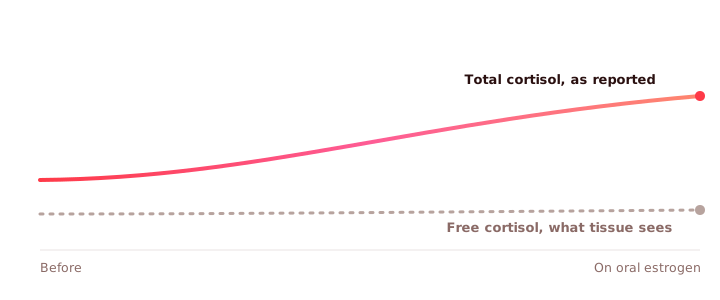
The first connection is about transport. Most cortisol in blood is not floating free. It travels attached to a carrier protein called corticosteroid-binding globulin, and estrogen raises how much of that protein you have. A standard blood test measures total cortisol, meaning bound plus free. So changing the carrier changes the number without changing the hormone your tissues are responding to.
The second connection is about control. The axis that produces cortisol and the axis that produces estrogen share their top two control centres in the brain, and they push against each other. Sustained pressure on one is not reliably confined to it.
| The transport effect | The control effect | |
|---|---|---|
| What changes | The carrier protein in blood | Hormone output from the brain and the gonad |
| Direction | Estrogen acts on cortisol measurement | Stress hormones act on reproductive hormones |
| Shows up as | A total cortisol result that looks high | Irregular or absent periods, altered reproductive hormone levels |
| Is the free hormone different? | Largely no | Not the question being asked |
| Who it affects | Anyone taking oral estrogen, including the combined pill and oral HRT | Everyone, including men |
The rest of this page takes those one at a time. If you want the wider map of how cortisol sits alongside thyroid hormone, insulin and the rest, that is beyond cortisol, the index this page belongs to. For the hormone itself and the shape of an ordinary day, start with cortisol 101.
How estrogen changes what a cortisol test reads
Oral estrogen can raise measured total cortisol substantially while leaving the free fraction largely where it was, and the route of administration decides whether this happens at all. That second half is the part almost nobody writes down, and it is the practical difference between a result that needs explaining and one that does not.
A study at Guy's and St Thomas' compared 37 women: 14 using oral estrogen, 8 using transdermal estrogen, and 15 who were estrogen-naive. Samples were taken between 08:30 and 09:30 after an overnight fast. The results split cleanly along the route.
| Group | Total serum cortisol | Corticosteroid-binding globulin | Salivary cortisol |
|---|---|---|---|
| Estrogen-naive controls (15) | 395.4 ± 53.2 nmol/L | 49.0 ± 11.8 mg/L | 13.8 ± 2.6 nmol/L |
| Oral estrogen (14) | 660.9 ± 89.9 nmol/L | 110.9 ± 19.6 mg/L | 15.5 ± 2.6 nmol/L |
| Transdermal estrogen (8) | 334.7 ± 72.0 nmol/L | 51.0 ± 5.4 mg/L | 15.7 ± 3.9 nmol/L |
Read the rows against each other. Total serum cortisol was 67% higher on oral estrogen than in controls. The carrier protein was roughly double. Total cortisol on transdermal estrogen was no different from controls. And the salivary values, which track the free fraction, were similar in all three groups.
The authors' explanation is mechanical rather than mysterious: swallowing estrogen sends it through the liver first, and the liver makes the carrier protein. A patch or gel bypasses that first pass, so it does much less to the carrier. Their practical conclusion was that it is probably unnecessary to routinely stop transdermal estrogen before assessing the stress axis, which is a narrower and more useful statement than the blanket advice people usually repeat.
This is the clearest example in endocrinology of a result moving without the biology moving, and it is a good reason to be careful with any single cortisol number. Why one figure settles so little is covered in normal cortisol levels, and the wider set of things that quietly distort a cortisol result, including what clinical guidelines say about stopping estrogen before testing, is in why cortisol disorders are hard to diagnose.
How stress affects the reproductive axis
This is the direction that is genuinely about your body rather than your paperwork. Glucocorticoids act at three separate levels of the chain that makes reproductive hormones, and the effect is suppression.
A review by Whirledge and Cidlowski at the National Institute of Environmental Health Sciences sets out where those effects land: at the hypothalamus, to decrease the synthesis and release of gonadotropin-releasing hormone; at the pituitary, to inhibit the synthesis and release of luteinizing hormone and follicle stimulating hormone; and at the testis or ovary, to modulate steroid production or the making of eggs and sperm directly.
The same review is careful about a point that gets lost when this is retold as a stress-is-bad story.
“Precise levels of glucocorticoids are required for proper gonadal function; where the balance is disrupted, so is fertility.”
Whirledge S, Cidlowski JA. Glucocorticoids, stress, and fertility. Minerva Endocrinologica, 2010.
Required. Not merely tolerated. The reproductive system does not want as little cortisol as possible, which is why the framing of cortisol as a toxin to be driven down is a poor guide to anything. Cortisol's ordinary daily job, and the other hormones that move with it, are covered in stress hormones.
Does cortisol block estrogen?
Not by blocking it directly. It suppresses the chain that produces it. The distinction matters because it tells you where to look when something goes wrong, and the answer is usually upstream of the ovary rather than at it.
The clearest clinical expression of this is functional hypothalamic amenorrhea. The Endocrine Society's 2017 clinical practice guideline, cosponsored by the American Society for Reproductive Medicine, the European Society of Endocrinology and the Pediatric Endocrine Society, describes it as a form of chronic anovulation not due to identifiable organic causes, but often associated with stress, weight loss, excessive exercise, or a combination of those.
Three things in that guideline are worth carrying away, and the third is the one that changes what a reader should do:
- It is a diagnosis of exclusion. The guideline states that investigations should include assessment of systemic and endocrinologic causes. In plain terms, a clinician rules other things out before landing here. Nobody can arrive at this label from the outside, and a page cannot give it to you.
- Treatment is multidisciplinary. The guideline calls for medical, dietary and mental health support together. Not one of those three is a supplement.
- The complications are not cosmetic. The guideline names bone loss and infertility among them. Periods that have stopped are not a nuisance to wait out. They are a reason to book an appointment, and the cost of waiting is measured in bone.
So the honest answer to "does cortisol block estrogen" is that sustained stress physiology can lower estrogen output by quieting the signals above it, that this is well described, and that the version of it with a name is something a clinician diagnoses after excluding other causes.
What changes across the menstrual cycle
Cycle phase changes how strongly cortisol responds to a stressor, more than it changes the ordinary daily rhythm. That is a narrower claim than the internet usually makes, and it is what the studies support.
The landmark study here compared four groups: 20 men, 19 women in the follicular phase, 21 women in the luteal phase, and 21 women using oral contraceptives, all exposed to a standard laboratory stressor and, on a separate day, given an injection that stimulates the adrenal glands directly. The free salivary cortisol response to the stressor followed this pattern: luteal phase and men were comparable, and both were higher than the follicular phase and the oral contraceptive group, which were comparable to each other.
A later and much smaller study of 42 women not taking oral contraceptives, using a virtual reality version of the same stress test, pointed the same way: women in the luteal phase showed higher cortisol after exposure than women in the follicular phase, 5.96 nmol/L against 4.31 nmol/L on average. The authors reported that no other significant differences were found, and described the effect as a tendency. With 24 women in one group and 18 in the other, that caution is appropriate and worth repeating rather than dropping.
Now the arm that complicates the tidy version, because leaving it out would be the failure this section exists to avoid. A separate study of 179 people found that the sharp cortisol climb in the first hour after waking was not influenced by menstrual cycle phase at all. Awakening time, health status and age mattered. Follicular against luteal did not.
Put those together and the picture is specific rather than sweeping. Reactivity to a challenge appears to shift with cycle phase. The morning rise, in that study, did not. Anyone telling you your whole cortisol rhythm swings with your cycle is claiming more than the evidence in front of them. If you are timing a test around this, the best time to test cortisol works through why the hour of the sample is part of the result.
What the pill does to a cortisol result
The clearest finding is that oral contraceptives change the gap between your total cortisol and your free cortisol, rather than changing how much cortisol you make. Which test you had therefore decides what you see.
In the four-group study above, total blood cortisol showed no group difference between the sexes or between the follicular and luteal phases in either test. The differences lived entirely in the free fraction. The authors' conclusion is worth reading slowly.
“ACTH and cortisol secretion is not affected by OC use per se but the amount of bioavailable unbound cortisol (‘free’) is greatly reduced in this group of women after stimulation.”
Kirschbaum C, Kudielka BM, Gaab J, Schommer NC, Hellhammer DH. Psychosomatic Medicine, 1999. OC means oral contraceptive.
They went on to advocate measuring free and total cortisol together in future work, precisely because none of the group differences they found were visible in total blood cortisol. That is a methodological point with a very practical consequence: two people with identical adrenal function can produce different-looking results depending on what they take and which fraction the assay reads.
The action this implies is small and genuinely useful. Tell whoever orders the test exactly what you take, including the combined pill, the patch, the ring, oral or transdermal HRT, and anything else hormonal. It is not a footnote on the form. It is part of how the result gets interpreted, and leaving it off can cost months. Which sample type reads which hormone, and what each one can honestly tell you, is set out in how to check hormone levels.
Is "estrogen dominance" a real thing?
It is not a recognised clinical diagnosis. The phrase is used very widely online and by some practitioners, and it is worth being precise about what is real inside it and what is not, because the answer is not simply that it is nonsense.
In this telling, estrogen is said to be acting without enough progesterone to oppose it, and a long list of symptoms is attributed to that ratio: heavy or irregular periods, breast tenderness, bloating, mood changes, fatigue and weight gain. Cleveland Clinic notes that some providers use the term this way. What it is not is a condition defined in clinical guidelines, and there is no agreed threshold, and no single test that establishes it.
Three things are true at once here, and holding all three is the honest position:
- The underlying idea is real in specific medical contexts. Estrogen exposure without opposition genuinely matters to the womb lining. The NHS lists high estrogen levels among the main things that can increase the chance of getting womb cancer, and includes being overweight, some types of HRT, never having given birth, polycystic ovary syndrome, going through menopause after the age of 55 and tamoxifen among the associated factors. This is the serious version of the idea, and it points toward a clinician rather than away from one.
- The symptom list is too broad to identify anything. The symptoms attributed to it are also the symptoms of thyroid disease, anaemia, depression, polycystic ovary syndrome, fibroids, and the menopausal transition. A label that fits all of those fits none of them usefully.
- The testing sold alongside it is the weakest part. ACOG's 2023 clinical consensus on compounded bioidentical menopausal hormone therapy states that evidence to support marketing claims of safety and effectiveness is lacking, and that these preparations should not be prescribed routinely when approved formulations exist. If a hormone panel is being used to justify a compounded product, that is the document to read first.
The practical move is to drop the label and keep the symptom. A clinician investigating heavy or irregular bleeding is investigating the bleeding, which is a question with an answer, rather than a ratio, which is not. Where estrogen genuinely is changing, during the menopausal transition, the research is specific and is covered in cortisol and perimenopause and in cortisol and menopause.
Cortisol and estrogen in men
Men make estrogen, need it, and the cortisol interaction runs in both directions. This is not a women-only topic, and treating it as one is how a genuine finding in a man gets ignored.
Cleveland Clinic puts the production plainly: in males, the body converts small amounts of androgens such as testosterone into estrogen. The enzyme that does the converting is aromatase, and it is active in tissues including body fat, which is why body composition is part of this conversation rather than separate from it. Estrone, the weaker estrogen, is described by MedlinePlus as made mostly by body fat and the adrenal glands.
What estradiol does in men is not incidental. A review in Reviews in Urology describes it as essential for modulating libido, states that spermatogenesis is modulated at every level by estrogen, and describes estradiol as necessary for sperm maturation and successful fertilization. Too little is a problem, not only too much.
The direction people rarely expect is estrogen acting on the stress axis. In a double-blind study, 16 healthy young men wore a patch delivering 0.1 mg of estradiol per day and were exposed to a psychosocial stressor 24 to 48 hours later. Compared with the placebo group they showed exaggerated peak ACTH and cortisol responses, and a greater noradrenaline response. Mood ratings before and after did not explain the difference. Estrogen was changing the size of the hormonal stress response itself, in men, over a couple of days.
When enlarged breast tissue in a man is a finding rather than a nuisance
Gynecomastia is enlargement of male breast tissue, and StatPearls describes it as arising from imbalances in estrogen and testosterone, with estrogen driving growth of glandular tissue. The reason it belongs on this page is that it is one of the few places where an estrogen effect is visible from the outside, and the list of things that produce it is not trivial.
StatPearls lists tumours of the adrenal glands, pituitary, lungs and testes, along with hypogonadism, adrenal disease, thyroid disease, cirrhosis and renal failure. It also lists a long roster of medicines, including digoxin, thiazides, phenothiazines and theophylline, and notes that the most common culprits have estrogen-like activity, naming cimetidine, spironolactone, ketoconazole and finasteride. Its workup depends on what the examination finds: a testicular mass leads to ultrasound and hormone testing, a breast mass to imaging and possible biopsy, abdominal findings to liver tests and imaging.
That branching is the point, and it is why this is an appointment rather than a self-assessment. StatPearls does say that a healthy male with long-standing gynecomastia of more than 12 months and no other symptoms or physical abnormalities needs no further workup. That is a clinician's conclusion after an examination, not a rule to apply to yourself. Deciding your own lump has been there long enough to ignore is exactly the reasoning the NHS symptom list exists to interrupt. Take it to a GP and let the person who can feel it make that call.
What a clinician tests, and when
Estrogen is measured by a blood test, chosen for the question being asked, and interpreted against your circumstances rather than against a chart. MedlinePlus sets out the three forms and what each is for.
| Form | What it is | Where it fits |
|---|---|---|
| Estrone (E1) | The weakest of the three, made mostly by body fat and the adrenal glands | Cleveland Clinic describes it as the primary form the body makes after menopause |
| Estradiol (E2) | The main estrogen in non-pregnant females of childbearing age, and the most potent form | The usual measurement in investigations of periods, fertility and the menopausal transition |
| Estriol (E3) | An estrogen that increases during pregnancy | Pregnancy-related testing |
MedlinePlus describes estradiol and estrone testing as used to help investigate conditions that may cause, or be caused by, estrogen levels that are too high or too low, including irregular periods, infertility and symptoms of perimenopause. In men, it names late puberty, breast growth, infertility and erectile dysfunction as reasons the same tests get ordered. Samples are blood or urine, and it notes that at-home tests usually use saliva. Its closing instruction is the operative one: talk with your provider to find out what your results mean for your health.
Two caveats are worth carrying into an appointment. Cleveland Clinic notes that a blood estrogen test may not be accurate because of the natural fluctuations of estrogen through the menstrual cycle, which is why the day a sample is taken matters as much as the fact of taking one. And if periods have stopped, MedlinePlus lists the tests typically run together: estradiol, FSH, LH, prolactin, testosterone and thyroid stimulating hormone. That panel is the shape of a real investigation, and not one element of it is cortisol.
What a cortisol reading can and cannot tell you here
Stated plainly, so there is no gap left for anyone to fill in. Auromone is building the Curve, a general wellness device designed to measure cortisol continuously from a trace of sweat at the wrist. It is designed to measure cortisol and no other hormone. It does not measure estrogen, estradiol, estrone, progesterone, FSH, LH or testosterone. It cannot tell you where you are in your cycle, it is not a fertility or contraception aid, and it does not detect, screen for or diagnose womb cancer, breast cancer, polycystic ovary syndrome, thyroid disease, amenorrhea or any other condition named on this page.
There is a further limit that trips up anyone comparing themselves with a paper. The studies quoted here measured cortisol in three different matrices: serum, saliva and, for the carrier protein, plasma. Those are different measurements with different numbers and different reference ranges, and they are not interchangeable. Sweat is a fourth thing again. A wellness reading has no clinical threshold and cannot be held up against a figure from a study.
And the thing this page is really about: if the hormone you want to know about is estrogen, cortisol is not a proxy for it. No cortisol measurement, ours or anyone's, tells you about your estrogen. The blood test in the section above is the tool for that question, and it belongs to a clinician.
This guide is for general education only. The Auromone Curve is a general wellness device under Health Canada and FDA guidance, not a diagnostic, and does not replace medical advice or laboratory testing. Hormonal symptoms deserve proper assessment rather than assumption. Please talk to a healthcare provider.
References
- Qureshi AC, Bahri A, Breen LA, Barnes SC, Powrie JK, Thomas SM, Carroll PV. The influence of the route of oestrogen administration on serum levels of cortisol-binding globulin and total cortisol. Clin Endocrinol (Oxf). 2007;66(5):632–635. (Source for the 37 women, the 67% higher total serum cortisol on oral estrogen, all three groups' cortisol and CBG values, the unchanged salivary cortisol, and the conclusion about transdermal estrogen and HPA assessment.)
- Kirschbaum C, Kudielka BM, Gaab J, Schommer NC, Hellhammer DH. Impact of gender, menstrual cycle phase, and oral contraceptives on the activity of the hypothalamus-pituitary-adrenal axis. Psychosom Med. 1999. (Source for the 81 adults and four groups, the salivary cortisol response pattern, the absence of any group difference in total blood cortisol, and the quoted conclusion about bioavailable unbound cortisol.)
- Kirschbaum C, Schommer N, Federenko I, et al. Short-term estradiol treatment enhances pituitary-adrenal axis and sympathetic responses to psychosocial stress in healthy young men. J Clin Endocrinol Metab. 1996. (Source for the 16 men, the 0.1 mg per day transdermal estradiol patch, and the exaggerated ACTH, cortisol and noradrenaline responses.)
- Whirledge S, Cidlowski JA. Glucocorticoids, stress, and fertility. Minerva Endocrinol. 2010;35(2):109–125. (Source for the three levels of glucocorticoid action on the reproductive axis and the quoted sentence on precise levels being required.)
- Gordon CM, Ackerman KE, Berga SL, et al. Functional Hypothalamic Amenorrhea: An Endocrine Society Clinical Practice Guideline. J Clin Endocrinol Metab. 2017. (Source for FHA as chronic anovulation without identifiable organic causes, its association with stress, weight loss and excessive exercise, its status as a diagnosis of exclusion, the multidisciplinary treatment approach, and bone loss and infertility among the complications.)
- Montero-Lopez E, Santos-Ruiz A, Gonzalez-Perez R, et al. The relationship between the menstrual cycle and cortisol secretion: daily and stress-invoked cortisol patterns. Int J Psychophysiol. 2018. (Source for the 42 women, the luteal against follicular post-stress values of 5.96 and 4.31 nmol/L, and the authors' statement that no other significant differences were found.)
- Kudielka BM, Kirschbaum C. Awakening cortisol responses are influenced by health status and awakening time but not by menstrual cycle phase. Horm Behav. 2003. (Source for the 179 participants and the absence of a follicular against luteal difference in the awakening response.)
- American College of Obstetricians and Gynecologists. Compounded Bioidentical Menopausal Hormone Therapy: ACOG Clinical Consensus No. 6. Obstet Gynecol. 2023. (Source for evidence to support marketing claims of safety and effectiveness being lacking, and for compounded preparations not being prescribed routinely where approved formulations exist.)
- Schulster M, Bernie AM, Ramasamy R. The role of estradiol in male reproductive function. Asian J Androl. 2016. (Source for estradiol being essential for modulating libido, spermatogenesis being modulated at every level by estrogen, and estradiol being necessary for sperm maturation.)
- Swerdloff RS, Ng JCM. Gynecomastia. StatPearls. (Source for the definition and hormonal mechanism, the tumour, hypogonadism, thyroid, cirrhosis and renal causes, the named medicines, the examination-led workup, and the statement about long-standing gynecomastia of more than 12 months.)
- MedlinePlus. Estrogen levels test. (Source for the three estrogens, estrone being made mostly by body fat and the adrenal glands, the reasons the test is ordered in women and in men, the sample types, and the instruction to talk with your provider.)
- MedlinePlus. Absence of menstruation (secondary amenorrhea). (Source for pregnancy being the most common cause, the stress, exercise and low body fat causes, the advice to see a provider after missing more than one period, and the panel of tests.)
- Cleveland Clinic. Estrogen and high estrogen. (Source for males converting androgens into estrogen, estrone predominating after menopause, the use of the term estrogen dominance by some providers for estrogen unopposed by progesterone, and the caveat about blood tests and cycle fluctuation.)
- NHS. Womb cancer symptoms and causes. (Source for the four main symptoms, the statement that these symptoms are common and can be caused by many different conditions, and high oestrogen levels being among the main things that increase risk, including menopause after 55 and tamoxifen.)
- NHS. Postmenopausal bleeding. (Source for any bleeding after menopause needing to be checked, even if it has happened only once, and the 2-week specialist referral.)
- NHS. Breast cancer in men: symptoms. (Source for the lump, nipple discharge, size and shape change, ulcer and inverted nipple list, and the statement that these symptoms are common and can be caused by other conditions.)
- NHS. Benefits and risks of hormone replacement therapy. (Source for tablets increasing blood clot risk while patches, sprays and gels do not, the slight stroke risk with tablets, and around 5 extra cases of breast cancer per 1,000 women taking combined HRT for 5 years.)
