
Do cortisol and testosterone work against each other?
Over months, yes. Over minutes, not reliably. That single distinction resolves most of the confusion in this topic, because the studies people quote at each other are measuring two different things on two different clocks.
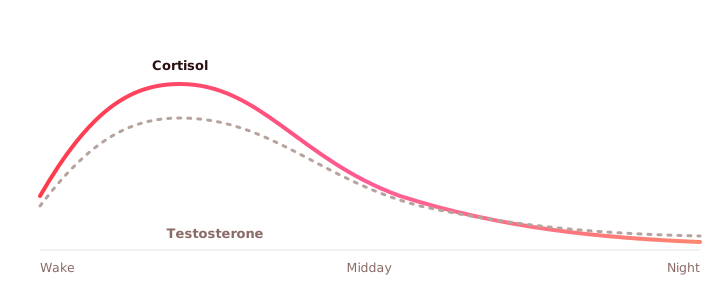
The long-timescale mechanism is well characterised. In their review of glucocorticoids and fertility, Whirledge and Cidlowski describe glucocorticoids acting on the reproductive axis at three points: the hypothalamus, where they decrease the synthesis and release of gonadotropin-releasing hormone, the pituitary, where they inhibit luteinizing hormone and follicle-stimulating hormone, and the testis or ovary, where they modulate steroid production and the making of eggs and sperm directly. StatPearls describes the same top-level effect, writing that cortisol inhibits gonadotropin-releasing hormone release from the hypothalamus, with subsequent impairment of gonadal activity.
Notice what that mechanism is. It is a signalling effect: cortisol turns down the instruction that tells the testis or ovary to produce. It runs through a chain of messengers, which is why it takes sustained exposure to show up, and why a bad afternoon does not do it.
| Timescale | What the research reports | How confident to be |
|---|---|---|
| Minutes (a lab stressor) | Both hormones can rise. A 2024 randomized pilot trial in young men found increased cortisol and increased testosterone after acute stress, with the testosterone rise not associated with the cortisol rise. A 2023 study of 87 adolescents found testosterone rose clearly after a standard laboratory stressor. | Consistent enough to say the see-saw is not what happens acutely. Both studies are small. |
| Days (an extreme physical effort) | In 22 men racing the 2011 Ironman World Championships, cortisol differed significantly from baseline immediately after the race, and testosterone was significantly lower than baseline at 1 day and at 2 days afterwards. | A small observational study in elite ultra-endurance athletes. Do not generalise it to a hard gym week. |
| Weeks (short sleep) | In 10 healthy men with a mean age of 24.3 years, 8 nights of 5-hour bedtimes lowered daytime testosterone by 10% to 15% (16.5 versus 18.4 nmol/L, P = .049). Daytime cortisol profiles were similar under both conditions. | Well-controlled, and the cortisol result is the interesting part. Testosterone fell without a matching daytime cortisol change. |
| Months (chronic stress, energy deficit) | Toufexis and colleagues describe activation of the stress axis, especially when repeating or chronic, as having an inhibitory effect on oestrogen and testosterone secretion. | This is the version of the claim that the mechanism actually supports. |
So the honest summary is that the relationship is real, directional, and much slower than the marketing suggests. If you want the same treatment applied to the inputs on the cortisol side, what moves your cortisol covers caffeine, alcohol, cold water and exercise with the evidence attached.
Where does each hormone come from?
Both are steroid hormones made from cholesterol, but in different tissues and under different instructions. That shared chemistry is the source of a popular and misleading story, so it is worth being exact.
- Cortisol. StatPearls describes it as synthesized from cholesterol within the zona fasciculata and zona reticularis of the adrenal cortex, under instruction from the pituitary.
- Testosterone. StatPearls describes Leydig cells in the testes producing testosterone from cholesterol. It also notes that both men and women produce weak-acting androgens in the zona reticularis of the adrenal glands, which is why the adrenal gland appears on both sides of this page.
- Most of it is not free. StatPearls describes most testosterone circulating bound to plasma proteins such as sex hormone-binding globulin and albumin, with small amounts of free testosterone acting at the tissue level. This is why a total and a free measurement can tell different stories.
The shared pathway is real. You can see it most clearly in 21-hydroxylase deficiency, where an enzyme needed for cortisol production is missing. MedlinePlus describes the consequence plainly: when 21-hydroxylase is lacking, substances that are usually used to form cortisol and aldosterone build up in the adrenal glands and are converted to androgens instead.
Supplement marketing takes that shared pathway and turns it into a budget, claiming that making stress hormones uses up the raw material that would otherwise become testosterone. That is not the mechanism any of the sources on this page describe. The suppression they describe is a signalling one, running through gonadotropin-releasing hormone and luteinizing hormone, and the 21-hydroxylase example runs in the opposite direction to the marketing story: blocking cortisol production there raises androgens rather than sparing them. More on how these systems share wiring in stress hormones.
Both hormones run on a daily rhythm, and it is steeper than people expect
Cortisol is famous for its daily arc: StatPearls describes levels rising during the final hours of sleep, peaking near the time of awakening, and declining through the day to their lowest concentration at night. The arc itself is covered in cortisol 101.
Testosterone does the same thing, and the swing is large. Endotext describes diurnal patterns of morning peak testosterone and nadir levels in the mid-afternoon in both younger and healthy older men. In a study that sampled 10 young and 8 middle-aged men every 30 minutes across 24 hours, every single subject showed a fall of at least 43% in total testosterone from the daily peak to the daily low.
Both young and middle-aged men displayed a significant diurnal rhythm in all variables, with a minimum fall of 43% in total testosterone from peak to nadir in all subjects.
Diver MJ and colleagues, Clinical Endocrinology, 2003
The practical consequence is blunt. A testosterone number without a time on it is close to meaningless, which is why StatPearls specifies 2 early morning measurements between 8 and 10 a.m., and why the Cleveland Clinic describes diagnosis as usually requiring two separate morning blood samples. A separate study of 132 men aged 30 to 79 found that biological variation generally accounted for more of the swing between repeat measurements than assay variation did, so the instability is mostly in the person, not the laboratory.
Timing is the same problem cortisol has, and we cover it for cortisol specifically in the best time to test cortisol. If you are trying to work out which hormones can be read at home at all, how to check hormone levels goes through the routes one by one.
What do long-term stress, hard training and short sleep actually do?
These are the three situations where the inverse relationship earns its reputation, and each one has been studied directly.
Short sleep
The cleanest experiment is also the most quoted, and it contains a detail that usually gets dropped. Leproult and Van Cauter put 10 healthy young men through 3 nights of 10-hour bedtimes, then 8 nights of 5-hour bedtimes. Daytime testosterone fell by 10% to 15%. Daytime cortisol profiles were similar under both conditions. Testosterone dropped without cortisol visibly rising alongside it, which is exactly the result the see-saw model would not predict. Sleep affects cortisol too, in both directions, and that loop is covered in cortisol and sleep.
Energy deficit
Not eating enough for the training you are doing is one of the better-documented ways to suppress the reproductive axis, and it has a measured threshold. In a controlled study of 29 regularly menstruating women, luteinizing hormone pulsatility was unaffected at an energy availability of 30 kcal per kilogram of lean body mass per day, and below that threshold pulse frequency fell while pulse amplitude rose.
In men, Lane, Magallanes and Hackney describe an equivalent picture under the name the exercise-hypogonadal male condition: men persistently training for endurance sport over an extended period show reduced basal free and total testosterone without a matching rise in luteinizing hormone. The authors are careful to add that the evidence base is limited, that the exact mechanism is unclear, and that the condition is not a common occurrence. Infertility, they note, is the concern that makes it worth a clinician's attention.
Training load
Hard training moves both hormones, and it is the context where people most want a single number to tell them whether to back off. It does not go well. Cortisol and overtraining covers what the hormone research found, and covers the serious conditions that hide inside the word overtraining. If you train and you want the practical version, cortisol for athletes is the page for that.
Is the testosterone-to-cortisol ratio meaningful?
It is a research variable with a real history, and it is not a test result. It was proposed in the 1980s as an index of the balance between building tissue up and breaking it down, and it has been tested repeatedly since.
We have written that history out in full, including what a 2017 systematic review found when the ratio was checked against athletes who were actually in trouble, in the overtraining guide. The short version for this page: the original threshold used free testosterone rather than total, the distinction is routinely lost in retelling, and the ratio does not sort athletes cleanly enough to put a training decision behind it.
To be exact about our own scope: the Auromone Curve is designed to measure cortisol. It does not measure testosterone, and it does not compute a testosterone-to-cortisol ratio.
Cortisol and testosterone in women
This question gets asked far less often than it should be, and the search terms around it are almost entirely male-coded. So, plainly: testosterone is not a male hormone. Women produce it in the ovaries, and both sexes produce weaker androgens in the zona reticularis of the adrenal glands.
The stress side of the relationship is not male-specific either. The energy availability threshold above was measured in women. Whirledge and Cidlowski describe glucocorticoids acting on the ovary as well as the testis. Cushing's syndrome, which is cortisol excess, shows the reproductive consequences directly: NIDDK describes menstrual periods becoming irregular or stopping, and excess hair on the face, neck, chest, abdomen and thighs.
What does not follow is that women should go and get a testosterone level checked. The 2019 Global Consensus Position Statement, endorsed by the Endocrine Society, the International Menopause Society and nine other bodies, is unusually direct on this point.
Direct assays for the measurement of total and free testosterone are highly unreliable in the female range. No cutoff blood level can be used for any measured circulating androgen to differentiate women with and without sexual dysfunction.
Global Consensus Position Statement on the Use of Testosterone Therapy for Women, 2019
The same statement identifies one evidence-based indication for testosterone therapy in women, the treatment of postmenopausal women diagnosed with hypoactive sexual desire disorder after a formal biopsychosocial assessment, and states that there are insufficient data to support its use for any other symptom or condition, or for prevention. Fatigue, mood and cognition are named in that group. A woman being sold a testosterone product for tiredness is being sold past the evidence.
One more thing worth saying on this page: the Curve is not a fertility product, is not for contraception, and is not for use in pregnancy.
Do supplements change either hormone?
The evidence behind the testosterone half of that aisle is thin, and it has been counted. A 2019 analysis in the Journal of Sexual Medicine took the 5 highest-rated testosterone-boosting supplements on Amazon, identified 19 unique ingredients across them, and searched the literature on the 10 most common. Of 191 studies found, 19% involved human subjects. Among the 37 human studies, 30% observed an increase in testosterone, 3% a decrease, 46% no effect, and 22% were indeterminate.
Read that as a whole rather than as a headline. Fewer than a third of the human studies on the most common ingredients found any increase at all, and the studies are on ingredients rather than on the products being sold.
On the cortisol side, the picture is different but still modest, and we have gone through it supplement by supplement in cortisol supplements: what the evidence says.
This page does not recommend a supplement, a stack or a protocol, and it is not going to. Testosterone replacement is a prescription medical treatment with real consequences, and it belongs with a clinician. StatPearls is specific about one of those consequences: testosterone supplementation significantly reduces sperm count, and while sperm production eventually returns after stopping, two-thirds of men recover after 6 months and 10% do not recover until after a year. The Endocrine Society's 2018 guideline recommends against routine screening of men in the general population for hypogonadism, and recommends diagnosing it on symptoms and signs together with consistently low measurements, confirmed by repeating a morning fasting total testosterone.
When do low testosterone symptoms need a doctor?
The symptoms people recognise are, per the Cleveland Clinic, most specifically sexual: low libido, loss of morning or spontaneous erections, and trouble attaining or maintaining an erection. The wider list includes low mood, concentration problems, increased body fat, reduced muscle strength, hot flashes, enlarged breast tissue, shrinking testicles, and loss of armpit and pubic hair.
That list is a differential, not a diagnosis. Every item on it belongs to several other conditions, and some of those conditions need finding.
See a clinician promptly if any of these are present
- Headaches, changes in vision including loss of side vision, or milky discharge from the breasts. NIDDK describes prolactinomas larger than 1 centimetre pressing against nearby parts of the pituitary gland and the brain, causing vision problems and headaches, and describes men with prolactinoma reporting loss of interest in sex associated with low testosterone, and erectile dysfunction. This combination is the reason not to treat low libido as a standalone complaint.
- The absence of headache or vision change does not rule a pituitary cause out. The Cleveland Clinic notes that most males with symptoms of low testosterone do not have a problem with their pituitary gland or testicles, and usually have an issue from obesity or diabetes. That is reassuring about base rates and useless as a personal screening test. Pituitary causes are found by testing, not by the absence of a headache.
- Weight gain with a round face, a fatty hump between the shoulders, easy bruising, wide purple stretch marks, or weak muscles. NIDDK lists these for Cushing's syndrome, which also causes decreased fertility, lowered interest in sex and erectile dysfunction in men, and irregular or absent periods in women. Its most common cause is long-term, high-dose glucocorticoid medicine.
- Loud snoring, witnessed pauses in breathing, or waking unrefreshed after a full night. The Cleveland Clinic lists obstructive sleep apnea among the causes of low testosterone. It is treatable, and it is frequently missed.
- Fatigue, weight gain, cold intolerance, dry skin, thinning hair, low mood, or a slowed heart rate. That is the NIDDK symptom list for hypothyroidism, which overlaps low testosterone almost completely. NIDDK is explicit that a hypothyroidism diagnosis cannot be based on symptoms alone, because many of its symptoms are the same as those of other diseases. The same sentence applies in reverse here.
- Persistent low mood or loss of interest. StatPearls lists depression in the differential diagnosis for male hypogonadism. It is common, it is treatable, and a testosterone result is not how it gets sorted out.
If you are having thoughts of harming yourself, that is an emergency and it is treatable. In Canada and the United States you can call or text 988, free and confidential, 24 hours a day. You do not have to be in immediate danger to use it.
The useful action here is a specific one rather than a vague instruction to "see someone". Clinical guidance describes what the first round of testing looks like: the Cleveland Clinic describes a total testosterone measurement usually requiring two separate morning blood samples, alongside luteinizing hormone and prolactin tests, and StatPearls specifies morning sampling between 8 and 10 a.m. with a repeat when a value comes back low. Asking for that, and asking what else on the differential is being excluded, is a more productive appointment than arriving with a supplement to discuss.
And one thing a normal result does not do. Because testosterone falls at least 43% from peak to trough across a day in the study above, a value drawn in the afternoon is not comparable to a morning reference range. A reassuring afternoon number settles less than it appears to.
Can a wearable read testosterone?
Not the Auromone Curve. It is designed to measure cortisol, from sweat, and it measures no other hormone. It does not read testosterone, luteinizing hormone, follicle-stimulating hormone, oestradiol or thyroid hormones, and it does not calculate a testosterone-to-cortisol ratio.
Further hormone sensors are planned for the same band. Only the cortisol sensor is being built, and there is no date attached to anything beyond it. We would rather say that plainly than let a roadmap do work that a product has not earned.
Everything on this page about testosterone is a clinical question, answered with clinical tests, by a person with a licence. That is not a limitation we are apologising for. It is the correct division of labour.
This guide is for general wellness education only. The Auromone Curve is a general wellness device: it is designed to monitor cortisol continuously; it does not diagnose, treat, or cure any condition, and it does not replace clinical testing or medical advice. Symptoms of low testosterone deserve a proper medical assessment. Please talk to a healthcare provider.
References
- StatPearls. Physiology, Cortisol. (Synthesis from cholesterol in the zonae fasciculata and reticularis; diurnal rhythm; inhibition of gonadotropin-releasing hormone.)
- StatPearls. Physiology, Testosterone. (Leydig cell synthesis from cholesterol; adrenal zona reticularis androgens in both sexes; protein binding.)
- StatPearls. Male Hypogonadism. (Two early morning measurements between 8 and 10 a.m.; differential diagnosis including depression and pituitary masses; effect of testosterone supplementation on sperm count and recovery times.)
- Endotext. Androgen Physiology, Pharmacology, Use and Misuse. (Morning peak and mid-afternoon nadir in younger and healthy older men.)
- Bhasin S, et al. Testosterone therapy in men with hypogonadism: an Endocrine Society clinical practice guideline. 2018. (Against routine population screening; diagnosis on symptoms plus consistently low measurements, confirmed by repeating a morning fasting total testosterone.)
- Cleveland Clinic. Low testosterone (male hypogonadism). (Symptom list; causes including obstructive sleep apnea, opiates and Cushing syndrome; two separate morning samples plus LH and prolactin.)
- Diver MJ, et al. Diurnal rhythms of serum total, free and bioavailable testosterone and of SHBG in middle-aged men compared with those in young men. Clin Endocrinol. 2003. (10 young and 8 middle-aged men; minimum 43% fall from peak to nadir in all subjects.)
- Brambilla DJ, et al. Intraindividual variation in levels of serum testosterone and other reproductive and adrenal hormones in men. Clin Endocrinol. 2007. (132 men aged 30 to 79; biological variation generally exceeded assay variation.)
- Leproult R, Van Cauter E. Effect of 1 week of sleep restriction on testosterone levels in young healthy men. JAMA. 2011. (10 men, mean age 24.3; 8 nights of 5-hour bedtimes; daytime testosterone down 10% to 15%, 16.5 vs 18.4 nmol/L, P = .049; daytime cortisol profiles similar.)
- Loucks AB, Thuma JR. Luteinizing hormone pulsatility is disrupted at a threshold of energy availability in regularly menstruating women. J Clin Endocrinol Metab. 2003. (29 women; unaffected at 30 kcal/kg lean body mass per day, disrupted below it.)
- Lane AR, Magallanes CA, Hackney AC. Reproductive dysfunction from exercise training: the "exercise-hypogonadal male condition". Arch Med Deporte. 2019. (Reduced basal free and total testosterone without concurrent luteinizing hormone elevation; the authors note the evidence is limited and the condition uncommon.)
- Hooper DR, et al. Evidence of the exercise-hypogonadal male condition at the 2011 Kona Ironman World Championships. Int J Sports Physiol Perform. 2019. (22 men; testosterone significantly lower at 1 and 2 days post-race, cortisol significantly different immediately post.)
- Whirledge S, Cidlowski JA. Glucocorticoids, stress, and fertility. Minerva Endocrinol. 2010. (Suppression at the hypothalamus, the pituitary and the gonad.)
- Toufexis D, et al. Stress and the reproductive axis. J Neuroendocrinol. 2014. (Reciprocal relationship; chronic stress-axis activation inhibits oestrogen and testosterone secretion.)
- Fan Y, et al. Salivary testosterone and cortisol response in acute stress modulated by seven sessions of mindfulness meditation in young males. Stress. 2024. (Both hormones rose after acute stress; the testosterone rise was not associated with the cortisol rise.)
- Rodgers EL, Kuhlman KR. Early life adversity is associated with attenuated testosterone reactivity to acute stress among adolescents. Psychoneuroendocrinology. 2023. (87 adolescents; clear testosterone increase following the Trier Social Stress Test for Children.)
- Glass DJ, et al. Mixed evidence for stress effects on cortisol-testosterone coupling in Syrian refugee and Jordanian non-refugee adolescents. Psychoneuroendocrinology. 2026. (768 adolescents; limited support for the coupling hypothesis.)
- Davis SR, et al. Global Consensus Position Statement on the Use of Testosterone Therapy for Women. J Clin Endocrinol Metab. 2019. (Assays unreliable in the female range; no usable cutoff; one evidence-based indication; insufficient data for other symptoms.)
- Balasubramanian A, et al. Testosterone imposters: an analysis of popular online testosterone boosting supplements. J Sex Med. 2019. (19 ingredients, 191 studies, 37 human studies: 30% increase, 3% decrease, 46% no effect, 22% indeterminate.)
- NIDDK. Cushing's syndrome.
- NIDDK. Prolactinoma.
- MedlinePlus Genetics. 21-hydroxylase deficiency. (Precursors that would form cortisol are converted to androgens instead.)
