Important: this page is general wellness education. It can't tell you whether your cortisol is high, and the signs below overlap with many ordinary causes. If you have persistent or worrying symptoms, please see a healthcare provider.
What people mean by "high cortisol"
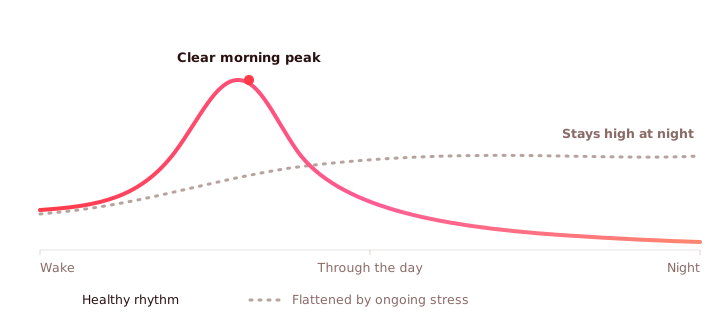
Cortisol is meant to be high in the morning and low at night. When people say their cortisol feels "high," what usually matters isn't one big number, it's cortisol staying up at the wrong time, like the evening, or a daily rhythm that has flattened out. That's why two people with the same morning value can feel completely different: the shape of the day is the part that counts.
Everyday signs people associate with it
These are things people commonly connect with high or mistimed cortisol. They are not proof of anything on their own, and each has many possible causes:
- Trouble falling asleep, or waking in the early hours.
- Feeling "wired but tired", restless but exhausted.
- Afternoon energy crashes.
- Difficulty winding down in the evening.
- A sense that your battery never fully recharges.
Notice these are all about timing and energy, exactly the things a daily cortisol pattern reflects. They're a reason to look closer, not a conclusion.
Why a single test can miss it
A one-off cortisol test captures a single moment. If your issue is cortisol staying high in the evening, an 8 a.m. blood draw can look perfectly normal. Cortisol problems are pattern problems, and a pattern needs more than one data point to see.
Get real data, then talk to a provider
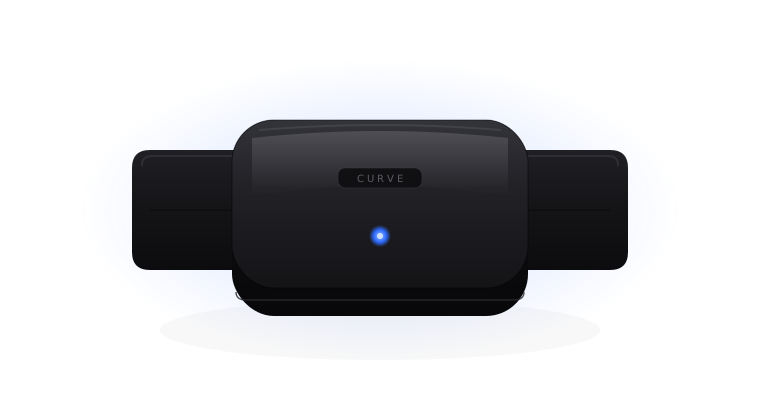
This is where continuous monitoring helps. The Auromone Curve reads cortisol from a trace of sweat on your wrist continuously, so you can see whether your cortisol drops in the evening the way it should, or stays stubbornly up. That's useful information to bring to a clinician, who can order proper testing if something looks off.
To be clear about what it is: Auromone shows the pattern. It does not diagnose. Used alongside your provider, it turns "I feel like something's wrong" into something you can actually look at together.
Start with Cortisol 101 for the basics, or see habits that support a healthy rhythm.
High cortisol vs a mistimed rhythm
It's worth separating two ideas that get blurred together. "High cortisol" sounds like one big number. But for most people the everyday version isn't a sky-high reading, it's cortisol showing up at the wrong time: still elevated in the evening, or a daily curve that has gone flat. Two people with an identical morning value can feel completely different depending on the shape of the rest of their day.
That's why timing, not a single peak, is usually the more useful lens. A rhythm that rises and falls on schedule tends to feel like steady energy; one that's stuck "on" tends to feel like the signs below.
Signs, grouped by when they show up
Because cortisol is about timing, it can help to notice when you feel off, not just that you do. These are things people commonly associate with a mistimed rhythm, not proof of anything:
| Time of day | What people notice |
|---|---|
| Morning | Groggy and hard to wake, even after enough hours in bed |
| Afternoon | An energy crash that coffee doesn't really fix |
| Evening | Wired and restless, unable to wind down |
| Night | Waking in the small hours with a busy mind |
Every one of these has plenty of ordinary explanations too. They're a reason to look closer, not a conclusion.
When it's worth seeing a doctor
Some situations call for a professional, not a wearable. Consider seeing a healthcare provider if:
- Symptoms are persistent, worsening, or interfering with your life.
- You have unexplained changes in weight, blood pressure, mood, or skin.
- Something simply feels wrong and you want it properly checked.
If you arrived here worried about a puffy face, cortisol face is not a medical diagnosis, though the facial change it borrows from is real. There are genuine medical conditions involving cortisol, such as Cushing's syndrome and Addison's disease, but those are diagnosed by clinicians with proper lab testing, never by a wellness device or a symptom list. Even in the clinic they can be hard to pin down; here is why a normal cortisol test can still miss Cushing's. If that's a concern, a provider is the right first stop. If your symptoms point the other way, toward cortisol that is too low, here is what adrenal insufficiency is and how it is actually diagnosed. And if cortisol is only your current best guess, the conditions behind the phrase "hormone imbalance" covers thyroid disease, diabetes, PCOS, low testosterone and high prolactin alongside it.
What to bring to your provider
Continuous data won't diagnose anything, but it can make the conversation far more concrete. A simple way to prepare:
- Track your pattern for about two weeks, so there's a real trend and not a single day.
- Note when your symptoms tend to hit, and line them up against your curve.
- Bring both to your appointment as context your provider can build on.
It turns "I feel like something's off" into something the two of you can actually look at.
This guide is for general wellness education only. It is not medical advice, not a diagnosis, and not a substitute for professional testing. The Auromone Curve is a general wellness device and does not diagnose, treat, or cure any condition. If you're worried about your health, talk to a healthcare provider.
References
- National Institute of Diabetes and Digestive and Kidney Diseases (NIDDK). Cushing's Syndrome.
- MedlinePlus, U.S. National Library of Medicine. Cushing Syndrome / Hypercortisolism.
- StatPearls (NCBI Bookshelf). Physiology, Cortisol.