How do you check your hormone levels?
You measure a hormone in a body fluid, and there are four practical routes to doing it. They differ less in the chemistry than in who orders the test, who looks at the result, and how much of the sampling you are responsible for getting right.
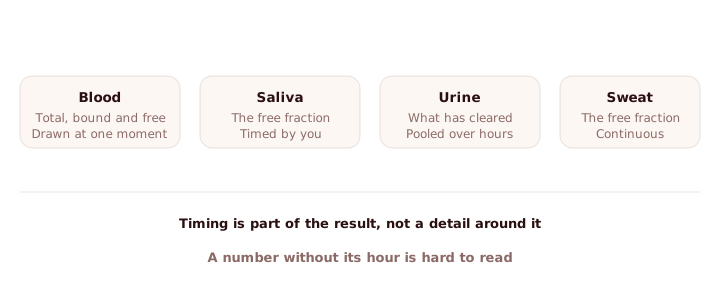
- A clinician orders a panel. Blood is drawn at a laboratory or a collection centre, the laboratory reports against its own reference intervals, and the person who ordered it reads the result beside your history and your examination. This is the route for any question whose answer is a diagnosis.
- You order a laboratory test yourself. Consumer-initiated testing runs the same laboratory assays without a prior appointment. Quest's consumer service states that "No doctor visit is required for purchase, but an independent healthcare provider is involved throughout the process," and Labcorp OnDemand states that "All Labcorp OnDemand testing requires an order from an authorized healthcare professional," which it arranges through contracted providers. Collection is at a patient service centre, or at home with a kit.
- You collect at home and mail it in, or read it yourself. Saliva, urine or a finger-prick sample, either posted to a laboratory or read at home by a strip and a phone camera. The collection instructions are the test here, because you are the one performing them.
- A wearable measures one hormone continuously. This is a new and narrow category. It produces a trace rather than a result, it covers a single analyte, and it is not a laboratory test.
The useful question is not which route is best. It is which one carries the information your question needs, and that is decided by the two paragraphs below.
If you feel acutely unwell right now, none of this is your next step
Every test on this page is a draw-and-wait or a mail-and-wait test, and the turnaround is the whole problem when something is happening today. Sudden severe weakness, vomiting you cannot stop, confusion, chest pain, or fainting are reasons to seek urgent care now, not reasons to buy a kit. Our guide to the best time to test cortisol opens with the picture that needs emergency care, sourced to clinical guidelines, and it is worth two minutes before you order anything.
Blood, saliva, urine or wearable: which one reads what?
Blood reports total hormone, saliva reports the free fraction, urine reports metabolites plus timing, and a continuous wearable reports a shape rather than a value. Those are four different kinds of statement about the same body, and a lot of confusion about hormone testing comes from comparing them as though they were the same measurement in different packaging.
| Sample | What it reports | Commonly used for | The catch |
|---|---|---|---|
| Venous blood (serum or plasma) | Total hormone, bound plus free, at one instant | Most clinician-ordered panels: thyroid, follicle-stimulating hormone, luteinizing hormone, prolactin, estradiol, testosterone, cortisol | One instant. For a hormone that varies by the hour or the day, the moment of the draw is part of the answer |
| Saliva | The free, unbound fraction | Cortisol at chosen times of day, including late at night | Collection technique and timing sit entirely with you, and values are not interchangeable across assay methods |
| Urine, fresh or 24-hour | What was excreted over a window rather than at a point | Cortisol output across a full day, ovulation tracking from cycle hormone metabolites | A 24-hour collection discards timing on purpose. A strip reads a metabolite, not the parent hormone |
| Dried urine | Hormones and their metabolites from timed spots on filter paper | Mapping sex hormone metabolites and the daily cortisol pattern together | Several collections across a day, a laboratory delay, and in the case of DUTCH a practitioner to order it |
| Finger-prick blood, collected at home | A laboratory-style value from a small capillary sample | Mail-in sex hormone panels | You still have to hit the right morning and the right cycle day, unsupervised |
| Continuous wearable (cortisol only) | The movement of one hormone through the day and night | Seeing the shape of your own cortisol rhythm | Not a laboratory test, no reference interval, no result to act on, and it covers one hormone |
MedlinePlus puts the blood-versus-everything-else point plainly for cortisol: "Most of your cortisol is in your blood, so cortisol tests often use a sample of blood drawn at a lab. But some cortisol passes into your urine and saliva." The same logic runs across the estrogens, where MedlinePlus notes that a provider's office or laboratory takes blood or urine, while "If you use an at-home test, the sample is usually saliva (spit)."
One practical consequence, before anything else: do not compare a number from one method against a range printed for another. A saliva value and a serum value are not the same quantity, and even within saliva the assay matters. Our guide to normal cortisol levels goes through why published ranges disagree with each other so often.
Which hormones can you check at home, and which need a lab?
Cortisol and the cycle hormones have real at-home routes. Anything whose answer is a diagnosis does not. Here is what the main options actually measure, taken from each company's own product pages as of September 2026, with no ranking implied.
| Option | Sample | What it reports | Who orders it |
|---|---|---|---|
| Eli Health Hormometer | Saliva, read with a phone | Cortisol, with results the company states arrive "within 20 minutes"; progesterone and testosterone tests are listed as pre-order | You. The company states the Hormometer "is a wellness product and is not a substitute for laboratory or clinical testing" |
| DUTCH, by Precision Analytical | Dried urine, several timed collections | Sex hormones and their metabolites alongside a cortisol awakening response and a diurnal pattern, under the product name "Dried Urine Test for Comprehensive Hormones" | A practitioner, through the company's provider portal |
| LetsGetChecked female hormone test | Finger prick, mailed to a laboratory | Follicle-stimulating hormone, luteinizing hormone, prolactin and estradiol | You, with the company stating its "clinical team is on standby throughout the testing process" |
| Everlywell | At-home collection, mailed in | A women's health test covering hormones, per the company's product page | You |
| Mira | Urine, read by a monitor | Luteinizing hormone, estrone-3-glucuronide, a progesterone metabolite and follicle-stimulating hormone on its four-hormone wands | You. Mira states its results are "not intended to diagnose, screen for, or indicate PCOS or any other medical conditions" |
| Inito | Urine, read by a phone attachment | Estrogen, luteinizing hormone, a progesterone metabolite and follicle-stimulating hormone, in the company's words to confirm "whether ovulation actually happened" | You |
| Oova | Urine strip, read by an app | Luteinizing hormone, an estrogen metabolite and a progesterone metabolite, tracked as a pattern over time | You |
| Quest and Labcorp consumer services | Venous draw at a collection centre, or a home kit | The same laboratory assays used for clinician-ordered panels | You buy it, a provider is involved in ordering or reviewing |
Notice the shape of that table. The at-home options cluster around two problems that repeat on a known schedule, the cortisol day and the menstrual cycle, because a repeating pattern is exactly what a cheap, frequent measurement is good at. The hormones that sit outside that cluster, and the questions that need a physical examination or an imaging study beside the number, stay with a clinician and a laboratory.
Two more things belong to the laboratory rather than to any kit. The first is dynamic testing, where a drug is given and the response is measured, which is how several endocrine questions are actually settled. The second is the interpretation itself. A number is not a diagnosis, and our guide to why cortisol disorders are hard to diagnose walks through how much work sits between a value and a conclusion, even in expert hands.
Why does timing change the answer?
Because several hormones are not a level, they are a schedule. Sample at the wrong hour or the wrong cycle day and you have measured a real thing at a meaningless moment, and nothing in the report will tell you that happened.
Cortisol: the hour is part of the measurement
StatPearls, the NIH-hosted clinical reference, describes cortisol secretion as following "a diurnal rhythm, with levels beginning to rise during the final hours of sleep, peaking near the time of awakening, and gradually declining throughout the day to reach the lowest concentration at night." That is why MedlinePlus describes blood samples as "usually taken twice during the day, once in the morning when cortisol levels are normally at their highest, and again around 4 p.m., when levels are normally much lower," and why a provider may ask for several saliva samples collected at home at different times. The full version of this argument, including which clinical test is pinned to the clock and which is pinned to your waking time, is in the best time to test cortisol.
Testosterone: morning, and often twice
MedlinePlus is specific about the window: "Your provider will take a blood sample in the morning, between 7 and 10. During these hours, your testosterone levels are typically the highest." A single low value is also not treated as settled. StatPearls states that "When testosterone is low, repeat morning testosterone measurement is required to confirm the finding due to biologic variability," and that the initial laboratory step is a morning serum total testosterone between 8 and 10 a.m. The upstream signalling is pulsatile, with StatPearls describing gonadotropin-releasing hormone released "in pulses every 1 to 3 hours," which is the mechanical reason one draw of a pulsing system can mislead. How steep that daily swing is, and what stress does to the hormone on top of it, is in cortisol and testosterone.
The cycle hormones: the day, not the hour
For estradiol, progesterone, follicle-stimulating hormone and luteinizing hormone, the calendar outranks the clock. MedlinePlus states that the meaning of a progesterone result depends on "Where you were in your menstrual cycle when your blood sample was taken," and that because levels change through the cycle "you may need to be tested several times." Vendors build that into their instructions: LetsGetChecked asks for a morning sample "on days 3 to 7 of our menstrual cycle (as your hormone levels vary throughout your cycle)," while noting that people with absent or unpredictable periods can collect on any weekday. Inito measures a progesterone metabolite specifically because it "rises only after ovulation," which is a timing claim as much as a chemistry one.
The practical rule that falls out of all three: a hormone result is a statement about a moment, and you choose the moment. If you cannot say why you sampled when you did, that is the first thing to fix, ahead of switching brands.
What does a hormone panel include?
There is no standard panel, and treating the word as though it named a fixed list is the most common way to buy the wrong test. What arrives under that word depends entirely on who assembled it and for what question.
A consumer mail-in panel tends to be a small, fixed set chosen for a common question. LetsGetChecked's female hormone test runs four markers: follicle-stimulating hormone, luteinizing hormone, prolactin and estradiol. A dried-urine product takes a different approach, reporting metabolites and daily patterns rather than single values, which is why DUTCH includes a cortisol awakening response and a diurnal pattern alongside the sex hormones. A four-hormone urine wand from Mira covers luteinizing hormone, an estrogen metabolite, a progesterone metabolite and follicle-stimulating hormone, aimed squarely at the cycle.
A clinician-ordered panel is assembled backwards from a hypothesis. The question decides the markers, the markers decide the timing, and a second round of tests often follows the first. That is a different object from a fixed menu item, even when several of the assays are identical, and it is the main reason two people can compare "hormone panels" and find they are discussing unrelated things. If you want the wider map of how the axes connect, Auromone Health's hormones section covers how cortisol sits beside the thyroid and reproductive systems.
Free versus total, and why it matters
Most of the hormone in your blood is bound to carrier proteins and is not available to your tissues, so "how much is there" and "how much is working" are different questions. MedlinePlus puts it directly: "All of the sex hormones in your blood are either bound to proteins or unbound (free). Free sex hormones work with your tissues, helping with a variety of bodily functions," while hormones bound to proteins such as sex hormone binding globulin "cannot work with your tissues."
That is why a total measurement can look unremarkable while the free fraction is not. MedlinePlus gives the reason a provider adds an SHBG test: "you could have symptoms from too little or too much free testosterone even when your total testosterone level is normal." A total testosterone test "measures both bound and free testosterone" and is the most common form, with a separate free testosterone test measuring only the unattached part.
The binding protein is itself a moving target, which is the part that catches people out. MedlinePlus associates higher SHBG with liver disease, hyperthyroidism and "Use of estrogen-containing medicines, such as hormone therapy for menopause or birth control pills," and lower SHBG with hypothyroidism, type 2 diabetes or insulin resistance, obesity, PCOS and overuse of steroid or anabolic medicines. So an oral contraceptive can shift the total number without any change in what your tissues are seeing, and the report will not flag it unless somebody knows you take one. The same thing happens to cortisol through a different carrier protein, and cortisol and estrogen sets out how far the total can move while the free fraction stays put.
Cortisol has the same structure with a different carrier, which is the reason saliva is used for it at all. In a 2024 method-comparison study published in Practical Laboratory Medicine, Lee and colleagues measured 188 saliva and 94 serum samples from 47 participants and reported that salivary cortisol correlated strongly with serum free cortisol, r = 0.858 by immunoassay and 0.868 by mass spectrometry. The same paper found the immunoassay read systematically higher than mass spectrometry in saliva, by a mean difference of 3.2 nmol/L, and concluded that while both methods are suitable for tracking changes in HPA axis activity, "the observed systematic bias between IA and LC-MS/MS emphasizes the importance of method selection." Two honest measurements of the same spit can disagree by a fixed amount, which is a good thing to know before you compare your result to a number you found online.
What invalidates a hormone test?
Six things, and five of them happen before the sample reaches the laboratory. None of them produce an error message. They produce a clean-looking number that answers a question you did not ask.
- The wrong hour. A cortisol drawn at noon and a testosterone drawn at 4 p.m. are both real measurements of the wrong moment. MedlinePlus pins testosterone to 7 to 10 a.m. and cortisol to a morning and an afternoon draw for exactly this reason.
- The wrong cycle day. For the reproductive hormones the result is read against where you were in the cycle, and MedlinePlus says so in as many words. Collecting whenever the kit arrives is the single most common way a mail-in panel becomes uninterpretable.
- Medicines and supplements nobody was told about. MedlinePlus warns that for an estrogen test "You may need to stop taking certain supplements and medicines, such as the birth control pill and hormone therapy for menopause, before this test," and adds the necessary counterweight: do not stop anything unless the provider tells you to. Hormonal contraception deserves its own mention, because it moves both the hormone and the binding protein.
- Ordinary physiology on the day. MedlinePlus lists stress, pregnancy, exercise, hot and cold temperatures and certain medicines including birth control pills among the things that affect cortisol levels, and notes you may need to rest before the test. A sample taken after a hard session or a stressful commute is a sample of that.
- One sample of something that varies. The response to biological variability in clinical practice is repetition, not a better single number. StatPearls requires a repeat morning measurement to confirm a low testosterone, and MedlinePlus notes that progesterone may need testing several times.
- Comparing across methods. Immunoassay and mass spectrometry can disagree systematically on the same sample, as the 2024 salivary cortisol comparison found. A result belongs with the reference interval of the laboratory and method that produced it.
If you are choosing between options on price, what a cortisol test costs works through the same trap from the money side: the cheapest test is usually the one that answers the fewest questions.
At-home kits versus a doctor's order
The assay is often the same. What differs is who is accountable for the parts around it. A laboratory running a consumer-initiated estradiol test is running the estradiol test, not a lesser version of it. The differences sit upstream and downstream of the pipette.
- Who decides what to measure. A kit sells a fixed list. A clinician picks markers from your history, and frequently picks different ones after the first round.
- Who controls the collection. In a clinic, a phlebotomist controls the time and the technique. At home, you do, which is fine when the instructions are followed exactly and invisible when they are not.
- What happens next. Consumer services do build in clinical contact, and describe it themselves: Quest offers a discussion with an independent healthcare provider at no extra cost, and LetsGetChecked states that if results fall outside its expected range you may receive a call to discuss next steps. That is a real safety net. It is not the same as an ongoing relationship with someone who examined you.
- What the result is allowed to mean. A consumer result is a measurement. Turning it into a conclusion takes a clinician, which is why the companies themselves draw that line, Mira stating its results are not intended to diagnose or screen for any medical condition and Eli Health stating its product is not a substitute for laboratory or clinical testing.
None of this makes at-home testing a lesser choice. It makes it a different one, with more of the responsibility sitting with you. Our comparison of at-home cortisol tests takes the same question down to one hormone and its specific options.
Where does continuous measurement fit, and where does it not?
It fits where the question is a pattern, and it does not fit where the question is a number with a reference interval beside it. A hormone panel and a continuous reading are not competing answers to one question. They answer different questions, and a panel answers several that continuous measurement cannot touch.
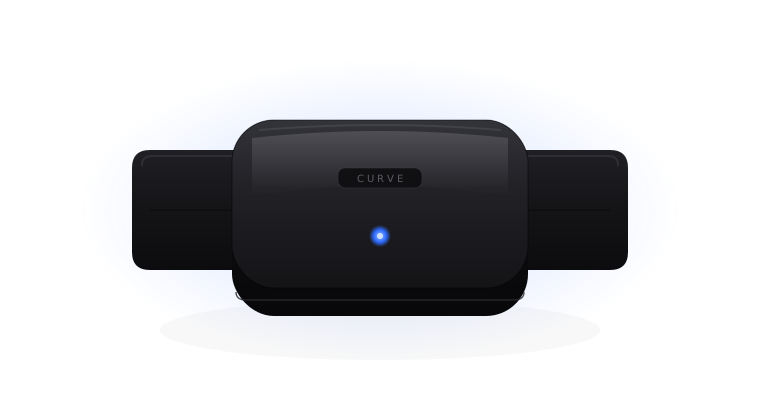
The Auromone Curve is a wrist band designed to read cortisol continuously from a trace of sweat, day and night. It ships in Q4 2026. Three limits are worth stating plainly, because they are the ones people ask about:
- It measures cortisol, and no other hormone. It does not read estradiol, progesterone, testosterone, luteinizing hormone, follicle-stimulating hormone, thyroid hormones, insulin or glucose. Further sensors for the same band are planned, and cortisol is the first one. We will not describe a capability the device does not have.
- It is not a laboratory test and does not replace one. It is a general wellness device. It has no reference interval, it will not tell you whether a reading is normal, and it is not part of diagnosing anything.
- It is not a fertility, contraception or pregnancy product. If your question is about ovulation, conception or a pregnancy, the tools for that are the urine hormone monitors above and a clinician, not this band.
What continuous measurement adds is the axis every sampled test throws away, which is time between samples. A four-point saliva profile gives four moments and infers the line between them. A panel gives one. Where that distinction matters most is in questions of shape: when the rise happens relative to your waking, how steep the fall through the day is, what the overnight stretch looks like. For a like-for-like on the two approaches to cortisol specifically, we wrote Auromone versus Eli Health, including the case for buying theirs if you want a reading this month.
What do you do with a result?
Treat it as one data point taken at one moment by one method, then decide whether the moment and the method matched your question. That sounds modest, and it is the step that turns testing into something useful rather than something worrying.
Three questions do most of the work. Was the sample taken at the hour or the cycle day the test is designed for? Is the reference interval the one belonging to this laboratory and this method, rather than a range from an article? And was anything running that day that changes the number, such as hormonal contraception, an acute illness, a hard training session, or a medicine nobody logged?
If the answer to any of those is no, the number is not wrong so much as unanchored, and repeating it properly beats reasoning hard about it. If the answers are all yes and the result still does not sit right with how you feel, that combination is a good reason to talk to a clinician rather than to buy a second kit. Bring the actual report, the collection times, and the medicine list. Those three things make a fifteen-minute appointment considerably more productive, and they are the part you can control.
This guide is for general education. The Auromone Curve is a general wellness device, not a diagnostic, and does not replace medical advice or clinical testing. Product descriptions reflect each company's own published material as read in September 2026 and may change; check the current product page before buying. Eli Health, DUTCH, Precision Analytical, LetsGetChecked, Everlywell, Mira, Inito, Oova, Quest and Labcorp are trademarks of their respective owners, and none of them are affiliated with Auromone. If you have symptoms that concern you, talk to a healthcare provider.
References
- MedlinePlus, U.S. National Library of Medicine. Cortisol Test. (Blood, urine and saliva samples; morning and about 4 p.m. draws; several home saliva samples at different times; stress, pregnancy, exercise, temperature and birth control pills affecting levels.)
- MedlinePlus. Testosterone Levels Test. (Total versus free testosterone; blood draw in the morning between 7 and 10.)
- MedlinePlus. SHBG Blood Test. (Bound versus free sex hormones; symptoms with a normal total testosterone; conditions and medicines that raise or lower SHBG.)
- MedlinePlus. Estrogen Levels Test. (Blood or urine at a laboratory, saliva for at-home tests; stopping certain supplements and medicines, including the birth control pill and menopausal hormone therapy.)
- MedlinePlus. Progesterone Test. (Blood sample; result meaning depends on where you were in the menstrual cycle; may need testing several times.)
- Rege J, Turcu AF, Auchus RJ, et al. Physiology, Cortisol. StatPearls. (Diurnal rhythm: rising in the final hours of sleep, peaking near awakening, lowest at night.)
- Nassar GN, Leslie SW. Physiology, Testosterone. StatPearls, updated April 2026. (GnRH released in pulses every 1 to 3 hours; most testosterone bound to SHBG and albumin; morning total testosterone between 8 and 10 a.m. as the initial step; repeat morning measurement required to confirm a low result.)
- Lee A, Jang S, Lee S, et al. Comparative analysis of salivary cortisol measurements using different assay methods in relation to serum-free cortisol measurement. Pract Lab Med. 2024;40:e00393. (188 saliva and 94 serum samples from 47 participants; salivary cortisol against serum free cortisol at r = 0.858 by immunoassay and 0.868 by mass spectrometry; immunoassay bias of 3.2 nmol/L; both methods suitable for dynamic HPA assessment.)
- Eli Health. Hormometer, product page as of September 2026. (Saliva cortisol read with a phone, results within 20 minutes, progesterone and testosterone listed as pre-order, "a wellness product and is not a substitute for laboratory or clinical testing".)
- Precision Analytical. DUTCH Test, as of September 2026. (Dried urine collection; sex hormone and cortisol metabolites; cortisol awakening response and diurnal pattern; provider ordering.)
- LetsGetChecked. Female Hormone Test, as of September 2026. (Finger prick; FSH, LH, prolactin and estradiol; morning collection on days 3 to 7 of the cycle, any weekday if periods are absent or unpredictable; clinical team on standby.)
- Everlywell. At-Home Women's Health Test, as of September 2026.
- Mira. Mira monitor and test wands, as of September 2026. (Four-hormone wands reading LH, E3G, PdG and FSH; "intended for hormone monitoring and cycle tracking"; "not intended to diagnose, screen for, or indicate PCOS or any other medical conditions".)
- Inito. Inito Fertility Monitor, as of September 2026. (Estrogen, LH, PdG and FSH from urine; PdG "rises only after ovulation"; confirming "whether ovulation actually happened".)
- Oova. Oova, as of September 2026. (Urine strips reading luteinizing hormone, E3G and PdG, tracked as patterns over time.)
- Quest Diagnostics. Quest Health, as of September 2026. ("No doctor visit is required for purchase, but an independent healthcare provider is involved throughout the process"; collection at Quest locations, in-home collection, or home kits; hormone and thyroid category.)
- Labcorp. Labcorp OnDemand, as of September 2026. ("All Labcorp OnDemand testing requires an order from an authorized healthcare professional"; collection at a Labcorp location or with an at-home kit; hormone test category.)