
Is there a wearable that tracks hormones?
Yes, but the word "tracks" is doing an enormous amount of work in that sentence. A ring that tells you which phase of your cycle you are in is tracking hormones in the sense that it reports something hormones cause. It is not tracking hormones in the sense of knowing how much of one is in your body. Both products sit in the same search results, use the same vocabulary, and answer different questions.
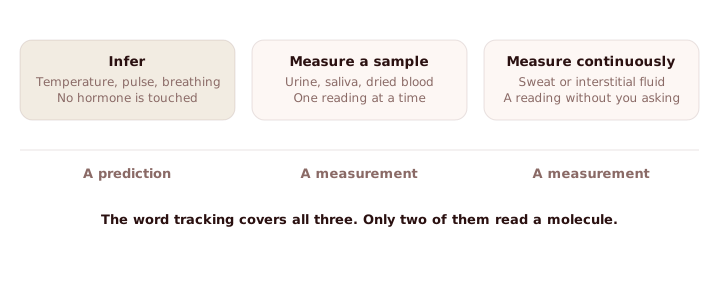
So the useful sort is not by brand or form factor. It is by what the sensor physically touches. Once you sort that way, the category collapses into three groups, and almost every question people ask about hormone trackers turns out to be a question about which group they are holding.
| Group | What the sensor touches | What it reports | Examples, September 2026 |
|---|---|---|---|
| 1. Physiological inference | Skin, pulse, temperature. No hormone. | A phase, an event, or a modelled hormone estimate | Oura, WHOOP, Apple Watch, Samsung, Garmin, Clair |
| 2. A sample, at intervals | Urine or saliva, outside the body | A hormone or its metabolite, per sample | Mira, Inito, Oova, Proov, Eli Health |
| 3. Continuous, from a body fluid | Sweat or interstitial fluid, on or in the skin | One hormone, repeatedly, through the day | Auromone, Lume Health, Level Zero Health |
Inferring a hormone is not measuring one
An inference uses a signal the hormone influences. A measurement uses the hormone. Progesterone raises core body temperature after ovulation, so a device that reads your skin temperature every night can spot the shift and place ovulation on a calendar. That is real physiology and it is genuinely useful. It is also an event detected downstream of a hormone, by a model that has never sampled the hormone itself.
The companies are clearer about this than their reviewers are. Oura's own explanation of Cycle Insights says that "the most important biosignal for menstrual cycle tracking is your body temperature trend", describes temperature dropping through the follicular phase and rising through the luteal phase, and states that "Oura is not a diagnostic tool". Apple says that "the Cycle Tracking app uses this data to provide a retrospective estimate of when you likely ovulated", and that the app "should not be used for birth control or to diagnose a health condition". Neither company claims to read a hormone, because neither does.
Two consequences follow, and they are the practical reason the distinction matters rather than a semantic one.
- An inference inherits everything else that moves its input. Skin temperature responds to a hot room, a fever, alcohol, a duvet and the menstrual cycle. The model has to separate the hormonal signal from all of them, using only the signal.
- An inference can only report what it was trained to report. A temperature model trained to place ovulation can place ovulation. It cannot tell you your progesterone level, because no quantity of temperature data contains that number.
The clearest case: a wearable that reports hormone names
Most group-one devices report a phase or a score. At least one reports the hormones themselves, from the same kind of signals. Clair Health says its wearable tracks "estrogen, progesterone, LH (luteinizing hormone), and FSH (follicle-stimulating hormone)", with sleep, recovery, activity, heart rate and HRV as secondary metrics. As of September 2026 its site says Founding Members ship in December 2026 and that the first 5,000 sold out.
How it gets there is set out plainly on its own site, and the sentence rewards a close reading: "Clair's multi-modal sensor array captures over 130 biomarkers spanning cardiovascular, thermoregulatory, autonomic, electrodermal, and other domains, then uses machine learning models trained against clinical-grade hormone measurements to decode the combined pattern into continuous hormonal insights."
Every input in that list is a physiological signal. None of them is a hormone. The verb carrying the weight is decode, and the company is candid about it: a model learns how 130 body signals relate to hormone levels measured some other way, then reports what it expects those levels to be. Clair describes validating that against FDA-registered at-home hormone tests, which is the right reference to choose and a sensible way to build such a model.
The output is still a model's estimate rather than an assay. That is not a knock on the engineering, which is ambitious, and a well-trained model can be genuinely informative. It is a statement about what the number on the screen is, and it is exactly why this page sorts by what the sensor touches rather than by what the app displays. Clair's own argument for building this way is a fair one: it says general fitness platforms misread cyclical physiology, and that a woman's HRV dropping in the luteal phase "looks like a recovery problem to a fitness algorithm". Clair also markets itself as a first in its category. That is its claim to make, and this page does not answer it in kind.
None of this makes inference inferior. It makes it a different instrument. The same argument, applied to stress rather than the cycle, is the subject of cortisol vs HRV, and the device-by-device version is whether your watch measures cortisol.
What do the rings and watches actually sense?
Pulse timing, movement, skin temperature, breathing, and on some models a blood-oxygen trend. That list is the whole of the raw material behind every cycle phase, recovery figure and heart-rate-derived stress number these devices produce, and our sourced table of what each wearable measures sets it out feature by feature. There is no hormone assay inside a ring or a watch sold today, and none of these companies says there is.
What they do with that raw material differs, and some of it is good work. Oura reports that its period-prediction algorithm was trained on a large body of members' sleep data and is, in the company's words, "more than 96% accurate", which is a claim about predicting an event rather than about measuring a hormone. Oura also notes that its Fertile Window feature "is a CE-marked medical device in the European Union", while adding that it "is not intended to be used a method of birth control". A device can be regulated, well validated on its own task, and still not be measuring a hormone. Those are independent facts, and they get blurred constantly.
WHOOP, Samsung and Garmin belong in the same column. Their cycle, recovery and stress features are built from cardiovascular and temperature signals, and none of them reports a hormone concentration.
Which devices measure a hormone in a sample?
The ones that ask you for urine or saliva. This is the group that unambiguously measures a hormone, and the trade is that you get a reading when you take a sample, not continuously. Most of them are aimed at the menstrual cycle, where a few well-timed readings answer the question.
Two clarifications people find useful. First, several of these systems read a metabolite rather than the hormone itself: PdG is a urinary metabolite of progesterone, and E3G is a urinary metabolite of estrogen. Second, "quantitative" is a real dividing line. A classic ovulation strip gives you a line. A quantitative system gives you a number, which is what lets you see a trend instead of a threshold.
| Product | Sample | What it reads | How it is read |
|---|---|---|---|
| Mira | Urine, by wand | LH, E3G, PdG and FSH, depending on the wand | Fluorescence in a reader, reported as numbers |
| Inito | Urine | Estrogen, LH, PdG and FSH | Phone-camera imaging, fluorescence and colour, about 10 minutes |
| Oova | Urine, by strip | LH, E3G and PdG, quantitatively | Scanned by the app, about 10 minutes |
| Proov | Urine | PdG, to confirm that ovulation happened | Described by Proov as FDA-cleared for that use |
| Eli Health Hormometer | Saliva | Cortisol, with progesterone and testosterone on pre-order | Read by a phone, results within 20 minutes |
Eli Health is the one in that table aimed at cortisol rather than the cycle, which makes it the closest neighbour to what we build, and the differences between a saliva sample and a continuous sensor are covered in detail in Auromone versus Eli Health.
Which devices measure continuously, and from what fluid?
This is the smallest group, and the honest summary is that it is early. Continuous sensing means a sensor sitting on or in the skin, sampling a body fluid over and over without you doing anything. There are two fluids in play for hormones: sweat, which sits on the surface, and interstitial fluid, the fluid between cells just under it.
The proof that continuous body-fluid chemistry works at consumer scale is glucose, not hormones. Biolinq's Shine sensor, which the company describes as "the first glucose sensor with no hypodermic needle for insertion" and states is "now FDA cleared", reads glucose intradermally and continuously. It measures no hormone, and that is precisely why it is worth citing: the hard engineering of continuous on-body measurement has been solved for one analyte, by a lot of companies, over about two decades.
Hormones are a harder target, and the reason is chemical. In their 2019 Nature Biotechnology review of biofluid sensing, Heikenfeld and colleagues write that small lipophilic molecules "such as cortisol (one to tens of nanomolar) exhibit strong correlation between sweat and blood plasma concentrations", likely because they pass readily through cell membranes, and that this "is expected to be true for other steroid hormones (progesterone, testosterone, etc.)". They add the caveat that matters: blood correlation "should only be expected for unbound (active) fractions". They also name the central difficulty, that "perhaps the biggest inherent challenge for sweat biosensing is to correct for confounding factors caused by diluted (filtered) analyte partitioning". Low concentrations, and a sample whose dilution changes with how much you are sweating.
Where the companies stand, from their own pages in September 2026:
- Auromone, the band this site is about, is designed to measure cortisol only, continuously, from a trace of sweat at the wrist. In development, and reserving is free.
- Lume Health describes a wrist-worn sweat sensor and hormone-monitoring wearables, and is at waitlist stage. Its site does not specify the analytes or state that sensing is continuous.
- Level Zero Health describes real-time hormone monitoring from interstitial fluid using nanotechnology and DNA-based sensing, in a minimally invasive wearable. Its site does not name the hormones or give an availability date.
Read that list the way I would read a competitor's: three companies describing intentions, at different distances from a shipped product. The comparison of cortisol-sensing approaches keeps a running status table, and what we will and will not claim about our own measurement is on the science page.
Do hormone trackers work?
The measurement kind generally do the thing they say. The inference kind work at their own task and not at the one buyers often imagine. Almost every disappointed review of a hormone tracker turns out, on inspection, to be a group mismatch rather than a broken product.
A quantitative urine system does measure LH, and its number does move with your cycle. A temperature ring does place ovulation, retrospectively and often well. The failure mode is buying the ring in order to find out a progesterone level, or buying strips in order to get a continuous picture of a hormone that moves hour by hour. Both are the right instrument pointed at the wrong question.
How accurate are hormone trackers?
Accuracy is only defined against a reference, so the word means two different things in this category. Before comparing any two figures, check what each one was measured against.
- A measurement device has a reference. A urine or saliva test can be run beside a laboratory assay on the same sample, and the agreement between them is a real, checkable quantity. This is the kind of figure you can argue about.
- An inference device usually has no hormone reference at all. When a ring quotes a percentage, it is almost always about predicting an event, such as the day a period starts. That is a legitimate number. It is not a statement about closeness to a hormone level, and it should not be read across as one. The exception is a device deliberately trained and validated against hormone assays, as Clair describes doing. There the reference genuinely is a hormone, and the figure describes how well a model predicts a measurement it does not itself make.
Three questions travel well across the whole category. What was it compared against, and on the same samples? Who was in the comparison, and were they like you? And is the figure about a concentration or about a prediction? A number without those attached is a headline rather than a measurement, which is the argument I made at more length about sleep-staging accuracy claims.
We publish no accuracy figure for the Curve, because it has not earned one yet. When there is a number worth reporting, it will appear on the science page with its method beside it.
What does continuous measurement add that a daily strip cannot?
Timing, and only timing. For a hormone that is roughly stable across a day, a well-timed sample tells you almost everything, and a continuous sensor adds convenience rather than information. For a hormone that moves on a schedule, a sample is a single frame from a film.
Cortisol is the clearest case of the second kind. It runs on a daily rhythm, rises sharply in the first half hour after waking, falls across the day and bottoms out overnight. Heikenfeld and colleagues make the same point from the sampling side, noting that "for study of circadian biology that requires frequent sampling throughout the day (cortisol, melatonin, etc.), blood is inconvenient", and listing the cortisol awakening response among the few applications where short sensor lag genuinely matters.
This is why cortisol, rather than the sex hormones, is the first thing we built a sensor for. The shape is the information, and a shape needs many points. What that shape looks like across a normal day is laid out on the cortisol meter page, and how cortisol interacts with the rest of the endocrine system is covered in cortisol and your other hormones.
What none of these devices can do
No device in any of the three groups diagnoses a hormone disorder. Not the rings, not the urine and saliva tests, and not the continuous sensors, ours included. Hormone disorders are identified by clinicians using timed laboratory testing, dynamic testing and a physical examination, and a consumer device is not a step in that pathway.
None of these devices, the Auromone Curve included, should be used for fertility, contraception or pregnancy decisions. The companies say so themselves. Apple states that Cycle Tracking "should not be used for birth control or to diagnose a health condition". Oura states that its Fertile Window feature "is not intended to be used a method of birth control". Mira states that its "products are intended for hormone monitoring and cycle tracking" and that "results are not intended to diagnose, screen for, or indicate PCOS or any other medical conditions". Eli Health describes the Hormometer as "a wellness product" that "is not a substitute for laboratory or clinical testing".
If something about your cycle, your energy or your symptoms concerns you, that is a conversation with a clinician, and a device's data is at most something to bring along to it.
How to choose, by the question you are asking
Start from your question, not from the product category. The three groups map cleanly onto three different questions, and the mapping is the whole decision.
| If your question is | The group that answers it | Why |
|---|---|---|
| When did I ovulate, and when is my period due? | Inference, or urine tests | Both work. A ring is passive and retrospective, urine is same-day and quantitative. |
| What is my actual LH, estrogen or progesterone number? | A sample, at intervals | A measured level means reading the molecule. An inference device can estimate one, which is a different thing. |
| What shape does my cortisol make across a day? | Continuous, from a body fluid | A rhythm needs many points. Two samples cannot draw a curve. |
| Do I have a hormone disorder? | None of them | That is a clinical question, answered with laboratory testing and an examination. |
One more filter, which costs nothing and eliminates a surprising amount. Ask what fluid the device touches. If a company cannot tell you plainly whether its sensor reads urine, saliva, sweat or interstitial fluid, or whether it reads a fluid at all, then it is in group one, and the hormone in the marketing is a conclusion rather than a reading. We hold ourselves to the same test: the Curve is designed to read cortisol from sweat, and nothing else.
This guide is for general wellness education only. The Auromone Curve is a general wellness device, not a diagnostic. It is designed to measure cortisol and no other hormone, it does not diagnose, screen for or rule out any condition, it is not for fertility, contraception or pregnancy decisions, and it does not replace medical advice or clinical testing. Other hormones are a research direction with no announced timeline. Product names are trademarks of their owners, and every description above reflects each company's own published materials as read in September 2026, which may change. If you have symptoms that concern you, talk to a healthcare provider.
References
- Heikenfeld J, Jajack A, Feldman B, Granger SW, Gaitonde S, Begtrup G, Katchman BA. Accessing analytes in biofluids for peripheral biochemical monitoring. Nature Biotechnology. 2019;37:407-419. (Cortisol at one to tens of nanomolar showing strong sweat-to-plasma correlation, expected to extend to other steroid hormones; correlation expected only for unbound, active fractions; dilution from analyte partitioning as the biggest inherent challenge for sweat biosensing; blood being inconvenient for circadian sampling of cortisol and melatonin; the cortisol awakening response as a case where sensor lag matters.)
- Oura. Cycle Insights: Cycle Phases, Fertile Window, Period Prediction. (Body temperature trend as the most important biosignal for cycle tracking; follicular and luteal temperature patterns; "more than 96% accurate" period prediction; "Fertile Window is a CE-marked medical device in the European Union"; not intended as a method of birth control; "Oura is not a diagnostic tool".)
- Apple. Health. (Wrist temperature data used to "provide a retrospective estimate of when you likely ovulated"; "The Cycle Tracking app should not be used for birth control or to diagnose a health condition".)
- Clair Health. Clair. ("Clair's multi-modal sensor array captures over 130 biomarkers spanning cardiovascular, thermoregulatory, autonomic, electrodermal, and other domains, then uses machine learning models trained against clinical-grade hormone measurements to decode the combined pattern into continuous hormonal insights"; estrogen, progesterone, LH and FSH tracked, with sleep, recovery, activity, heart rate and HRV as secondary metrics; validation against FDA-registered at-home hormone tests; Founding Members ship December 2026 and the first 5,000 sold out; the company's own "world's first" positioning line.)
- Mira. Mira hormone monitors and wands. (Urine wands reading LH, E3G, PdG and FSH by kit tier; fluorescent detection; "Mira products are intended for hormone monitoring and cycle tracking. Results are not intended to diagnose, screen for, or indicate PCOS or any other medical conditions".)
- Inito. Inito Fertility Monitor. (Estrogen, LH, PdG and FSH from urine; 10 minutes; phone-camera imaging using fluorescence and visual colorimetric imaging; quantitative hormone values.)
- Oova. Oova. (Quantitative LH, E3G and PdG from a urine strip read by the app in about 10 minutes; fertility and perimenopause uses.)
- Proov. Proov. (PdG testing; the company describes Proov as "the only FDA-cleared at-home diagnostic test to confirm successful ovulation".)
- Eli Health. Hormometer. (Saliva sampling read by a phone; "results within 20 minutes"; cortisol available with progesterone and testosterone on pre-order; described as "a wellness product" that "is not a substitute for laboratory or clinical testing".)
- Level Zero Health. Level Zero Health. (Real-time hormone monitoring; nanotechnology and DNA-based sensing; interstitial fluid described as correlated with blood readings; a minimally invasive wearable worn on the skin. No hormones named and no availability date given.)
- Lume Health. Lume Health. (A wrist-worn sweat sensor described as hormone-monitoring wearables; waitlist stage. Analytes not specified and continuous operation not stated on the page.)
- Biolinq. Biolinq Shine. (Continuous intradermal glucose sensor, "the first glucose sensor with no hypodermic needle for insertion", "now FDA cleared". Glucose only, no hormone.)
