What is Garmin Body Battery?
A single number, from 5 to 100, meant to represent how much you have left in reserve. Garmin's owner's manual for the Venu 3 describes it in one sentence: "Your watch analyzes your heart rate variability, stress level, sleep quality, and activity data to determine your overall Body Battery™ level." The manual then splits the scale into four bands, and those bands are the whole of the official interpretation:
- 5 to 25. Very low reserve energy.
- 26 to 50. Low reserve energy.
- 51 to 75. Medium reserve energy.
- 76 to 100. High reserve energy.
Garmin's practical guidance is equally short. "Good sleep charges your Body Battery," the manual says, and "strenuous activity and high stress can cause your Body Battery to drain more quickly." On the Garmin Index Sleep Monitor, where the band only reads the night, the wording narrows to the overnight change: "Your sleep band analyzes your heart rate variability, sleep quality, and sleep stages to determine your overnight Body Battery™ change."
One line from Garmin's own blog is worth more than the rest of the interpretation put together, because it corrects the mistake most readers arrive with: "A healthy approach to life doesn't mean keeping your Body Battery full all-day long. It is supposed to diminish during the day." The number is a description of expenditure. Spending it is the point.
Body Battery, Firstbeat Analytics, Training Readiness and Garmin Connect are trademarks of Garmin Ltd. or its subsidiaries, and everything in this guide describes Garmin's method only as Garmin and Firstbeat describe it, as of September 2026.
Before the mechanism: what the number is not for
Garmin says this more plainly than any competitor would say it for them. Its blog states that "Your Garmin smartwatch is not a medical device," that "Your watch cannot tell you if you're sick, and you should not use it to determine if you're sick," and that Garmin smartwatches and their data "are not intended to diagnose, treat, cure or prevent any disease."
Read that in both directions, because the second direction is the one that gets people hurt. A low number is not a finding. And a normal or high number rules nothing out. Body Battery is computed from heartbeat timing compared against your own recent baseline, so it is not a check for infection, for a cardiac problem, or for anything else, and a full battery is not evidence that you are well. If you have symptoms that worry you, chest pain, breathlessness, fainting, a fever you cannot explain, or an illness that is not improving, that is a question for a clinician and not for a wrist graph. The same applies to every score on this site, ours included.
What is Body Battery calculated from?
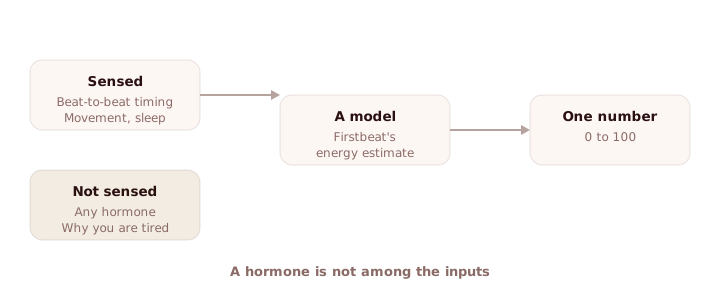
The timing between your heartbeats, plus movement and sleep. Everything else is modelling on top of that. The chain has three links, and each one is documented publicly.
First, the raw signal. Garmin's 2023 technical note on beat-to-beat intervals explains that its wearables measure the interval between successive pulses optically at the wrist, using photoplethysmography, and calls those beat-to-beat intervals, or BBI, to distinguish them from the R-R intervals an electrocardiogram produces. Every heart-rate variability metric, Garmin notes, is computed from that time series: "The basic measurement used to compute every HRV metric, such as the root mean square of successive differences (RMSSD) and the standard deviation of NN intervals (SDNN), is a time series of inter-beat intervals (IBI)."
Second, the model. Firstbeat Analytics, the Finnish company whose engine Garmin acquired in June 2020, published its method in a white paper on stress and recovery analysis from 24-hour heart-rate variability. The pipeline it describes runs the beat-to-beat data through an artifact filter, resamples it, then derives both heart-rate variability measures and quantities you would not expect from a pulse: RMSSD, high-frequency power, low-frequency power, the amplitude of respiratory sinus arrhythmia, and then respiration rate, oxygen consumption and excess post-exercise oxygen consumption, calculated with neural-network models. The day is then segmented and each segment sorted by a decision tree.
Third, the classification, which is where the word "energy" enters. Firstbeat's definitions are explicit and worth quoting, because they are the load-bearing assumption of the whole metric. Stress is "Increased activation level of the body when sympathetic activity dominates the ANS and parasympathetic (vagal) activation is low." Recovery is "Reduced activation level of the body when parasympathetic (vagal) activation dominates the ANS over sympathetic activity." Physical activity is detected metabolically: in the white paper's description, a segment counts as physical activity when estimated oxygen consumption exceeds 30% of the individual's VO2max, and as daily physical activity between 20 and 30%. Segments the model cannot place, or that contain more than 75% artifacts, are labelled an unrecognized state.
Firstbeat then describes the accounting step that Body Battery is built on, in terms of body resources: the balance between stress and recovery reactions "is used for estimating whether the body resources have been accumulated or consumed during the measured period." That is the battery metaphor, stated in physiology. What Garmin does not publish is the weighting, meaning how many points a given stretch of sympathetic dominance costs you against how many a given stretch of vagal dominance returns. The inputs are public. The arithmetic is not.
What is heart-rate variability, and why build an energy number on it?
Because the nervous system's grip on the heart changes fast, continuously, and without your permission, which makes the heart a convenient place to eavesdrop. Heart-rate variability is, in Garmin's phrasing, "variations in the time intervals between heartbeats." Your heart does not tick evenly. The gaps stretch and compress as the vagus nerve and the sympathetic nerves pull against each other, and the size of that wobble tracks which side is currently winning.
Firstbeat's white paper makes the case for this being a real signal rather than a convenient one, and the argument is sound. It notes that the association between autonomic activity and heart-rate variability "has been confirmed by studies of invasive autonomic blockade in laboratory settings, where blocking of parasympathetic and sympathetic activity with medication (atropine, metoprolol) decreased and reverted HRV, respectively." When you chemically remove one branch of the nervous system, the variability changes in the predicted direction. That is about as direct a demonstration as physiology offers without opening anyone up.
So the premise is defensible: autonomic tone is genuinely informative about load and rest, and it can be read passively, all night, from a watch you forgot you were wearing. The reason to be careful is not that the signal is fake. It is that a great deal of interpretation sits between the signal and the word "energy". If you want the longer treatment of what heart-rate variability does and does not support, including which parts of the standard stress-score story hold up, that is the subject of cortisol vs HRV.
What drains and recharges Body Battery
Anything that shifts your autonomic balance, which is a much wider list than "training and sleep". Garmin's guidance and Firstbeat's stress-factor table do not quite agree in scope, so here are both, attributed.
| Influence | Direction | Stated by |
|---|---|---|
| Sleep | Charges. Garmin calls a good night "your best opportunity to recharge your Body Battery to near max capacity" | Garmin blog and manual |
| Naps and rest | Slow the drain or add a little back | Garmin manual |
| Strenuous activity | Drains, and faster | Garmin manual |
| Daily and emotional stress | Drains | Garmin blog |
| Alcohol | Drains. "The stress of metabolizing alcohol drains your Body Battery faster and degrades the restorative quality of sleep" | Garmin blog |
| Illness | Can stop it charging overnight | Garmin manual and blog |
| Fitness level | Higher fitness, more stress absorbed for the same cost | Garmin blog |
| Food and caffeine | Garmin states these have no impact on Body Battery | Garmin manual |
| Stimulants such as coffee, medications, acute infection, pain, dehydration, heat, noise, altitude | Listed as factors that affect heart-rate variability | Firstbeat white paper |
| Age | Heart-rate variability, recovery during sleep and the proportion of stress all decline with increasing age in Firstbeat's database | Firstbeat white paper |
The caffeine row is the interesting one, and it is a genuine tension rather than a gotcha. Garmin's manual says flatly that "Food intake, as well as stimulants like caffeine, has no impact on your Body Battery." Firstbeat's white paper, describing the method underneath, lists "Stimulants e.g. coffee" among the physical factors that affect heart-rate variability. Both can be true at once if Garmin's pipeline is not given any food or caffeine input and does not model it, while the espresso still moves the pulse signal the model is reading. The practical consequence is worth knowing: a late coffee may show up in your number without the app ever attributing it, and you will be left explaining the dip some other way.
The three biggest movers, in Garmin's own telling, are sleep, alcohol and illness, and all three act on the same lever. They change how much of the night the model can classify as parasympathetic dominance. Anything that keeps your nervous system busy while you are lying still will cost you overnight charge, whether or not you experienced it as stressful.
Why is my Body Battery always low?
Most often because the model is reading sustained sympathetic activity, and because you are comparing the number against an expectation Garmin never set. Garmin's own article on this lists five reasons, and only one of them is training: overall daily stress, poor sleep, fitness level, alcohol, and ordinary individual variation. Its framing is that the battery is meant to deplete.
Beyond that, four structural explanations account for most of the complaints, and none of them means the device is broken.
- It is scored against you, not against other people. Firstbeat's method builds an individual physiological model, updating your resting and maximum heart rate from your own recorded data. Your 40 and a friend's 40 are not the same quantity, and comparing them is meaningless.
- The night is doing most of the work. In the Firstbeat database, an average of 60% of sleep time was detected as recovery, and a typical 24-hour measurement was 51% stress against 26% recovery. If your sleep is short or broken, the only large charging window in the day is short or broken too.
- Sympathetic dominance is not the same as feeling stressed. Firstbeat's factor table puts alcohol, medications, acute infections, pain, dehydration, heat and altitude in the same column as work pressure and anxiety. The model sees activation, not its cause.
- Some of the day is simply unreadable. Garmin's manual says grey bars on the graph "indicate times when you were too active to determine your stress level." Garmin's technical note adds that when motion passes a threshold the device "will decline to provide a beat measurement at all," leaving a gap in the series. A busy, physical day is partly missing data.
Now the version of this question that actually deserves an answer: why does it read low on a day I feel fine, and high on a day I feel wrecked? Because the two things are measured on different instruments, one electrical and one subjective, and they are related without being interchangeable. Föhr and colleagues followed 221 overweight, psychologically distressed working-age adults across nine months, comparing heart-rate-variability-based stress and recovery against the Perceived Stress Scale, and reported that initial levels of physical activity, objective stress and objective recovery were associated with the change in subjective stress over time. Related, measurably. Identical, no.
Firstbeat's own white paper contains the cleanest illustration of the gap. It describes an experimental sleep study in which recovery measured by the method "was diminished during sleep after intensive late-evening exercise, although no changes were observed in EEG-based polysomnographic or movement-based sleep quality." The sleep looked normal on the laboratory standard. The autonomic signal did not. Whichever of those you call "how you slept" is a choice, not a fact.
Can Body Battery go to zero, and what does that mean?
No. Garmin's manual puts the range at 5 to 100, so 5 is the floor rather than zero. A reading of 5 means the model has reached the bottom of its scale, not that your body has reached the bottom of anything. This matters more than it sounds, because a metric with a floor cannot tell you how far past the floor you are. Two very different days both read 5, and the number stops carrying information exactly where people start reading the most into it.
What a sustained floor does tell you is that the model has been finding sympathetic dominance and little vagal recovery for a while. That is worth noticing, particularly if it persists through nights that should have recharged it. What it cannot tell you is why, and Garmin's position on the why is unambiguous: the watch is not a medical device and cannot tell you whether you are ill. A run of very low mornings alongside symptoms is a reason to see a clinician, not a reason to read the graph harder.
How accurate is Body Battery?
The question does not have an answer, and that is a property of the metric rather than a dodge. Accuracy is agreement with a reference standard. There is no reference standard for how much energy a person has, no laboratory instrument that outputs a true Body Battery against which the estimate could be scored. So the composite cannot be validated in the way a sleep-staging algorithm can be validated against polysomnography. It can only be asserted, and then judged by whether it behaves sensibly against your own history. Searching the peer-reviewed literature for a validation of the Body Battery score itself in September 2026 returned nothing on the metric, which is what you would expect for a proprietary composite rather than a sign of concealment. The same logic applies to every readiness and recovery score on the market, a point I made at more length about a different company's number in the Oura sleep-staging lawsuit, and it applies to anything we would ever compute at Auromone too.
What can be checked is the layer beneath it, and there the published evidence is mixed and specific. Two findings, both opened and read rather than summarised:
- The input signal, on Garmin hardware. Dial and colleagues, publishing in Physiological Reports in 2025, compared five consumer wearables against a chest-strap electrocardiogram across 536 nights in 13 healthy adults. For overnight heart-rate variability the Garmin Fenix 6 reached a concordance correlation coefficient of 0.87, with a mean absolute percentage error of 10.52%, across 150 nights. The Oura Generation 4 reached 0.99 and WHOOP 4.0 reached 0.94 on the same measure. The authors also excluded the Garmin device from the resting-heart-rate comparison because its timestamp methodology is not disclosed, and they concluded that "Oura devices showed the highest agreement for RHR and HRV, and WHOOP showed acceptable agreement, whereas Garmin Fenix and Polar demonstrated lower concordance." That is one older watch model in a small healthy sample, and the authors themselves note that device algorithms update and require frequent re-evaluation.
- The Firstbeat method, on sleep rather than energy. Kuula and Pesonen, at the University of Helsinki, tested the Firstbeat sleep analysis method against polysomnography across 40 nights in 20 healthy young adults. Accuracy was 0.93 for wake, 0.87 for slow-wave sleep, 0.84 for REM and 0.69 for light sleep, and the method underestimated REM sleep by a mean of 18 minutes and overestimated wake time by a mean of 14 minutes. They concluded the approach was feasible for distinguishing sleep from wake and identifying stages, and noted that their sample contained no diagnosed sleep disorders and that results are likely to differ where health issues are present.
Garmin is also candid about a limit in its own signal chain. Its technical note explains that the legacy beat-to-beat implementation prioritised availability during marginal signal quality, which required extra filtering that "limited the bandwidth with the consequence of sometimes affecting the accuracy of higher frequency HRV markers such as RMSSD." RMSSD is precisely the measure most sensitive to vagal activity, which is what the recovery half of the model is built on. The newer Enhanced BBI pipeline addresses this and adds a per-beat confidence flag, though Garmin notes that "BBI confidence is not 100% specific" and sometimes marks accurate beats as low confidence. Motion is the most common cause, followed by fit, low blood perfusion and lying on the arm wearing the watch.
The honest summary: the sensor is good, the method is published and physiologically grounded, the sleep layer has independent support with known weak spots, and the energy number on top is an interpretation that no study can confirm or refute. None of that makes it useless. It makes it a trend to read against yourself, which is exactly how Garmin describes it.
Body Battery, Stress level and Training Readiness: what is different
They share a sensor and answer different questions, which is why they routinely disagree. All three come from the same beat-to-beat stream. Here is what each one is, in Garmin's documentation.
| Metric | Scale | What Garmin says it is built from | The question it answers |
|---|---|---|---|
| Body Battery | 5 to 100 | Heart-rate variability, stress level, sleep quality and activity data | How much reserve is left right now |
| Stress level | 0 to 100 | Heart-rate variability analysed while you are inactive. 0 to 25 resting, 26 to 50 low, 51 to 75 medium, 76 to 100 high | How activated you are at this moment |
| Training Readiness | 1 to 100 | Sleep score, recovery time, HRV status, acute load, sleep history over the last 3 nights and stress history over the last 3 days | Whether to train hard today |
Two consequences follow. Stress level is the narrowest and the most literal of the three, since Garmin describes it as analysing heart-rate variability "while you are inactive", which is why it goes blank during exercise rather than reporting a huge number. Training Readiness is the widest, folding in three days of history and a training-load term, so it can sit high on a morning when Body Battery is low, simply because it weighs your recent training differently from your current reserve. If you train seriously and want the hormonal side of that same question, cortisol and overtraining covers what the evidence supports and what it does not, and the athlete page covers where a hormone reading fits beside a recovery score.
What a heart-rate model cannot see
Its blind spots are structural, not bugs, and Firstbeat states the most important one itself. The white paper is direct about where the approach stops working: "the usefulness and validity of HRV-based methods can be limited in certain chronic conditions or illnesses that affect ANS functioning or when applied to persons using medications that affect the heart significantly." That is a large population, and it includes many of the people most motivated to track recovery. If you take a beta-blocker, or live with a condition that alters autonomic function, the number may not mean what the app implies.
Beyond that, four limits are worth naming plainly:
- It cannot see cause. The model detects activation. A hard session, a deadline, a fever, a hangover and a hot bedroom can all present as reduced vagal dominance, and the graph labels them the same way.
- It cannot measure while you move. Stress level is computed when you are inactive, and heavy motion produces grey bars or gaps in the underlying beat series.
- It has no absolute scale. Every reading is relative to your own recent history, so it cannot tell you where you sit against any external reference.
- It cannot measure a molecule. This is the one that matters for the rest of this site. Pulse timing is an electrical consequence of nervous-system activity. It is not a chemical measurement, and no amount of modelling converts one into the other.
Where a hormone reading sits next to it
A hormone and a heart-rate model are two different measurements, and neither is a version of the other. Cortisol is a hormone made by the adrenal cortex. StatPearls describes the chain: "Corticotropin-releasing hormone (CRH), synthesized and secreted by the paraventricular nucleus of the hypothalamus, stimulates the anterior pituitary to release ACTH. ACTH then acts on the adrenal cortex to promote cortisol synthesis and secretion." It also runs on a clock of its own, with secretion "beginning to rise during the final hours of sleep, peaking near the time of awakening, and gradually declining throughout the day to reach the lowest concentration at night." That rhythm belongs to the endocrine system and is not derived from your pulse.
The two are related, and Firstbeat has published its own estimate of how closely. Its white paper reports that significant correlations "have been reported (r between 0.40 and 0.50) between cortisol after awakening and indicators of stress and relaxation during sleep in hospital workers." Take that at face value and it says something precise: a moderate relationship, in one occupational sample, between a hormone measured in the morning and a heartbeat-derived description of the night. Enough to show the two systems are connected. Nowhere near enough for either to stand in for the other. Firstbeat is also fair about the trade in the opposite direction, noting that hormonal measurements require laboratory analysis of saliva, urine or blood, and that "the timing of distinct samples may affect the interpretation of the results significantly as there are strong diurnal rhythms in hormonal secretion." That is an accurate description of the problem with hormone testing, written by a company selling the alternative.
So the two instruments answer different questions. A heart-rate model tells you about autonomic state, continuously and passively, with the caveats above. A hormone measurement tells you the concentration of a specific molecule, which is a chemical fact rather than an inference, and which follows a daily shape that heartbeat timing does not encode. If you want the background on the hormone itself, start with cortisol 101, and cortisol and stress covers what the hormone does and does not do under load.
What I am not going to claim is that one explains the other. The Auromone Curve measures cortisol continuously from a trace of sweat at the wrist and shows you the shape of your own curve. It does not compute Body Battery, it is not a recovery score, and it cannot tell you why your Body Battery read 24 this morning. It also will not tell you whether a reading is normal, because that is a clinician's question. It is a general wellness device, not a diagnostic. For the device-by-device version of which wearables sense what, see whether your watch measures cortisol, and the measurement hub compares every method people actually use.
This guide is for general wellness education only. The Auromone Curve is a general wellness device, not a diagnostic, and does not replace medical advice or clinical testing. Body Battery, Firstbeat Analytics, Training Readiness, Garmin Connect and Garmin are trademarks of Garmin Ltd. or its subsidiaries, and Oura, WHOOP and Polar are trademarks of their respective owners. Descriptions of Garmin features reflect Garmin's and Firstbeat's published documentation as of September 2026 and may change with firmware. If you have symptoms that concern you, talk to a healthcare provider.
References
- Garmin. Venu 3 series Owner's Manual, Body Battery. ("Your watch analyzes your heart rate variability, stress level, sleep quality, and activity data to determine your overall Body Battery level"; the 5 to 100 range and its four bands; "Good sleep charges your Body Battery"; "Strenuous activity and high stress can cause your Body Battery to drain more quickly"; "Food intake, as well as stimulants like caffeine, has no impact on your Body Battery".)
- Garmin. Forerunner 965 Owner's Manual, Viewing the Body Battery Glance. (Graph of Body Battery and stress levels since midnight; blue bars for rest, orange for stress, green for timed activities, grey bars "indicate times when you were too active to determine your stress level".)
- Garmin. Lily Owner's Manual, Heart Rate Variability and Stress Level. ("Your watch analyzes your heart rate variability while you are inactive to determine your overall stress"; the 0 to 100 range and its bands; "Training, physical activity, sleep, nutrition, and general life stress all impact your stress level".)
- Garmin. Forerunner 965 Owner's Manual, Training Readiness. (The 1 to 100 score and its colour tiers; the six contributing factors: sleep score, recovery time, HRV status, acute load, sleep history over the last 3 nights and stress history over the last 3 days.)
- Garmin. Index Sleep Monitor Owner's Manual, Body Battery. ("Your sleep band analyzes your heart rate variability, sleep quality, and sleep stages to determine your overnight Body Battery change"; "Illness, alcohol consumption, and stress can prevent you from fully charging your Body Battery overnight".)
- Garmin. 5 reasons your Body Battery says you're running low. (Daily stress, sleep, fitness, alcohol and individual variation; "Alcohol is a huge stressor for your body. The stress of metabolizing alcohol drains your Body Battery faster and degrades the restorative quality of sleep"; "A healthy approach to life doesn't mean keeping your Body Battery full all-day long. It is supposed to diminish during the day".)
- Garmin. How getting sick might change your heart metrics. ("Your Garmin smartwatch is not a medical device"; "Your watch cannot tell you if you're sick, and you should not use it to determine if you're sick"; "not intended to diagnose, treat, cure or prevent any disease"; illness as a reason Body Battery struggles to charge.)
- Garmin. Garmin Enhanced BBI: An Example Night, November 2023, PDF. (BBI measured optically at the wrist and distinguished from ECG-derived RRI; every HRV metric computed from an inter-beat-interval time series; legacy filtering that "limited the bandwidth with the consequence of sometimes affecting the accuracy of higher frequency HRV markers such as RMSSD"; motion, fit and perfusion as causes of low-confidence beats; "BBI confidence is not 100% specific".)
- Garmin. vívoactive 5 Owner's Manual, Trademark Notices. (Body Battery and Firstbeat Analytics listed among trademarks of Garmin Ltd. or its subsidiaries.)
- Firstbeat Technologies Ltd. Stress and Recovery Analysis Method Based on 24-hour Heart Rate Variability, white paper, 2014, PDF. (Definitions of stress, recovery and body resources; the analysis pipeline, RMSSD, HFP, LFP, respiratory sinus arrhythmia amplitude, respiration rate, VO2 and EPOC; the 30% and 20 to 30% VO2max thresholds and the 75% artifact rule; autonomic blockade with atropine and metoprolol; Table 1 of stress factors including alcohol, stimulants such as coffee, medications, acute infections, pain, dehydration, heat, noise and altitude; the limitation in chronic conditions and heart-affecting medications; typical day of 51% stress and 26% recovery with 60% of sleep detected as recovery; diminished recovery after intensive late-evening exercise despite unchanged polysomnographic sleep quality; correlations of r between 0.40 and 0.50 with cortisol after awakening in hospital workers; the diurnal-rhythm caveat on hormonal sampling; declines with age.)
- Garmin. Garmin acquires Firstbeat Analytics, 30 June 2020. (Firstbeat described as a provider of physiological analytics whose heartbeat analytics inform metrics including stress, sleep, VO2 max, training status and load, respiration rate and calories burned.)
- Dial MB, Hollander ME, Vatne EA, Emerson AM, Edwards NA, Hagen JA. Validation of nocturnal resting heart rate and heart rate variability in consumer wearables. Physiol Rep. 2025;13(16):e70527. (13 healthy adults, 536 nights, against a chest-strap ECG reference; Garmin Fenix 6 HRV concordance 0.87 with 10.52% mean absolute percentage error over 150 nights; Oura Generation 4 at 0.99 and WHOOP 4.0 at 0.94; Garmin excluded from the resting-heart-rate analysis owing to undisclosed timestamp methodology; the quoted conclusion; generalisability and algorithm-update limitations.)
- Kuula L, Pesonen AK. Heart Rate Variability and Firstbeat Method for Detecting Sleep Stages in Healthy Young Adults: Feasibility Study. JMIR Mhealth Uhealth. 2021;9(2):e24704. (20 healthy adults, 40 nights, against polysomnography; accuracy 0.93 wake, 0.87 slow-wave sleep, 0.84 REM, 0.69 light sleep; REM underestimated by a mean of 18 minutes and wake overestimated by a mean of 14 minutes; no participants with diagnosed sleep disorders.)
- Föhr T, Tolvanen A, Myllymäki T, et al. Physical activity, heart rate variability-based stress and recovery, and subjective stress during a 9-month study period. Scand J Med Sci Sports. 2017;27(6):612-621. (n = 221 overweight, psychologically distressed working-age adults; HRV recordings over 1 to 3 work days against the Perceived Stress Scale; initial levels of physical activity, objective stress and recovery associated with the change in subjective stress.)
- Kaur J, Gandhi J, Sharma S. Physiology, Cortisol. StatPearls. Updated December 2025. (The CRH to ACTH to adrenal cortex chain; secretion rising in the final hours of sleep, peaking near awakening and reaching its lowest concentration at night.)